The current phase of the moon as an emoji is a simple way to represent what the Moon looks like in the sky using a familiar digital symbol. Moon emojis can show a new moon, crescent, quarter, gibbous, or full moon, making them useful for messages, captions, calendars, and astronomy-related posts.
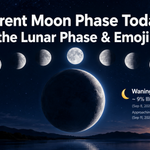
Today, August 15, 2026, the Moon is in a waxing crescent phase, with roughly 9–11% of its visible disk illuminated depending on the location and calculation time. The new moon occurred on August 12, while the first quarter will arrive on August 20.
Understanding the Moon Phase Emoji 🌙
Moon phase emojis are digital symbols that visually suggest different stages of the lunar cycle. The eight commonly used phase emojis range from 🌑 for a new moon through crescent and quarter phases to 🌕 for a full moon. They are convenient, but they are symbolic rather than precise astronomical instruments.
🌑 The new moon emoji represents the beginning of a lunar cycle, when the Moon’s illuminated side faces mostly away from Earth. It can also symbolize fresh starts, quiet moments, or a blank page in digital conversations.
🌒 The waxing crescent emoji shows a thin illuminated portion growing after the new moon. It works well when discussing early lunar growth, evening skies, new beginnings, or the gradual development of an idea. ✨
🌓 The first quarter emoji represents a Moon that appears roughly half illuminated from Earth. Despite its name, it marks about one quarter of the Moon’s complete lunar cycle, making this symbol useful for astronomy discussions.
🌔 The waxing gibbous emoji represents a Moon that is more than half illuminated but has not reached full moon. It is especially useful for describing the days when moonlight becomes noticeably brighter each evening. 🌙
🌕 The full moon emoji represents the lunar phase when the Moon appears fully illuminated from Earth. People commonly use it for nighttime scenery, photography captions, astronomy posts, and messages connected with the bright night sky.
🌖 The waning gibbous emoji shows a mostly illuminated Moon after the full moon has passed. It represents the stage when visible illumination begins decreasing, making it a useful symbol for the second half of the lunar cycle. 🌌
🌗 The last quarter emoji shows approximately half of the Moon illuminated again, but the illuminated side is opposite the first-quarter appearance. It represents a later stage of the cycle and approaching completion.
🌘 The waning crescent emoji displays a narrow illuminated section before the next new moon. It is often associated with quiet nighttime imagery, endings, reflection, rest, and the final stage of the lunar cycle. 🌙
🔭 Moon emojis are helpful for casual communication because they turn an astronomical concept into a recognizable visual symbol. However, the emoji alone does not provide exact illumination, position, altitude, or moonrise information.
📱 A moon emoji can look slightly different across operating systems and applications. Apple, Google, Microsoft, Samsung, and other platforms may use different artwork, even though the underlying Unicode character represents the same basic symbol.
🌃 Moon phase emojis are especially useful in social media captions because they communicate a nighttime or lunar theme immediately. A carefully chosen symbol can make a short caption feel more visual without requiring a long explanation.
🌙 If you are discussing the Moon’s actual astronomical phase, it is better to combine the emoji with words such as “waxing crescent” or “full moon.” This gives readers both the visual symbol and the scientifically meaningful description.
✨ The emoji 🌒 does not automatically update when the real Moon changes phase. It remains the same Unicode character until a person, website, application, or automated system chooses a different symbol.
🌕 A full moon emoji can communicate more than astronomy in everyday conversations. Depending on context, it may suggest beauty, mystery, nighttime, calmness, romance, dreams, or a memorable evening under moonlight.
🌑 The new moon symbol can also represent something invisible or beginning quietly. Writers sometimes use it when discussing reflection, personal goals, planning, or the start of a new chapter, although those meanings are cultural rather than astronomical.
🌒 A crescent Moon is one of the easiest lunar stages to recognize visually. Its narrow illuminated shape makes it especially popular in artwork, messaging, calendars, wallpapers, and posts about peaceful evening skies. 🌌
🌓 Quarter-moon symbols are useful when you want to show a distinct lunar stage without using a completely bright or dark symbol. They can also help readers understand how the Moon changes throughout its monthly cycle.
🌔 The waxing gibbous emoji is a useful choice when the Moon is becoming brighter but is not yet full. It visually communicates growth, increasing illumination, and the approach of a full moon.
🌖 The waning gibbous emoji is less commonly recognized by casual users, but it is scientifically useful. It identifies a mostly illuminated Moon that has already passed its fullest stage and is gradually losing visible brightness.
🌘 The waning crescent completes the familiar eight-symbol sequence. When used with the other lunar emojis in order, it provides a simple visual representation of the repeating Moon cycle from darkness to brightness and back again.
What Is the Moon Phase Today? 🌙
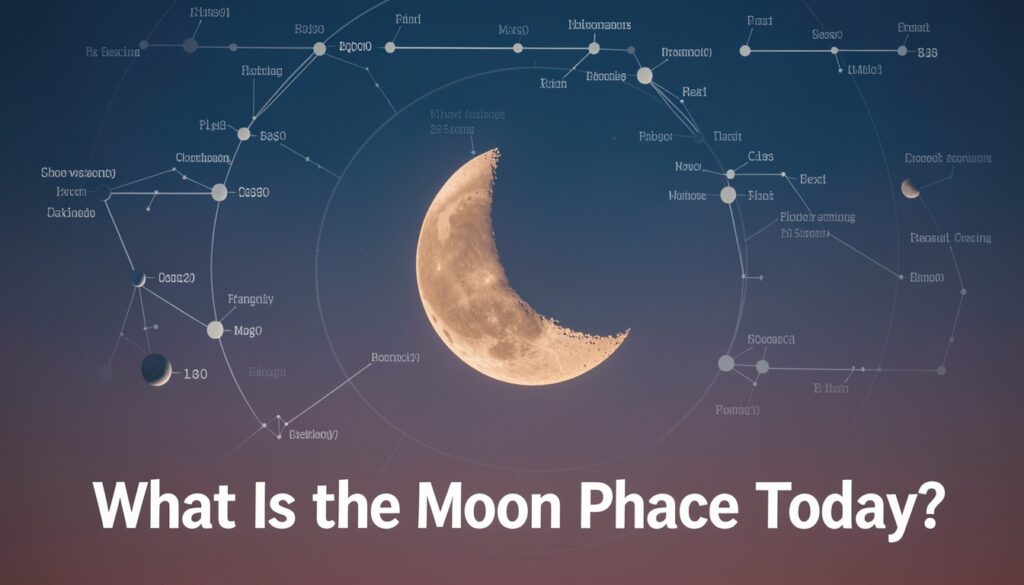
The actual lunar phase changes continuously, although astronomers traditionally divide the cycle into recognizable stages. On August 15, 2026, the Moon is a waxing crescent, only a few days after the August 12 new moon. The first quarter is scheduled for August 20.
🌒 On August 15, 2026, the best matching phase emoji is the waxing crescent, 🌒. The real Moon is still relatively thin because only a small portion of its sunlit side is visible from Earth.
🔭 The Moon’s August 2026 cycle began with the new moon on August 12. By August 15, it had moved into its early waxing stage, so a crescent symbol provides a much closer match than a full or quarter-moon emoji.
🌙 The Moon is not actually shaped like a crescent. A crescent is the portion of the spherical Moon that appears illuminated from our viewpoint, while sunlight is always illuminating approximately half of the Moon’s surface.
✨ A waxing crescent becomes progressively brighter each evening as the lunar cycle advances. This makes the phase particularly interesting for casual observation because the visible illuminated portion changes noticeably from one night to the next.
🌆 Waxing crescent Moons are generally associated with the evening sky shortly after sunset. Their visibility depends on location, weather, atmospheric conditions, horizon obstruction, and the Moon’s exact position relative to the Sun.
🌒 The phrase “waxing crescent” has two important parts. “Waxing” means the visible illuminated portion is increasing, while “crescent” describes the thin shape seen from Earth.
📅 A moon phase calendar can help you track how the current crescent will develop. After the waxing crescent stage, the Moon will approach first quarter, then waxing gibbous, and eventually full moon.
🌌 The exact illumination percentage may differ slightly between websites because astronomical calculations can use different times, locations, or rounding methods. That does not necessarily mean the sources disagree about the basic lunar phase.
🔭 If you want to observe today’s Moon, look toward the western sky after sunset when conditions allow. A clear horizon and low light pollution can make the young crescent easier to notice.
🌙 The emoji 🌒 is therefore the most suitable casual symbol for today’s lunar appearance. It should be treated as a visual approximation rather than a precise rendering of the Moon’s exact illuminated fraction.
🌓 The first quarter is not today’s phase because that stage comes several days later. Current lunar information should always be checked against a reliable astronomical calendar when accuracy matters.
🌔 A waxing gibbous emoji would also be incorrect for August 15 because the Moon has not yet reached that later stage. Choosing the right symbol means considering both whether illumination is increasing and how much is visible.
🌑 The new moon emoji is also not the best choice today. Although the Moon recently passed the new moon stage, the visible crescent has already begun developing and is expected to become increasingly noticeable.
🌕 Using the full moon emoji today would exaggerate the Moon’s brightness. A full moon occurs later in the cycle, when nearly the entire Earth-facing disk appears illuminated.
🌖 The waning gibbous emoji represents the opposite direction of change. It belongs after the full moon, when illumination decreases, so it does not accurately represent today’s growing crescent.
🌗 The last quarter symbol is also unsuitable for today’s phase because it belongs much later in the lunar cycle. Accurate emoji matching requires knowing where the Moon is moving, not just how bright it looks.
🌘 The waning crescent appears shortly before a new moon. Today’s waxing crescent is its opposite in terms of progression, because the illuminated portion is increasing rather than decreasing.
📱 For a social media post about today’s Moon, you could write “Tonight’s Moon: Waxing Crescent 🌒.” This is clearer than posting only an emoji because readers immediately understand which lunar phase you mean.
🌃 Moon photography can make the crescent appear different from an emoji because photographs capture real illumination, shadows, atmospheric effects, and surface detail. Emojis intentionally simplify these visual features for digital communication.
✨ The key point is simple: today’s astronomical phase should determine your emoji choice. For August 15, 2026, 🌒 is the closest standard moon-phase emoji because the Moon is waxing crescent.
All Moon Phase Emojis in Order 🌑
The eight standard moon-phase emojis provide a convenient visual sequence for the lunar cycle. They are usually presented as 🌑 🌒 🌓 🌔 🌕 🌖 🌗 🌘, moving from new moon through increasing illumination, full moon, and then decreasing illumination.
🌑 New moon begins the sequence and represents the darkest-looking stage from Earth. It occurs when the Moon is positioned approximately between Earth and the Sun, leaving its sunlit side largely facing away from us.
🌒 Waxing crescent follows the new moon as a small illuminated portion becomes visible. This stage represents increasing illumination and is commonly associated with young evening crescents and the beginning of a new lunar cycle.
🌓 First quarter comes after the waxing crescent. About half of the visible lunar disk is illuminated, while the Moon continues moving toward the brighter gibbous stage.
🌔 Waxing gibbous follows first quarter and precedes full moon. More than half of the visible disk is illuminated, so the Moon appears increasingly bright in the night sky.
🌕 Full moon is the midpoint of the visual brightness sequence. The Earth-facing side appears almost completely illuminated, creating the familiar bright circular Moon seen at night.
🌖 Waning gibbous follows the full moon. The Moon remains mostly illuminated, but the visible bright portion begins shrinking as the cycle moves toward the last quarter.
🌗 Last quarter occurs when approximately half the visible disk is illuminated again. It is sometimes called third quarter, and the illuminated side appears opposite the first-quarter configuration.
🌘 Waning crescent is the final visible crescent stage before the cycle returns to new moon. The illuminated portion continues decreasing until the Moon becomes difficult to see against the bright solar background.
🌙 Reading the emojis from left to right makes the lunar cycle easier to understand. The first four symbols show increasing illumination, while the final three after full moon show decreasing illumination.
✨ The sequence is useful for educational posts because readers can quickly connect each emoji with a recognizable Moon appearance. It turns an abstract astronomical cycle into a simple visual progression.
🔭 Moon observers can use the sequence as a basic reference, but serious observations should rely on astronomical data. Emoji artwork cannot accurately represent the Moon’s orientation or exact illumination for every location.
📱 Digital calendars sometimes use moon symbols to represent dates within a lunar cycle. These icons can be convenient, although users should check the calendar’s calculation method when exact timing is important.
🌑 The darkest symbol does not mean the Moon has disappeared from space. It remains present, but its illuminated side is oriented away from Earth, making it difficult or impossible to see with the unaided eye.
🌒 The first crescent is especially recognizable because sunlight begins outlining a small section of the Moon’s visible surface. Its position and visibility change each day as the Moon moves around Earth.
🌓 The quarter symbols are valuable reference points because they divide the cycle into major stages. They also help explain why “quarter” refers to the Moon’s orbital cycle rather than exactly one-quarter of the visible disk.
🌔 Gibbous means the Moon appears larger than a semicircle but smaller than a full circle. The waxing gibbous phase therefore sits naturally between first quarter and full moon.
🌕 Full moon is often the easiest phase to identify without a calendar. Its bright circular appearance is distinctive, although atmospheric conditions can make it appear warmer, dimmer, or more colorful.
🌖 After full moon, the visible illuminated portion begins decreasing. The waning gibbous emoji helps distinguish this stage from the visually similar waxing gibbous phase.
🌗 Last quarter and first quarter can look confusing when represented by simple symbols. Their difference is the direction of illumination and their position within the lunar cycle, not merely the amount of light.
🌘 Once the waning crescent finishes, the cycle reaches another new moon. The sequence then repeats, showing why the Moon’s phases form a continuous cycle rather than a one-time progression.
What Do the Different Moon Emojis Mean? 🌙
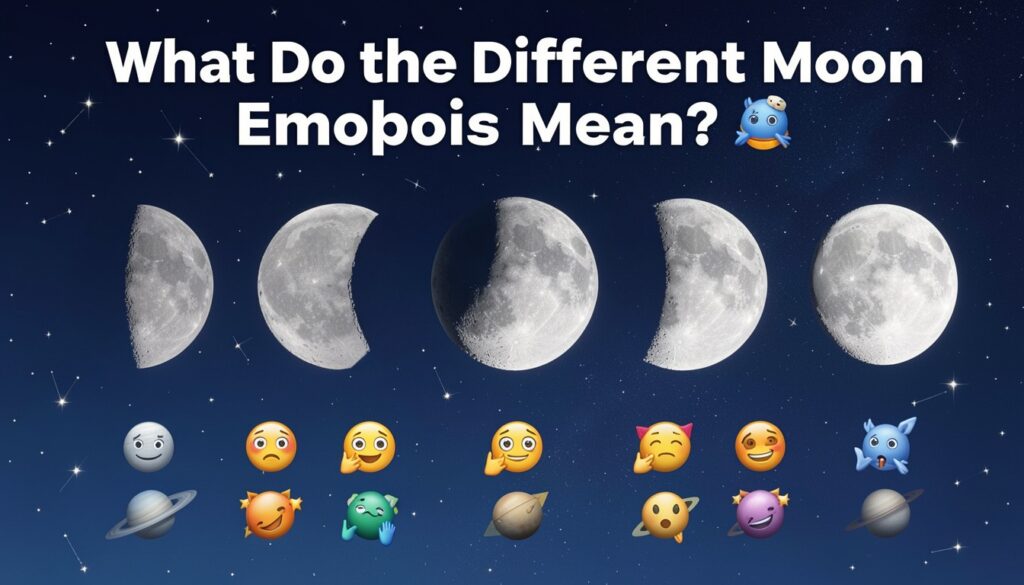
Moon emojis can have both astronomical and conversational meanings. Astronomically, each symbol suggests a particular lunar phase; culturally, users may associate the same symbols with calmness, mystery, romance, spirituality, nighttime, dreams, or change.
🌑 The new moon emoji can symbolize beginnings because it starts a new lunar cycle. In everyday messages, it may also communicate quietness, privacy, darkness, reflection, or the feeling of starting something without outside attention.
🌒 The waxing crescent emoji often suggests growth and gradual progress. Because the visible Moon is becoming brighter, people may use it to represent hope, development, anticipation, or something slowly taking shape. ✨
🌓 The first quarter emoji can symbolize balance or an important midpoint. Its half-lit appearance makes it suitable for messages about decisions, progress, transitions, and reaching a meaningful stage.
🌔 The waxing gibbous emoji represents increasing brightness and anticipation. It can work beautifully in captions about waiting for an important moment, building confidence, or approaching a personal milestone.
🌕 The full moon emoji often conveys beauty, mystery, romance, or nighttime. In a literal astronomy context, however, it simply represents the phase when the Moon’s Earth-facing side appears fully illuminated.
🌖 The waning gibbous emoji can suggest reflection after a high point. Its decreasing illumination may inspire themes of slowing down, reviewing progress, releasing unnecessary pressure, or moving thoughtfully into a new phase.
🌗 The last quarter emoji can symbolize completion and transition. Because it occurs late in the lunar cycle, it may be used metaphorically for closing chapters, reassessing priorities, or preparing for renewal.
🌘 The waning crescent emoji can represent quiet endings. Its delicate shape is often visually associated with peaceful nights, rest, solitude, reflection, and the final moments before a fresh beginning. 🌌
🌙 A moon emoji does not have one universal emotional meaning. Context matters, so the same symbol can represent astronomy in one message and romance, spirituality, or nighttime atmosphere in another.
✨ Moon emojis are popular because they combine recognizable imagery with emotional flexibility. A single character can make a message feel calmer, more poetic, mysterious, or connected to the night sky.
🌃 In travel captions, moon emojis can emphasize evening scenery without making the caption overly descriptive. A crescent may suggest a quiet sunset, while a full moon can highlight a bright nighttime landscape.
💫 In romantic communication, the full moon emoji may suggest affection, beauty, or a memorable night. These interpretations are social conventions rather than scientific definitions, so the intended meaning depends on the surrounding words.
🔭 In educational astronomy content, it is better to use moon emojis alongside scientific labels. Writing “Waxing Crescent 🌒” prevents confusion and teaches readers what the symbol represents.
🌑 A new moon symbol can also be used when discussing calendars and lunar timing. Because lunar calendars follow repeating phases, the symbol provides a quick visual cue for readers.
🌒 A crescent may represent change because it is visibly different from one night to another. Its gradual growth gives the symbol a natural association with patience and steady progress.
🌕 The full moon is frequently used in photography captions because its circular shape is visually striking. It can add atmosphere to a post even when the post is not specifically about astronomy.
🌖 Waning symbols can communicate slowing or decreasing intensity. When used metaphorically, they may suggest taking a step back, conserving energy, or recognizing that every peak eventually changes.
🌗 Quarter-moon emojis can communicate transition because they sit between stronger visual stages. Their balanced appearance makes them suitable for captions about change, decisions, or finding perspective.
🌘 A waning crescent can create a peaceful mood without needing many words. Its small illuminated edge naturally fits themes of quiet nights, reflection, sleep, and gentle endings. 🌙
🌌 Overall, moon emoji meanings depend on both astronomy and communication. Understanding the scientific phase helps you choose accurately, while the surrounding message determines the emotional or symbolic interpretation.
Does the Moon Emoji Match the Real Moon? 🔭
A moon emoji is a simplified digital representation, so it does not always match the real Moon exactly. The emoji indicates a general lunar stage, while the actual Moon’s appearance depends on illumination, location, orientation, time, atmospheric conditions, and the platform displaying the symbol.
🔭 Moon emojis match the real lunar cycle only approximately. They identify broad phases such as waxing crescent or full moon, but they cannot reproduce the exact shape visible from a specific location.
🌒 A real waxing crescent can have different apparent orientations depending on where an observer is located on Earth. An emoji usually uses one fixed artwork orientation, so it may not visually resemble the local sky perfectly.
📱 Different devices can display the same Unicode moon character using different artwork. This means the emoji’s graphic appearance may vary between iPhone, Android, Windows, and other platforms.
🌙 The actual Moon changes continuously rather than jumping from one emoji design to another. The eight emojis simplify that continuous change into recognizable categories for easier communication.
✨ Illumination percentage is another reason emojis are approximate. A crescent could represent a relatively small illuminated fraction, but the emoji does not tell you whether the real Moon is 3%, 9%, or 18% illuminated.
🌃 Local horizon conditions also affect what you see. A Moon may be technically above the horizon while clouds, buildings, mountains, trees, or bright city lights make it difficult to observe.
🌎 The Moon’s appearance can also vary with latitude. Observers in different parts of the world can see the illuminated crescent tilted differently, while a standard emoji generally does not adjust its orientation.
🔭 For scientific observation, an astronomy application or reliable lunar calendar is more useful than an emoji. Such tools can provide illumination, rise and set times, position, distance, and phase information.
🌑 The new moon is especially difficult to match visually because there may be little or no visible illuminated surface. The emoji communicates the phase symbolically rather than showing the actual astronomical geometry.
🌕 The full moon emoji is visually closer to reality because the Moon generally appears circular and bright. Even then, the emoji cannot show craters, shadows, atmospheric haze, or subtle variations in brightness.
🌒 A real crescent Moon can appear much thinner or thicker than the emoji. The difference becomes especially noticeable around the earliest and latest crescent stages.
🌓 Quarter-moon emojis provide a useful approximation of half illumination. However, the real Moon’s illuminated boundary is affected by viewing geometry, so the emoji should not be treated as an exact astronomical diagram.
🌔 Gibbous phases can be particularly difficult to represent accurately with a small emoji. A real gibbous Moon has a curved terminator and detailed surface features that simplified artwork cannot reproduce.
🌖 Waning gibbous Moon emojis may look similar to waxing gibbous emojis on some platforms. Their scientific distinction comes from whether illumination is increasing or decreasing, not simply from the overall brightness.
🌗 The two quarter phases demonstrate why direction matters. Two Moons can each appear half illuminated but represent different points in the cycle depending on which side is bright and whether the Moon is waxing or waning.
🌘 A real waning crescent can be challenging to observe because it appears close to sunrise. The emoji remains easy to view at any time because it is a digital character rather than a sky object.
📅 A lunar calendar can tell you which broad phase applies on a particular date. Combining that information with local observation provides a much better picture than relying on an emoji alone.
🌌 Photography also reveals details that emojis cannot. Camera exposure, lenses, atmospheric conditions, and image processing can show craters and lunar surface patterns absent from standardized digital symbols.
📲 If accuracy matters, use the emoji as a label and astronomical data as the evidence. For example, “Waxing Crescent 🌒 — about 9% illuminated” communicates both the symbol and useful factual information.
🔭 The best way to think about moon emojis is as visual shorthand. They are excellent for communication and quick reference, but they should never replace astronomical calculations when precise lunar information is required.
Moon Phase Emoji Chart and Lunar Cycle 🌙
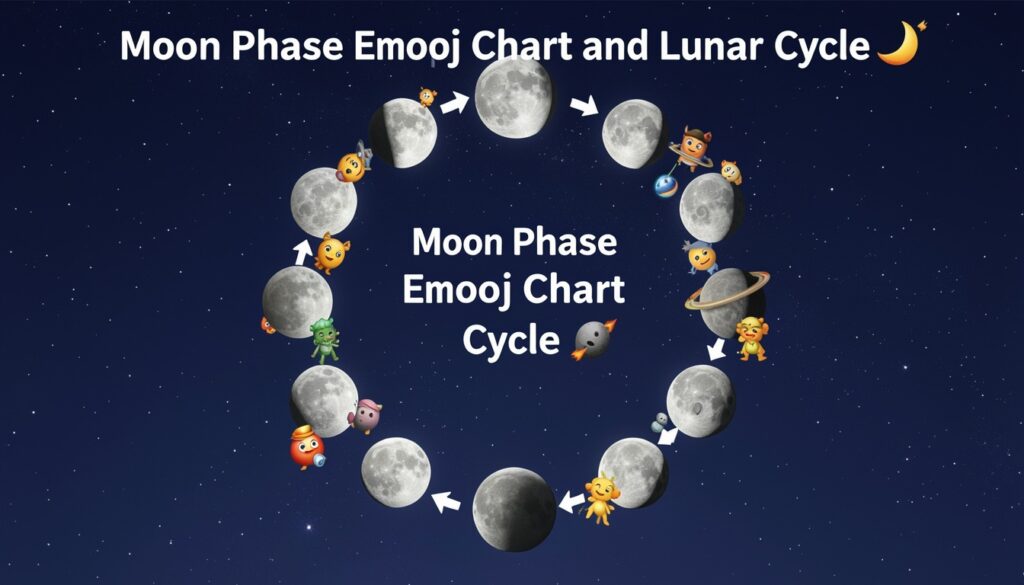
A moon phase emoji chart makes the lunar cycle easier to understand by placing the major symbols in chronological order. The familiar sequence begins with new moon, reaches full moon, and then gradually returns toward another new moon.
🌑 New Moon begins the visual sequence. The Moon’s illuminated side faces largely away from Earth, so the lunar disk is difficult to see against the daylight sky.
🌒 Waxing Crescent follows new moon. A small illuminated portion becomes visible, and the amount of sunlight reflected toward Earth gradually increases during this stage.
🌓 First Quarter occurs when approximately half of the visible lunar disk is illuminated. It marks a major point in the waxing half of the lunar cycle.
🌔 Waxing Gibbous comes after first quarter. More than half of the visible disk is illuminated, creating a bright Moon that is approaching the full moon stage.
🌕 Full Moon occurs when the Moon appears fully illuminated from Earth. It is one of the easiest lunar phases to identify and is commonly featured in calendars and night-sky imagery.
🌖 Waning Gibbous begins after full moon. The Moon remains mostly illuminated, but the visible bright portion gradually decreases as the cycle continues.
🌗 Last Quarter marks another approximately half-lit appearance. It occurs during the waning half of the cycle and is also known as the third quarter.
🌘 Waning Crescent appears shortly before the next new moon. Only a small portion remains illuminated, and the Moon becomes increasingly difficult to observe before sunrise.
📊 A chart is useful because it turns the continuous lunar cycle into eight recognizable checkpoints. These stages provide a simple framework for learning how lunar illumination changes over time.
🌙 The cycle does not stop at the waning crescent. Once the Moon reaches new moon again, the sequence repeats, creating the familiar approximately 29.5-day synodic cycle.
🔭 The Moon’s actual orbital period relative to the stars is different from the time between identical phases. This distinction explains why lunar cycle terminology can vary depending on the astronomical measurement being discussed.
📅 Lunar calendars use the repeating phases to organize dates and months. Different cultures and calendar systems may define months differently, but lunar observation has played an important role in timekeeping for centuries.
🌒 The waxing half of the chart represents increasing visible illumination. It moves from darkness through crescent and quarter stages toward the brightest full moon.
🌖 The waning half represents decreasing visible illumination. It moves from full moon through gibbous and quarter stages toward the thin crescent before another new moon.
✨ Using emojis in a chart can make educational material easier to scan. Readers can immediately distinguish phases visually before learning the scientific terminology associated with each stage.
🌕 A full moon is not caused by Earth blocking sunlight from reaching the Moon. Instead, the Moon is positioned so that the side facing Earth is strongly illuminated by the Sun.
🌑 A new moon is not an absence of the Moon itself. It is a viewing geometry in which the illuminated side is mostly turned away from Earth.
🌗 Quarter phases are named for their place in the lunar cycle, not because only one-quarter of the visible Moon is illuminated. This is an important distinction when reading a moon phase chart.
📱 Emoji charts are particularly useful in social media posts and educational graphics. They offer a compact way to explain lunar stages without requiring large astronomical diagrams.
🌌 Once the eight symbols are memorized, identifying the broad lunar stage becomes much easier. The chart can then serve as a quick reference whenever you need to choose a moon emoji.
How to Choose the Right Moon Emoji for Today 📱
Choosing the right moon emoji is easiest when you first identify the actual lunar phase and then select the matching Unicode symbol. A reliable moon calendar gives you the phase, while the emoji provides a simple visual representation for your message.
🔭 Start by checking a trustworthy lunar calendar or astronomy source. Look for the Moon’s current phase rather than choosing an emoji based only on how bright the sky appears.
🌒 If the source says “waxing crescent,” choose 🌒. This symbol is the standard shorthand for a crescent that is growing after the new moon.
🌓 If the source reports “first quarter,” choose 🌓. The Moon should appear approximately half illuminated, although the exact visual orientation depends on the observer’s location.
🌔 If the phase is “waxing gibbous,” use 🌔. This tells readers that more than half of the visible disk is illuminated and that the Moon is still approaching full moon.
🌕 For a full moon, choose 🌕. This is the clearest and most universally recognizable moon-phase emoji for a fully illuminated lunar disk.
🌖 If the Moon is “waning gibbous,” use 🌖. The Moon is still mostly bright, but its visible illumination is decreasing after the full moon.
🌗 For “last quarter” or “third quarter,” choose 🌗. This symbol represents the later half-lit stage of the cycle rather than the earlier first quarter.
🌘 When the Moon is a “waning crescent,” select 🌘. This indicates a thin crescent that is shrinking as the cycle approaches another new moon.
🌑 Use 🌑 for a new moon. Remember that the symbol is a representation, because the actual new Moon is difficult to see under ordinary observing conditions.
📅 Always consider the date and time when selecting a phase emoji. A lunar phase can change between dates, and exact phase timing can occur at a specific moment rather than throughout an entire calendar day.
🌎 Location matters for observing the Moon’s position and orientation. The broad phase is generally shared globally, but moonrise, moonset, altitude, and apparent tilt vary with location.
📱 Your device does not automatically know which phase you intend to communicate. Typing a moon emoji simply inserts the chosen Unicode character; it does not dynamically track the Moon.
✨ If your post is educational, write the phase name alongside the emoji. “Waxing Crescent 🌒” is much more informative than using 🌒 alone.
🌙 If your post is poetic or casual, the emoji can stand on its own. The surrounding caption can provide the emotional meaning while the symbol supplies the nighttime visual atmosphere.
🔭 Astronomy enthusiasts should verify the phase using an updated source before posting. This is particularly important for content labeled “today,” “tonight,” or “current.”
🌃 Travelers can combine the moon phase with local sky information. Knowing the phase does not automatically tell you whether the Moon will be visible at your preferred viewing time.
📊 A moon phase chart is useful when planning content ahead of time. It lets you select appropriate emojis for future posts without confusing waxing and waning stages.
🌕 If you are writing a full moon caption several weeks ahead, check the calendar again before publishing. Lunar dates and local times can matter when your content promises current astronomical information.
🌒 For today’s August 15, 2026 phase, the appropriate standard emoji is 🌒 because the Moon is in its waxing crescent stage. The illumination is still low but increasing after the August 12 new moon. (Time and Date)
✨ The simplest rule is “check first, choose second.” Confirm the real lunar phase, identify whether it is waxing or waning, and then select the corresponding emoji from the eight-symbol sequence.
Moon Emoji Meanings for Messages, Captions, and Social Media 💬
Moon emojis work especially well in digital communication because they combine visual symbolism with short text. Their meaning can be literal, such as identifying a lunar phase, or expressive, such as suggesting romance, mystery, peace, nighttime, or reflection.
🌙 A simple moon emoji can make a good-night message feel warmer without adding many words. It creates an immediate nighttime association and works naturally with calm, friendly, or affectionate conversations.
🌕 The full moon emoji is useful for photography captions because it instantly establishes a nighttime setting. Pair it with a short description of the sky, landscape, or evening atmosphere for a stronger visual effect.
🌒 A waxing crescent can represent a small beginning that is expected to grow. This makes it suitable for captions about personal progress, new projects, fresh goals, and hopeful changes. ✨
🌑 The new moon emoji can support messages about starting again. It may suggest leaving an old chapter behind and beginning something quietly, although this symbolic interpretation is separate from its astronomical meaning.
🌓 A quarter-moon emoji can symbolize reaching an important midpoint. It works nicely in captions about progress, decisions, balance, or taking a moment to evaluate how far you have come.
🌔 A waxing gibbous can represent anticipation because the Moon is moving toward fullness. It is a thoughtful choice for captions about waiting for something exciting or preparing for an important moment.
🌖 A waning gibbous can suggest slowing down after an intense period. Its decreasing illumination provides a natural metaphor for reflection, rest, simplification, or releasing unnecessary pressure.
🌗 The last quarter can represent transition. It fits messages about finishing a project, reconsidering priorities, or preparing for the next stage after an important period of growth.
🌘 A waning crescent can create a peaceful, quiet mood. It works especially well with captions about late nights, early mornings, solitude, reflection, sleep, or the beauty of subtle things.
💫 Moon emojis can add personality to short social media posts without overwhelming the text. One carefully selected symbol often looks more natural than filling a caption with multiple unrelated emojis.
🌌 Travel writers can use moon symbols to add atmosphere to descriptions of beaches, mountains, deserts, historic cities, or outdoor destinations after sunset.
💖 Romantic messages often use 🌙 or 🌕 because nighttime imagery naturally creates a softer mood. However, the words around the emoji should carry the main emotional message rather than relying on the symbol alone.
✨ Inspirational captions can pair a waxing crescent with themes of gradual progress. The growing Moon provides a visual reminder that meaningful change does not always happen instantly.
🌑 Reflective posts may use the new moon symbol to represent silence or renewal. The metaphor can be effective when the caption focuses on personal growth rather than presenting symbolism as scientific fact.
🌕 A full moon can make a simple good-night message more visually expressive. Adding a short personal sentence alongside the emoji keeps the message natural and avoids making it feel overly decorative.
🌒 If your caption specifically discusses today’s lunar phase, use the matching emoji and name. This provides useful information while still keeping the post visually attractive.
📱 Remember that different platforms may render moon emojis differently. If visual consistency matters for branding, check how the chosen symbol appears on the devices most commonly used by your audience.
🌙 Moon symbols are flexible enough for personal messages, educational posts, calendars, travel captions, photography, and lifestyle content. Their effectiveness comes from being simple, recognizable, and emotionally adaptable.
🔭 When discussing astronomy, avoid implying that an emoji itself changes with the Moon. The symbol is fixed, while the real lunar phase changes continuously according to orbital geometry.
✨ The strongest moon captions combine a clear message with a relevant symbol. Whether your goal is education, romance, inspiration, or nighttime atmosphere, choose the emoji because it supports the words rather than replacing them.
Moon Phase Emojis on iPhone, Android, and Other Devices 📱
Moon phase emojis are Unicode characters, but their visual appearance is controlled by the platform’s emoji design. This means the same character can look slightly different on iPhone, Android, Windows, or another device while retaining the same basic meaning.
📱 Unicode provides the underlying character, while individual platforms create their own emoji artwork. As a result, the same moon emoji can have different shading, texture, proportions, or orientation depending on the device.
🌒 A waxing crescent remains a waxing crescent regardless of whether its artwork looks slightly different. The character’s identity comes from the Unicode standard rather than from one company’s specific visual design.
🍎 Apple devices use their own emoji artwork, so an emoji sent from an iPhone may not look exactly the same when viewed elsewhere. The recipient still receives the corresponding Unicode character.
🤖 Android devices can display moon emojis according to the emoji font and design supplied by the device or software environment. Updates can sometimes change how symbols appear visually.
💻 Windows and other desktop systems may use their own emoji presentation. This explains why screenshots of the same moon character can show noticeably different artwork across platforms.
🌙 The meaning should therefore be based on the emoji character rather than tiny visual differences. A slightly different crescent design does not normally indicate a different astronomical phase.
✨ If you are creating a website, remember that visitors may see different emoji designs. A page should not depend on a particular emoji artwork for essential information.
🔭 For astronomy websites, pairing the emoji with text is safer. “Waxing Crescent 🌒” remains understandable even if the user’s device renders the symbol differently.
📊 A moon phase chart made entirely from emoji characters may therefore look slightly different for different readers. This is normal behavior for platform-dependent emoji rendering.
🌕 The full moon is generally recognizable across platforms because its basic visual concept is simple. Differences may still appear in shading, facial details on unrelated moon characters, or surrounding design choices.
🌑 The new moon symbol can also vary slightly in appearance. Its core meaning remains the same, even if the exact black or dark-gray rendering differs between systems.
🌗 Quarter-moon symbols are particularly useful when the text label accompanies them. Since their visual orientation can vary, the words “first quarter” or “last quarter” remove potential ambiguity.
🌘 Crescent symbols can sometimes look visually similar across different designs. The Unicode identity is what determines whether a symbol represents waxing crescent or waning crescent.
📲 Messaging apps may also apply their own emoji presentation or interface styling. Therefore, users should not assume that a screenshot represents exactly how the emoji appears on another person’s phone.
🌙 Emoji differences are not evidence that the Moon itself looks different. The real lunar appearance depends on astronomy and observation, while the emoji is simply a digital graphic.
💬 When communicating with an international audience, combining the moon emoji with plain-language text improves accessibility. Not every reader interprets symbols in exactly the same way.
🔭 Astronomy educators can use moon emojis as introductory visual aids. Students can then move from the simplified symbols toward accurate diagrams showing the Sun-Earth-Moon geometry.
✨ Social media creators can use emojis freely as decorative elements, but should avoid treating their artwork as scientifically exact. A simple caption can distinguish visual symbolism from astronomical information.
📱 If an emoji appears as a blank box or unsupported character, the device or application may not support the relevant Unicode presentation. Updating software or using text alongside the symbol can solve the communication problem.
🌌 The important point is that moon emojis are standardized symbols with platform-specific artwork. Their appearance may change across devices, but their intended Unicode meaning remains consistent.
How to Match the Real Moon With the Correct Emoji 🌌
Matching the real Moon with an emoji requires a simple three-step process: identify the current lunar phase, determine whether illumination is increasing or decreasing, and select the corresponding symbol. This approach keeps casual digital communication aligned with real astronomy.
🔭 First, check the actual lunar phase using a reliable astronomical source. Avoid guessing from the Moon’s brightness because clouds, haze, and viewing conditions can make its appearance misleading.
🌒 Second, determine whether the Moon is waxing or waning. Waxing means the visible illuminated portion is increasing, while waning means it is decreasing.
🌑 If the Moon is at new moon, choose 🌑. This phase begins the familiar sequence and occurs when the Moon’s sunlit side is directed mostly away from Earth.
🌒 If only a small growing crescent is visible, select 🌒. This is the standard emoji for the waxing crescent stage following new moon.
🌓 If the Moon is around first quarter, choose 🌓. This marks the point where approximately half of the Earth-facing disk is illuminated during the waxing part of the cycle.
🌔 If more than half is illuminated and brightness is increasing, select 🌔. This identifies the waxing gibbous phase before full moon.
🌕 When the Moon appears fully illuminated, use 🌕. The full moon is the most visually recognizable stage and generally needs little explanation in casual communication.
🌖 After full moon, choose 🌖 when the Moon remains mostly illuminated but is decreasing in visible brightness. This is the waning gibbous phase.
🌗 When approximately half the disk is illuminated during the waning half, choose 🌗. This represents last quarter, also called third quarter.
🌘 When only a small decreasing crescent remains, select 🌘. This is the final standard phase before the Moon returns to new moon.
📅 Check the date as well as the phase name. A page describing yesterday’s Moon may show a different emoji from one accurately describing today’s lunar stage.
🌎 Consider location if you are describing visibility or orientation. The broad phase is shared across Earth, but the Moon’s rise time, position, altitude, and apparent orientation differ between locations.
🌙 Remember that an emoji is a category, not a live astronomical image. It can tell readers “waxing crescent,” but it cannot tell them the exact percentage of illumination or where to find the Moon.
✨ For accurate content, combine three pieces of information: the phase name, approximate illumination when useful, and the matching emoji. This creates a concise but trustworthy description.
🔭 On August 15, 2026, astronomical calendars place the Moon in the waxing crescent stage. Sources list roughly 9% illumination for Pakistan locations around that date, while another current calculation reports about 11%, reflecting differences in time and calculation context.
🌒 Because the Moon is waxing after the August 12 new moon, 🌒 is the most appropriate standard phase emoji for August 15. The first quarter follows on August 20, so the Moon has not yet reached 🌓
📱 If you are publishing an article, social post, or calendar entry, write the phase in words before or after the emoji. This makes the information understandable even if the reader’s device renders the symbol differently.
🌌 If your purpose is photography or stargazing, go beyond the emoji. Check moonrise and moonset times, local weather, light pollution, and the Moon’s altitude to determine whether the phase will actually be easy to observe.
💫 If your purpose is casual communication, exact astronomical precision may not be necessary. A correctly chosen phase emoji paired with natural wording is usually enough to communicate the general appearance or nighttime mood.
🌙 The most reliable rule is to let astronomy choose the emoji. Check the real lunar phase first, identify its position in the eight-stage cycle, and then use the corresponding symbol instead of guessing from memory.
FAQs
What is the current moon phase emoji today?
For August 15, 2026, the Moon is in the waxing crescent phase, so the best matching standard emoji is 🌒. The Moon is only a small percentage illuminated and is gradually becoming brighter after the August 12 new moon
What emoji represents a waxing crescent Moon?
The standard emoji for a waxing crescent Moon is 🌒. It represents the early stage after new moon when the visible illuminated portion is increasing.
Does the moon emoji automatically change with the real Moon?
No. Moon emojis are fixed Unicode characters. Your phone or messaging application does not automatically replace 🌒 with 🌓 or 🌕 as the real Moon moves through its lunar cycle.
What are the eight moon phase emojis in order?
The commonly used sequence is 🌑 new moon, 🌒 waxing crescent, 🌓 first quarter, 🌔 waxing gibbous, 🌕 full moon, 🌖 waning gibbous, 🌗 last quarter, and 🌘 waning crescent.
Does the moon emoji look the same on every phone?
No. Different operating systems and applications can use different emoji artwork. The character’s basic Unicode meaning remains the same, even though its visual design can vary.
How can I check the actual Moon phase?
Use a reliable astronomical website, lunar calendar, or moon-phase application that provides current calculations. For exact observing information, also check your local moonrise, moonset, and visibility conditions.
What is the difference between waxing and waning?
Waxing means the visible illuminated portion of the Moon is increasing. Waning means the visible illuminated portion is decreasing after the full moon.
Is a moon emoji an accurate picture of the real Moon?
Not exactly. It is a simplified visual symbol representing a broad lunar phase. The actual Moon’s appearance depends on its illumination, viewing angle, location, atmospheric conditions, and other observational factors.
Which emoji should I use for a full moon?
Use 🌕 for a full moon. It is the standard full-moon phase emoji and is widely recognizable in digital communication.
What emoji should I use for the Moon phase on August 15, 2026?
Use 🌒 because August 15, 2026 falls during the waxing crescent stage. The Moon had passed the new moon on August 12 and is moving toward first quarter on August 20.
Conclusion
The current phase of the moon as an emoji is easiest to identify by checking the real lunar phase first and then choosing the matching symbol. The eight familiar emojis provide a convenient visual sequence from 🌑 new moon to 🌕 full moon and back through the waning stages.
For August 15, 2026, the current phase of the moon as an emoji is best represented by 🌒, the waxing crescent symbol. The real Moon is gradually becoming more illuminated after the recent new moon, showing why a phase-aware emoji can make digital communication both attractive and informative.
Read More: Sorry For Late Wish Meaning In Hindi – इसका हिंदी में मतलब जाने