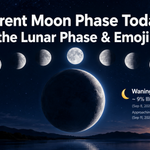
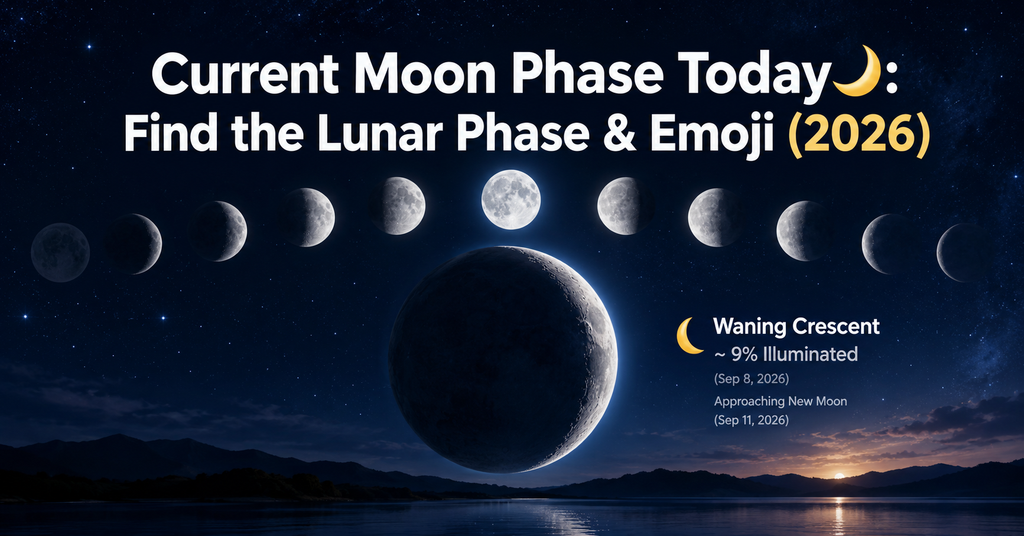
The Current Moon Phase Today is a waning crescent 🌘, meaning the illuminated portion of the Moon is becoming smaller as it approaches the next New Moon. On September 7, 2026, the Moon is near the end of its approximately 29.5-day lunar cycle, offering a thin, gentle crescent for early-morning observers.
Knowing the Current Moon Phase Today can help you understand what you see in the sky, choose the best time for observation, and use the right moon phase emoji or symbol in messages, calendars, captions, and social posts. 🌙 The eight main phases create a repeating lunar cycle from New Moon to Full Moon and back again.
What Is the Current Moon Phase Today?
The Moon does not produce its own light; sunlight illuminates different portions of its surface as it travels around Earth. Today’s waning crescent appears as a narrowing curve, with the visible illuminated portion decreasing each day before the New Moon. 🌘 This phase is especially noticeable before sunrise.
🌘 Today’s Moon is in a waning crescent phase, showing only a small illuminated portion of its visible surface. The shrinking crescent signals that the lunar cycle is approaching its quiet New Moon stage.
🌙 A waning crescent is one of the most recognizable late-cycle Moon phases. It appears thinner each morning as the Moon moves closer to alignment with the Sun.
✨ If you notice a delicate crescent before sunrise, you may be looking at today’s Moon. Its slim appearance is a natural result of the changing angle between Earth, Moon, and Sun.
🌅 The waning crescent is often easiest to observe during the early morning. Look toward the eastern sky before sunrise, when the Moon can appear as a graceful silver curve.
🔭 Today’s lunar appearance changes gradually rather than suddenly. Each day, the illuminated section becomes smaller, creating a smooth transition toward the New Moon.
🌒 The crescent shape does not mean the Moon itself is becoming smaller. The Moon remains essentially the same size; only the amount of sunlit surface visible from Earth changes.
🌌 A thin crescent can create beautiful early-morning skies. When atmospheric conditions are clear, the Moon may appear alongside bright stars or planets, creating an attractive celestial scene.
☀️ During the waning crescent phase, the Moon moves closer in the sky to the Sun from our viewpoint. This explains why it is generally seen during the hours before sunrise.
🌓 Moon phases are predictable because lunar motion follows a regular cycle. The waning crescent is the final major phase before the cycle begins again with a New Moon.
🌙 The Moon’s changing appearance is one of the easiest astronomical patterns to observe without equipment. Even casual skywatchers can follow the crescent as it becomes progressively thinner.
📅 Checking a moon phase calendar can help you know when to expect a crescent, quarter, gibbous, or full Moon. These predictable stages make lunar observation simple to plan.
🌘 A waning crescent represents the closing part of one lunar cycle. Its soft, narrow shape is visually different from the bright Full Moon seen roughly two weeks earlier.
👀 If you cannot see the Moon tonight, that does not mean the phase is incorrect. Visibility depends on local moonrise, moonset, weather, daylight, and your exact viewing location.
🌍 The Moon has the same basic phase worldwide at a given moment, although its position, orientation, rise time, and apparent angle can differ between locations.
🌠 The late crescent is particularly useful for learning lunar patterns. Watching it over several mornings makes the Moon’s gradual movement and changing illumination easier to understand.
🕰️ Moonrise and moonset times change every day. During the waning crescent stage, the Moon generally rises later, making early-morning observation increasingly important.
🌙 The thin crescent can look different through the atmosphere. Haze, clouds, brightness near the horizon, and nearby city lights may affect how clearly its shape appears.
🔬 The Moon’s phases are an excellent introduction to astronomy. They demonstrate how sunlight, orbital motion, and viewing geometry work together to create familiar celestial patterns.
💫 Today’s waning crescent is temporary. As the days pass, its illuminated area will continue shrinking until the Moon reaches the New Moon phase.
📖 Understanding today’s phase makes lunar calendars easier to read. Once you recognize the waning crescent symbol 🌘, you can quickly identify where the Moon is within its monthly cycle.
Moon Phase Emoji and Symbol Meaning
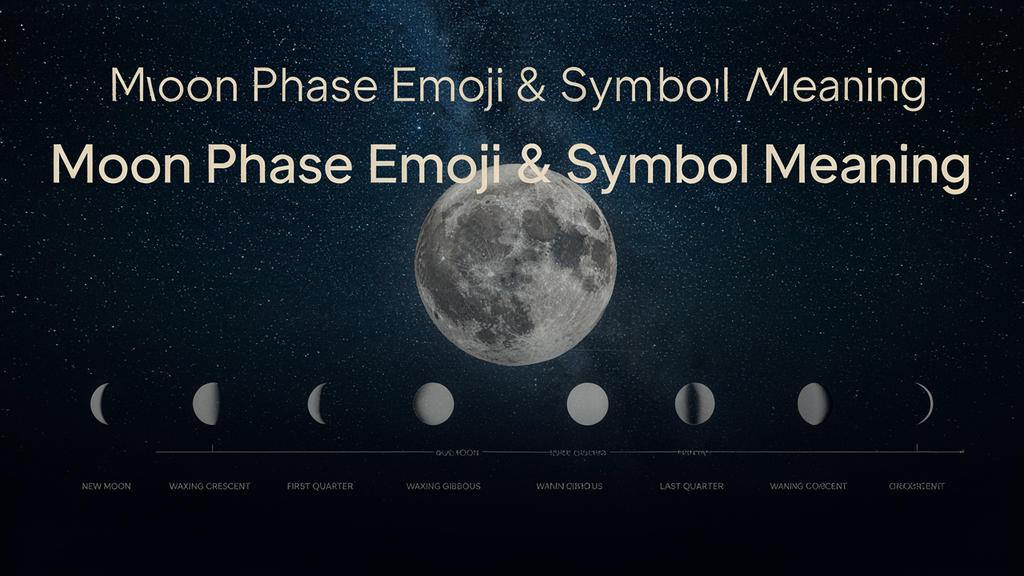
Moon emojis provide a simple visual way to represent the eight traditional lunar phases. The symbols 🌑 🌒 🌓 🌔 🌕 🌖 🌗 🌘 correspond broadly to New Moon, waxing crescent, first quarter, waxing gibbous, Full Moon, waning gibbous, last quarter, and waning crescent. 🌙 These symbols are commonly used in digital communication and calendars.
🌑 The New Moon emoji represents the beginning of the traditional lunar phase sequence. It shows a dark circle because the sunlit side faces away from Earth from our viewing perspective.
🌒 The waxing crescent emoji represents a growing crescent. It is used when the illuminated portion is increasing between the New Moon and First Quarter.
🌓 The first quarter emoji shows approximately half of the visible lunar disk illuminated. Despite its name, the Moon is about one-quarter through the full lunar cycle.
🌔 The waxing gibbous symbol represents a Moon that is more than half illuminated and still growing brighter. It appears shortly before the Full Moon.
🌕 The Full Moon emoji represents the phase when the Moon’s visible disk appears almost completely illuminated. It is one of the most familiar lunar symbols.
🌖 The waning gibbous emoji represents a Moon that remains more than half illuminated but is gradually becoming less bright. It follows the Full Moon.
🌗 The last quarter symbol shows roughly half of the visible lunar disk illuminated. It marks another major quarter point as the Moon moves toward its final crescent.
🌘 The waning crescent emoji represents the final visible crescent before New Moon. It is the symbol most closely associated with the current late-cycle phase.
🌙 The general crescent moon emoji is popular in messages because it can represent nighttime, dreams, calmness, romance, or the Moon without identifying one exact astronomical phase.
✨ Moon phase symbols are useful because they communicate an idea instantly. A single emoji can show whether someone means a crescent, Full Moon, New Moon, or another lunar stage.
🌑 If you are creating a lunar calendar, using consistent phase emojis makes the schedule easier to understand. Readers can recognize the progression visually without reading lengthy descriptions.
🌒 The waxing crescent symbol can suggest growth or beginning in a creative caption. Astronomically, it simply indicates that the illuminated portion is increasing after New Moon.
🌕 The Full Moon symbol often appears in social media posts about night photography, astronomy, celebrations, and nature. Its bright circular appearance makes it especially recognizable.
🌘 The waning crescent symbol is appropriate when describing the final days before a New Moon. It can also add a peaceful visual element to astronomy-related content.
🌓 The quarter Moon symbols are useful reminders that lunar phases are a continuous process. The Moon does not suddenly jump between shapes; illumination changes gradually.
🌔 A waxing gibbous emoji can help explain that the Moon is nearly full. It represents the period when more than half of the visible disk is illuminated and growing.
🌖 A waning gibbous symbol communicates the opposite movement. The Moon is still bright, but the illuminated portion is decreasing after the Full Moon.
🌗 The last quarter emoji is sometimes confused with the First Quarter symbol. The difference is the direction of illumination and whether the Moon is waxing or waning.
🌙 Moon emojis have both astronomical and cultural uses. In digital conversations, their meaning depends on context, so a crescent may express mood rather than precise lunar information.
📱 For accurate astronomy content, pair a moon emoji with its written phase name. Writing “Waning Crescent 🌘” removes ambiguity and makes the information easy for readers to understand.
The Eight Phases of the Moon Explained
The lunar cycle is commonly divided into eight recognizable phases. These stages begin with the New Moon, progress through waxing crescent and quarter phases, reach Full Moon, and then move through waning stages until another New Moon occurs. 🌕 Each phase reflects a changing view of the Moon’s sunlit half.
🌑 New Moon begins the traditional eight-phase sequence. At this stage, the Moon is positioned between Earth and the Sun, making the illuminated side difficult or impossible to see from Earth.
🌒 Waxing Crescent follows the New Moon. A small illuminated curve becomes visible, and that bright portion increases each day as the Moon moves around Earth.
🌓 First Quarter occurs when approximately half of the Moon’s visible disk is illuminated. It represents a major checkpoint in the lunar cycle and is easy to recognize.
🌔 Waxing Gibbous follows the First Quarter. More than half of the visible Moon is illuminated, and the bright portion continues increasing until Full Moon.
🌕 Full Moon occurs when the Moon’s Earth-facing side is broadly illuminated by sunlight. The complete-looking disk makes this phase especially popular for skywatching and photography.
🌖 Waning Gibbous begins after Full Moon. The Moon remains mostly illuminated, but the bright area starts shrinking as the cycle moves toward its final quarter.
🌗 Last Quarter shows approximately half of the visible Moon illuminated again. This time, the Moon is waning rather than waxing and continues toward a thinner crescent.
🌘 Waning Crescent is the final major stage before New Moon. The illuminated portion becomes increasingly narrow, eventually leading back to the beginning of another lunar cycle.
🔄 These eight phases create a repeating pattern rather than eight separate events. The Moon continuously changes position, while observers on Earth see different portions of its illuminated surface.
🌙 The lunar cycle takes approximately 29.5 days from one New Moon to the next. This period is called a synodic month and is slightly longer than the Moon’s orbital period around Earth.
📅 A moon phase calendar uses these repeating changes to organize lunar observations. It can show exact phase dates, illumination percentages, moonrise times, and other useful information.
🌗 Quarter phases are particularly useful reference points. They divide the visible progression into recognizable stages and help observers understand how the Moon changes throughout the month.
🌕 The Full Moon is not always perfectly circular from every visual perspective. Atmospheric conditions, camera exposure, and the Moon’s position can affect how its shape appears.
🌘 The crescent phases are thinner and generally less bright than gibbous or Full Moon phases. This makes them more challenging to photograph but often more delicate and visually appealing.
☀️ Every lunar phase results from sunlight illuminating the Moon. Earth’s shadow is not responsible for ordinary Moon phases; that misconception applies only during lunar eclipses.
🌍 The Moon’s phases occur because the Moon orbits Earth while sunlight illuminates half of it. Our changing viewing angle determines how much of that illuminated half we can see.
🔭 Binoculars can make lunar surface details easier to observe, especially near the boundary between light and darkness. However, the major phases can be identified easily without optical equipment.
🌌 The Moon’s position among the stars also changes throughout its cycle. Observing it repeatedly can help beginners understand both lunar movement and the broader night sky.
📚 Learning all eight phases provides a foundation for understanding lunar calendars. Once the sequence becomes familiar, predicting whether the Moon will be growing or shrinking becomes much easier.
✨ The most useful way to remember the sequence is simple: New, waxing crescent, first quarter, waxing gibbous, Full, waning gibbous, last quarter, and waning crescent.
Waxing Moon vs. Waning Moon

The words waxing and waning describe whether the illuminated portion of the Moon is increasing or decreasing. A waxing Moon grows brighter from New Moon toward Full Moon, while a waning Moon becomes less illuminated after Full Moon. 🌒 Understanding these terms makes moon calendars much easier to interpret.
🌒 Waxing means the illuminated portion is increasing. During this half of the lunar cycle, the Moon gradually appears brighter from Earth as it moves toward Full Moon.
🌘 Waning means the illuminated portion is decreasing. The Moon becomes progressively thinner after Full Moon until it reaches the New Moon stage.
📈 A waxing crescent grows wider each day. Although the Moon itself does not physically grow larger, the visible sunlit portion becomes greater from our perspective.
📉 A waning crescent does the opposite. Its illuminated section shrinks daily, creating the narrow crescent associated with the final days of the lunar cycle.
🌕 Full Moon sits between waxing and waning phases. After the Full Moon, the illuminated portion begins decreasing, marking the transition into the waning half of the cycle.
🌑 New Moon marks another important boundary. After New Moon, the visible illumination begins increasing again, starting the waxing portion of the next cycle.
🔭 You can identify waxing or waning by comparing the Moon over several days. A widening crescent is waxing, while a narrowing crescent is waning.
🌙 The direction of the bright edge can appear different depending on your hemisphere and viewing orientation. Therefore, shape alone should not replace a reliable lunar calendar.
📅 A moon phase calendar usually labels phases explicitly. Terms such as waxing crescent and waning gibbous tell you both the shape and direction of change.
✨ Waxing phases can be thought of as building toward Full Moon. Waning phases move away from Full Moon toward the darker New Moon stage.
🌗 Quarter phases help separate the two halves. First Quarter belongs to the waxing side, while Last Quarter belongs to the waning side.
🌔 A waxing gibbous Moon is already more than half illuminated. It continues increasing until Full Moon, making it easy to distinguish from a waning gibbous.
🌖 A waning gibbous remains bright even though illumination is decreasing. It follows Full Moon and eventually becomes a half-lit last quarter.
🌘 The current waning crescent phase shows that the lunar cycle is nearing completion. The next major milestone is the New Moon.
🌒 The waxing crescent is the visual opposite in terms of progression. It appears after New Moon and grows toward the First Quarter phase.
🌓 First Quarter and Last Quarter can look similar in photographs. Their position in the cycle and direction of illumination distinguish them astronomically.
🌌 Watching the Moon for a week is an excellent way to understand waxing and waning. The changes become obvious when several observations are compared.
🕰️ The Moon does not rise at the same time each day. Its later or earlier rise helps explain why different phases appear at different times of day.
🌍 Waxing and waning are universal concepts, but the apparent orientation of the crescent differs depending on where an observer is located on Earth.
💫 Remembering one simple rule can help: waxing means increasing illumination, while waning means decreasing illumination. That distinction explains a large part of lunar terminology.
How to Read a Moon Phase Calendar
A moon phase calendar shows where the Moon is within its repeating cycle. Most calendars include phase symbols, dates, illumination percentages, and sometimes moonrise and moonset times. 📅 Learning these details allows you to plan observations, photography, outdoor activities, and astronomy projects.
📅 Start by finding the date you care about. The symbol shown beside that date represents the Moon’s expected phase for that period.
🌑 A dark circle generally indicates New Moon. This means the Moon’s illuminated side is facing mostly away from Earth and the visible lunar disk is difficult to see.
🌕 A bright circular symbol indicates Full Moon. This is when the Moon’s Earth-facing side is broadly illuminated and the lunar disk appears brightest.
🌒 Crescent symbols show that less than half of the visible disk is illuminated. Check whether the calendar identifies the crescent as waxing or waning.
🌓 Quarter symbols represent approximately half illumination. The First Quarter is waxing, while the Last Quarter is waning.
🌔 Gibbous symbols indicate more than half of the visible disk is illuminated. Waxing gibbous comes before Full Moon, while waning gibbous follows it.
💡 Illumination percentages tell you approximately how much of the Moon’s visible disk is sunlit. The percentage changes gradually rather than jumping between major phases.
🕰️ Moonrise and moonset times are location-specific. A calendar for one city may show different times from another city even on the same date.
🌍 Always check the calendar’s location and time zone. This is especially important around exact phase changes, which can occur at different local calendar dates.
🔭 If you want to photograph the Moon, use the calendar to choose a suitable phase. Quarter phases can provide strong shadows and visible surface texture.
🌕 Full Moon is ideal when your goal is a bright, easily recognizable lunar disk. However, the strong sunlight can reduce the dramatic shadows visible near lunar edges.
🌗 Quarter phases often create excellent surface contrast. The boundary between lunar night and day produces long shadows that emphasize craters and mountains.
🌘 Crescent phases can be more challenging to observe. They are thinner and may be close to the Sun’s direction in the sky, requiring careful timing.
🌑 New Moon is useful for dark-sky observing because moonlight is minimal. Astronomers often prefer darker lunar conditions for observing faint deep-sky objects.
📱 Many online calendars also provide an emoji or moon phase symbol. These visual indicators make the calendar easier to scan quickly.
📝 If you are creating your own content, include both the phase name and emoji. For example, “Waning Crescent 🌘” is clearer than using only a symbol.
🌙 A lunar calendar is not the same thing as a regular monthly calendar. Lunar months follow Moon cycles, while standard civil calendars are based on fixed calendar conventions.
🔄 Because the lunar cycle repeats approximately every 29.5 days, phase dates shift through the days of the civil calendar from month to month.
✨ A good moon calendar can help you plan stargazing, photography, educational activities, and nighttime observations. It is a simple tool with many practical uses.
🧭 For the most accurate observation planning, combine the phase calendar with local moonrise, moonset, weather, and sky-position information.
How to Find the Moon Phase Tonight
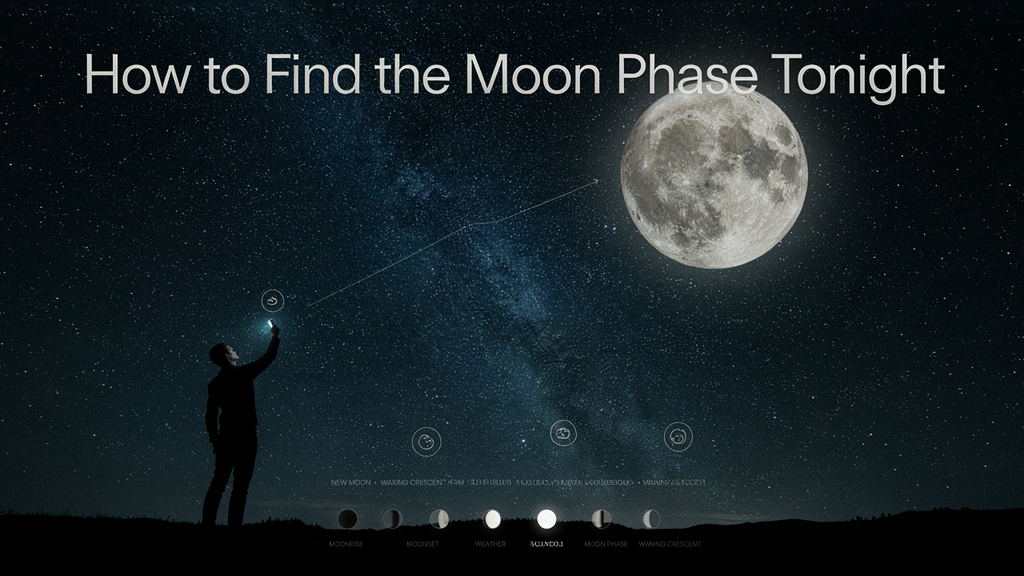
Finding the Moon is usually straightforward when you know the phase and approximate viewing time. The most important factors are local moonrise, moonset, daylight, weather, and the Moon’s position in the sky. 🌙 A phase calendar tells you what the Moon is doing, while local timing tells you when you can actually see it.
🌙 First, check whether the Moon is above your horizon. A correct phase does not guarantee visibility if the Moon has already set or has not yet risen.
🕰️ Check local moonrise and moonset times rather than relying on times from another city. Even nearby locations can have slightly different visibility schedules.
🌘 During a waning crescent, early morning is generally more useful than late evening. The Moon rises after midnight and remains visible into the daytime.
🌒 A waxing crescent is usually easier to find after sunset. As the illuminated crescent grows, it becomes increasingly visible during the evening hours.
🌕 A Full Moon is visible for much of the night. It generally rises around sunset and sets around sunrise, although exact times depend on location and date.
🌑 A New Moon is normally difficult to observe. Its position close to the Sun means there is little visible illuminated surface from Earth.
🔭 Binoculars can help reveal lunar detail, but they are not necessary for identifying major phases. Your unaided eyes can easily recognize a crescent, half Moon, or Full Moon.
🌌 Move away from strong artificial lights if possible. Light pollution does not prevent the Moon from being visible, but darker surroundings can make the overall sky more attractive.
☁️ Check the weather before planning an observation. Clouds can completely hide the Moon even when astronomical conditions are perfect.
📱 Astronomy apps and moon calendars can provide the Moon’s direction and altitude. These details are helpful when you are unsure where to look.
🧭 Use the compass direction provided by a reliable astronomy source. The Moon’s location changes throughout the night, so its direction at moonrise differs from its position later.
🌅 A waning crescent can appear close to the eastern horizon before sunrise. A clear horizon makes this phase easier to locate and photograph.
📸 If photographing the Moon, avoid automatic exposure settings when possible. The lunar surface is bright enough to confuse cameras that are trying to expose the surrounding dark sky.
✨ Patience helps with thin crescents. Wait until the sky is sufficiently dark but not so late that the Moon moves below the horizon.
🌍 Remember that Moon visibility is location-dependent. People in different cities may see the same phase at different times or at different positions in the sky.
🔎 If you cannot find the Moon, verify the date, time zone, and moonrise information. Small timing differences can matter when the Moon is close to the horizon.
🌙 The Moon may also be visible during daylight. Its visibility depends on its phase, altitude, sky brightness, and angular separation from the Sun.
🌗 Quarter phases can remain visible during convenient daytime or evening periods. Their predictable position makes them useful for beginner observation exercises.
📅 Use the lunar calendar as a planning guide, not a guarantee of clear skies. Real-world viewing always depends on weather and local horizon conditions.
🌠 With a little practice, finding the Moon becomes easy. Learn your local moonrise patterns, recognize major phases, and check the sky regularly.
Current Lunar Phase and Moon Illumination
Moon illumination describes the percentage of the visible lunar disk that is lit by sunlight. It is different from the Moon’s overall brightness and does not mean that a certain percentage of the Moon physically exists. 💡 On September 7, 2026, the Moon is a waning crescent with approximately 15–20% illumination depending on the exact time and location.
💡 Moon illumination measures how much of the visible disk appears sunlit. It changes continuously throughout the lunar cycle rather than only at the eight named phases.
🌘 During a waning crescent, illumination is relatively low. The percentage continues falling as the Moon approaches the next New Moon.
🌕 At Full Moon, illumination is close to 100 percent from the normal Earth-based viewing perspective. This produces the familiar bright circular lunar appearance.
🌑 Around New Moon, illumination approaches zero percent. The Moon may still be physically present in the sky, but its illuminated face is turned mostly away from Earth.
🌒 A waxing crescent usually has a low illumination percentage. As days pass, the illuminated section becomes progressively larger.
🌓 Around First Quarter, approximately half of the visible lunar disk is illuminated. The exact percentage may differ slightly depending on the precise time of observation.
🌔 Waxing gibbous means illumination is above half but below Full Moon. It is one of the brightest stages of the growing lunar cycle.
🌖 Waning gibbous also remains more than half illuminated. The important difference is that its illumination is decreasing after Full Moon.
🌗 Last Quarter represents another roughly half-lit stage. From this point, illumination continues declining toward the New Moon.
📊 Illumination percentages are useful for comparing nights. If tonight has 15% illumination and tomorrow has less, you know the crescent is approaching its darkest stage.
🌙 A small illumination percentage does not automatically mean the Moon is impossible to see. A thin crescent can still be striking when viewed under suitable conditions.
🔭 Surface details can be especially interesting near the terminator, the boundary between the illuminated and dark portions. Shadows there can emphasize lunar terrain.
☀️ Illumination comes entirely from sunlight. The Moon does not generate visible light itself, which is why its appearance changes as the viewing geometry changes.
🌍 The Moon’s physical surface remains unchanged as phases progress. What changes is how much of its sunlit hemisphere is visible from Earth.
✨ Illumination information is valuable for photographers. Different percentages create different levels of brightness, shadow, and visible lunar texture.
📅 Moon phase calendars often display both an emoji and illumination percentage. Using both gives readers a quick visual and numerical understanding.
🌘 A waning crescent with around 15% illumination looks noticeably different from a 40% crescent. The illuminated curve becomes narrower and more delicate.
🌕 Full Moon is visually dramatic because nearly the entire visible face is sunlit. However, the absence of long shadows can make surface relief less pronounced.
🌓 Quarter phases offer a balance between brightness and shadow. They can be excellent for observing craters and mountainous regions along the terminator.
🔄 Tracking illumination over a month provides a simple way to understand the lunar cycle. Watching the percentage rise and fall makes the concept much more intuitive.
Best Moon Phase for Stargazing and Photography
Every lunar phase creates different observing conditions. A bright Full Moon can be beautiful for lunar photography but can wash out faint stars, while a New Moon offers darker skies. 🌌 Crescent and quarter phases provide their own advantages, especially for lunar detail and creative photography.
🌑 New Moon is often preferred for deep-sky astronomy because there is little moonlight brightening the sky. This can improve conditions for observing faint galaxies, nebulae, and star clusters.
🌕 Full Moon is excellent for simple lunar photography. Its entire visible disk is illuminated, making the Moon easy to recognize and capture.
🌓 First Quarter can provide dramatic crater shadows. The transition between lunar day and night highlights surface features that may appear flatter near Full Moon.
🌗 Last Quarter offers similar shadow-rich opportunities. The changing illumination creates strong contrasts along the lunar terminator.
🌘 A waning crescent can create artistic images. Its thin shape looks especially attractive against a dark blue morning sky or alongside bright celestial objects.
🌒 Waxing crescent photography works well shortly after sunset. The Moon may appear above a colorful horizon, producing a visually appealing landscape composition.
📸 Use a stable tripod for serious lunar photography. Camera movement can soften fine details, particularly when using longer focal lengths or high magnification.
🔭 A telescope reveals much more surface detail than the naked eye. However, even a basic camera or smartphone can capture recognizable lunar phases.
🌌 For star photography, consider moonlight carefully. A bright Moon can illuminate landscapes but may reduce the visibility of faint stars.
🌙 Crescent phases offer a useful compromise for some compositions. The Moon provides a strong subject while leaving more surrounding sky relatively dark.
✨ Earthshine can sometimes make the darker portion of a thin crescent faintly visible. This creates a beautiful effect when exposure and atmospheric conditions are favorable.
🌅 Photographing the Moon near the horizon can add buildings, mountains, trees, or landscapes for scale. This makes the image feel more connected to Earth.
🧭 Planning is important because the Moon moves quickly across the sky. Check its direction and altitude before choosing your camera position.
☁️ Clear weather is essential. Thin clouds can soften the Moon, while thicker clouds may completely hide it.
📱 Smartphones can capture the Moon, but automatic exposure often makes it appear as a bright white spot. Lowering exposure manually can reveal more lunar detail.
🔭 Binoculars provide an easy step between naked-eye viewing and telescopes. They can make the crescent shape and lunar surface more noticeable.
🌕 Full Moon photography benefits from careful composition. Instead of centering the Moon every time, try including architecture, landscapes, or silhouettes.
🌗 Quarter Moon photography can emphasize texture. The long shadows created near the terminator reveal crater edges and uneven terrain.
🌘 Today’s waning crescent is especially suitable for early-morning photography. Its narrow shape can pair beautifully with dawn colors and other objects near the horizon.
📷 The best phase depends on your goal. Choose New Moon for dark skies, Full Moon for a bright disk, and quarter phases for detailed lunar terrain.
Moon Phase Meanings, Captions, and Symbolism
Moon phases have scientific meanings, but people also use them symbolically in writing, social media, journaling, art, and personal reflection. 🌙 These symbolic meanings are cultural and creative rather than scientific facts, so they should be understood as interpretations rather than astronomical properties.
🌑 The New Moon is often used as a symbol of beginnings. In creative writing, it can represent a quiet starting point, a fresh intention, or an opportunity to begin again.
🌒 A waxing crescent can symbolize growth. Its increasing light naturally inspires captions about progress, hope, patience, and becoming stronger one small step at a time.
🌓 The First Quarter can represent movement and decision. Its half-lit appearance works well in messages about taking action even when the entire path is not yet visible.
🌔 Waxing gibbous symbolism often focuses on preparation. The Moon is nearing fullness, making it a useful image for building confidence, progress, and anticipation.
🌕 Full Moon symbolism commonly emphasizes completion and brightness. In creative contexts, it can represent clarity, celebration, beauty, or a moment when hidden feelings become visible.
🌖 Waning gibbous can suggest reflection. Its decreasing illumination provides a natural metaphor for slowing down, reviewing experiences, and learning from what has already happened.
🌗 Last Quarter can symbolize transition. It marks a stage where the cycle is moving toward closure, making it suitable for messages about change and letting go.
🌘 Waning crescent often represents rest and closure. Its delicate light can inspire peaceful captions about quiet moments, reflection, and preparing for a new beginning.
🌙 The general Moon emoji can express nighttime without identifying an exact phase. It works naturally in messages about dreams, sleep, calm evenings, and peaceful thoughts.
✨ Moon imagery often appears in romantic writing because the night sky creates a sense of distance and connection. A simple crescent can make a message feel softer and more poetic.
🌌 Moon symbolism can also express solitude. A person may use a Moon caption to describe enjoying quiet time, thinking deeply, or finding comfort in peaceful surroundings.
🌘 A waning crescent can represent patience rather than sadness. Its fading light reminds us that cycles change naturally and that another beginning follows every ending.
🌕 A Full Moon caption can communicate confidence and visibility. The bright lunar disk provides an easy metaphor for standing openly in your own light.
🌒 A crescent can symbolize hope because even a small amount of light remains visible. This interpretation is especially common in inspirational and reflective writing.
🌑 The New Moon can represent a blank page. It is often used creatively to describe starting fresh without needing to carry every detail of the past forward.
🌓 Quarter phases can represent balance. Half-lit lunar imagery can suggest accepting both certainty and uncertainty while continuing forward.
🌔 Gibbous phases can symbolize preparation before achievement. The Moon has not reached fullness yet, but its progress is clearly visible.
🌖 Waning phases can provide a gentle metaphor for release. Rather than suggesting loss, they can represent making space for rest, reflection, and change.
🌙 Moon captions do not have one universal emotional meaning. Their interpretation depends on the surrounding words, relationship, culture, and situation.
💫 The strongest Moon captions connect the visual symbol with a clear thought. A meaningful sentence paired with the right lunar emoji can feel natural without becoming overly dramatic.
Today’s Moon Phase and What Happens Next
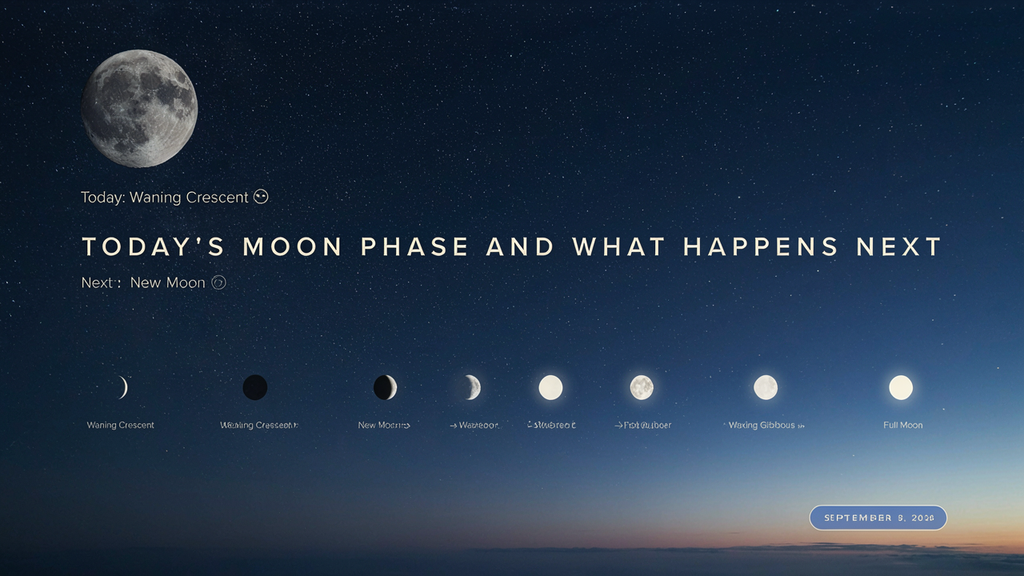
The Moon is currently in its waning crescent stage on September 7, 2026, and the illuminated portion is decreasing as the lunar cycle approaches the New Moon. 🌘 In Islamabad, the Moon phase is also listed as waning crescent, with the next New Moon occurring on September 11, 2026.
🌘 Today’s waning crescent means the Moon is approaching the end of its current cycle. The visible illuminated portion will continue becoming thinner during the following days.
📅 The next major lunar milestone is the New Moon. For Islamabad and much of Pakistan, the September 2026 New Moon occurs on September 11 at approximately 8:27 a.m. local time.
🌑 After New Moon, the Moon will begin a new waxing phase. A small crescent will gradually become visible again as the illuminated portion increases.
🌒 The first visible crescent after New Moon may be challenging to observe. Its proximity to the Sun and low altitude can make the timing especially important.
🌓 The Moon will eventually reach First Quarter. At that stage, approximately half of its visible disk will be illuminated, marking another major point in the cycle.
🌔 After First Quarter, the Moon enters the waxing gibbous stage. Each day brings more illumination until the next Full Moon.
🌕 The next Full Moon after the September New Moon occurs later in the month. September’s Full Moon is expected on September 26, 2026.
🌖 Following Full Moon, the Moon becomes waning gibbous. Its illuminated portion gradually decreases as it moves toward the Last Quarter.
🌗 The Last Quarter will again show approximately half of the visible disk illuminated. From there, the Moon will continue toward another waning crescent.
🔄 This sequence demonstrates why the Moon is called a cycle. There is no permanent starting or ending point in space; the familiar phases simply repeat continuously.
🌙 Today’s thin crescent can therefore be viewed as part of a much larger repeating pattern. Its changing appearance connects directly to the Moon’s position relative to Earth and Sun.
🌅 Because the Moon is waning, early-morning observation is generally more useful than evening viewing. Its rise occurs after midnight and it can remain above the horizon into the daytime.
🔭 Observers should choose a location with a clear horizon for the thin crescent. Nearby buildings, hills, trees, haze, and clouds can make low-altitude lunar viewing difficult.
📱 If you want to share today’s phase online, a simple caption such as “Waning Crescent 🌘” is both visually attractive and astronomically clear.
✨ The current phase is also a good reminder that the Moon changes every day. A photograph taken tomorrow may already show a noticeably thinner crescent.
🌌 Watching the Moon across several days can be more educational than viewing it only once. The gradual reduction in illumination becomes easy to recognize through repeated observation.
🕰️ Exact visibility changes by location and time. Moonrise, moonset, altitude, and illumination should therefore be checked using local astronomical information.
📊 Current lunar data can differ slightly between sources because the Moon’s illumination changes continuously. Small differences may reflect the exact observation time and geographic location.
🌑 As the New Moon approaches, the visible crescent becomes increasingly difficult to observe. Once the Moon is close to the Sun in the sky, safe and practical viewing becomes more limited.
🌙 After the New Moon, the cycle begins visually again with a waxing crescent. This repeating pattern is what makes the lunar cycle one of the easiest astronomical rhythms to follow.
Frequently Asked Questions
What is the Moon phase today?
On September 7, 2026, the Moon is in the waning crescent 🌘 phase. The illuminated portion is decreasing as the Moon approaches the New Moon. Exact illumination varies slightly according to the observation time and location, but sources place the visible illumination at roughly the mid-teens to around 20 percent for this date.
What is the Moon phase emoji for today?
The most suitable phase emoji for September 7, 2026, is 🌘, representing a waning crescent. This emoji visually corresponds to the final crescent stage before New Moon. You can write “Waning Crescent 🌘” when you want your social media post, calendar, article, or message to communicate the lunar phase clearly.
What does 🌘 mean?
The 🌘 emoji represents a waning crescent Moon. Astronomically, this means the illuminated portion visible from Earth is decreasing after the Last Quarter phase and before the New Moon. In casual messages, the emoji can also represent nighttime, calmness, reflection, dreams, or a peaceful evening depending on context.
What are the eight phases of the Moon?
The eight commonly recognized phases are New Moon 🌑, Waxing Crescent 🌒, First Quarter 🌓, Waxing Gibbous 🌔, Full Moon 🌕, Waning Gibbous 🌖, Last Quarter 🌗, and Waning Crescent 🌘. Together, they describe the repeating visual changes seen during approximately one 29.5-day lunar cycle.
What is the difference between waxing and waning?
Waxing means the illuminated portion of the Moon is increasing, while waning means the illuminated portion is decreasing. Waxing phases occur between New Moon and Full Moon. Waning phases occur between Full Moon and the next New Moon. Remembering “waxing = increasing” and “waning = decreasing” makes lunar calendars easier to understand.
When is the next New Moon in September 2026?
The September 2026 New Moon occurs on September 11 at approximately 8:27 a.m. local time in Pakistan according to the cited lunar calendar data. The exact local timing can vary in displayed calendars depending on location and time-zone settings.
When is the next Full Moon in September 2026?
The September 2026 Full Moon occurs on September 26 at approximately 9:49 p.m. in Pakistan according to the cited phase calendar. It is commonly identified as the Corn Moon, and it is also the Harvest Moon for 2026 according to BBC Sky at Night Magazine.
Can I see a waning crescent at night?
A waning crescent is generally better placed for observation during the early morning rather than the evening. It rises after midnight and can remain visible into the daytime. The exact viewing period depends on your location, horizon, weather, and the Moon’s altitude.
Does the Moon phase change every day?
Yes. The Moon’s illuminated appearance changes continuously as it orbits Earth. Although astronomers commonly divide the cycle into eight named phases, the transition between them is gradual. This is why the Moon can look noticeably different from one day to the next, especially around crescent and quarter phases.
Why does the Moon have different phases?
The Moon phases occur because the Moon orbits Earth while sunlight illuminates one half of its surface. As the Moon changes position, observers on Earth see different portions of that illuminated half. Ordinary Moon phases are therefore caused by viewing geometry, not by Earth’s shadow covering the Moon.
Conclusion
The Moon follows a beautiful and predictable cycle that can be understood without advanced astronomy equipment. The Current Moon Phase Today is a waning crescent 🌘, placing the Moon near the end of its present cycle and only a few days away from the September New Moon. Understanding the difference between waxing and waning, learning the eight main phases, and recognizing the matching emojis makes lunar calendars much easier to follow.
Whether you are checking the sky, preparing an astronomy article, creating a social media caption, or simply wondering why the Moon looks different tonight, lunar phase information can help. The Current Moon Phase Today is only one moment in an ongoing celestial cycle, so checking the Moon regularly can reveal how naturally and beautifully its appearance changes throughout the month. 🌙✨
Read More What Is the Current Phase of the Moon as an Emoji? (2026)