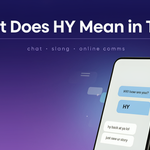
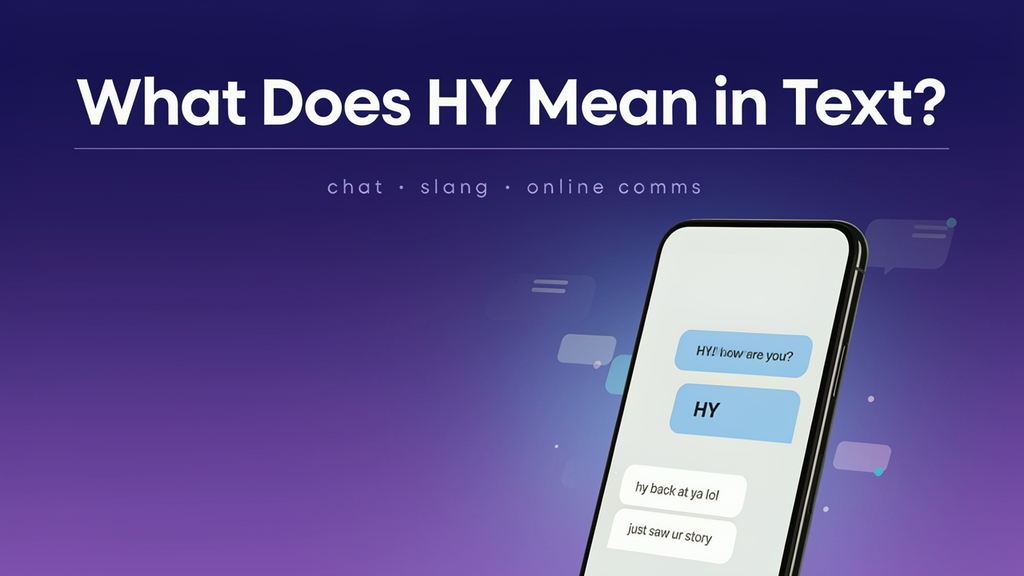
If you have received a message containing HY and wondered what the sender meant, you are not alone. Short abbreviations are common in texting, social media, and online conversations because people often prefer quick and casual ways to communicate. The meaning can sometimes be obvious from the surrounding words, while other situations require a little context.
In most casual conversations, HY may be used as a shortened or informal version of “hi,” although it can also appear as a typo, abbreviation, or context-dependent expression. Understanding the conversation around the abbreviation is important before deciding what the sender intended. This guide explains its possible meanings, examples, uses, and appropriate responses.
What Does HY Mean in Texting?
The most common interpretation of HY in casual texting is that it is a shortened form or informal variation of “hi.” Some people type it intentionally as a quick greeting, while others may accidentally write HY because the letters are close or because of fast typing. Unlike highly standardized abbreviations, its meaning is not always fixed.
- 👋 HY can work as a quick greeting when someone wants to start a casual conversation without typing a full “hi.” It usually feels relaxed and informal, especially between friends or people who already communicate regularly.
- 😊 When a friend sends HY by itself, they may simply be saying hello and waiting for you to continue the conversation. A friendly response such as “Hey!” or “Hi, what’s up?” usually works well.
- 💬 HY is often understood through context rather than a strict dictionary definition. If the message contains other friendly words, the abbreviation is more likely to function as an informal greeting.
- 🌟 Some texters use HY because they enjoy experimenting with shortened words. It can make a conversation feel quick and casual, especially when both people already understand each other’s texting habits.
- 📱 A message such as “HY, how are you?” is usually easy to understand because the rest of the sentence makes the intended meaning clear. In this situation, it functions much like a simple “Hi, how are you?”
- 😄 If someone normally writes “Hi” but suddenly types HY, it may simply be a typo or rushed message. There is no need to assume that the letters have a special slang meaning.
- 🗨️ HY may appear at the beginning of a conversation when someone wants your attention. Its purpose can be similar to sending “Hey” or “Hi” before asking a question.
- ✨ In informal online communication, abbreviations often develop naturally among groups of friends. HY may therefore have a slightly different personal meaning depending on the people participating in the conversation.
- 👀 If you are unsure what HY means in a particular message, look at the words immediately before and after it. Context is usually the strongest clue when interpreting unusual texting abbreviations.
- 🤝 A simple HY between close friends normally does not require a complicated interpretation. It can simply be a quick way to open a conversation and invite the other person to reply.
- 🌼 HY can sound especially casual when it appears alone, such as “HY!” The exclamation mark can make the message feel more energetic and friendly.
- 📲 People who frequently use texting shorthand may type HY without thinking about whether the abbreviation is formally recognized. Their main goal is often speed and convenience rather than perfect spelling.
- 🙂 If HY arrives from someone you know well, replying naturally is usually better than asking what the abbreviation means. A response such as “Hey! How’s everything?” keeps the conversation moving.
- 🔤 HY can sometimes be nothing more than an accidental letter combination. Fast typing, autocorrect, or keyboard mistakes can easily create unusual abbreviations that were never intended as slang.
- 💡 The safest interpretation comes from considering the entire message rather than focusing on two letters alone. Online abbreviations can have several meanings, and context helps separate intentional slang from mistakes.
- 👋 In a friendly conversation, HY may function almost exactly like “hi.” It can be particularly common in very short messages where the sender wants to greet you quickly before continuing.
- 🧩 If someone sends “HY, are you free?” the greeting is easy to identify from the sentence structure. The second part of the message confirms that the sender is beginning a normal conversation.
- 🌐 Texting language changes constantly as people create new shortcuts and expressions. HY is one example of why online communication cannot always be interpreted using traditional dictionary definitions alone.
- 😎 Among younger or highly casual texters, unusual spellings may be intentional because they feel faster or more personal. HY can therefore reflect a relaxed communication style rather than a formal abbreviation.
- 💬 Overall, HY is best interpreted by considering who sent it, what they wrote around it, and the platform being used. In many casual cases, it simply serves as an informal greeting similar to “hi.”
HY Meaning in Chat and Messages
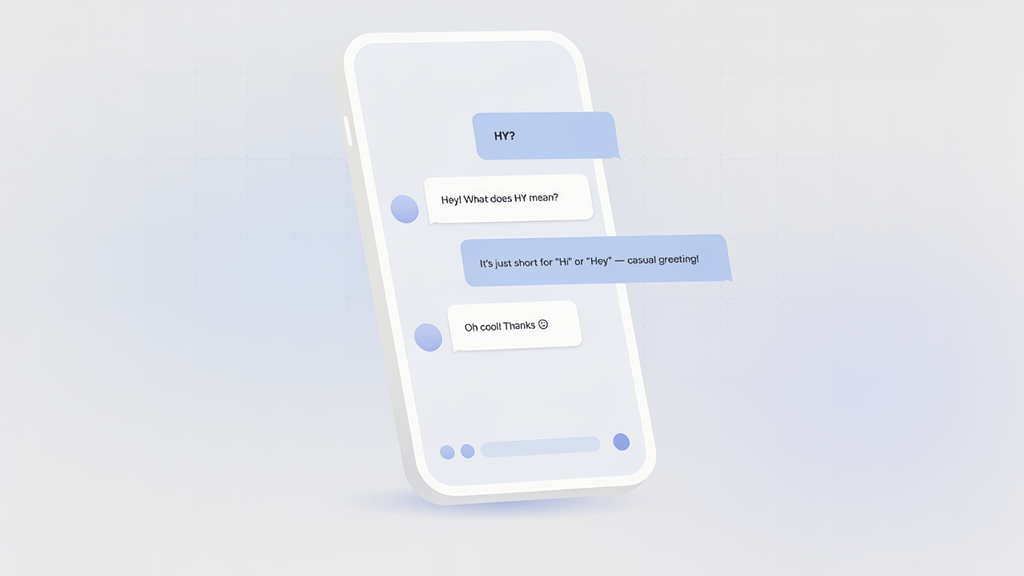
In chat and text messages, HY is generally interpreted according to the surrounding conversation. It can act as a greeting, a shortened spelling, or an accidental typo. Because texting has no universal grammar system, users frequently create personal shortcuts that make sense within their social circles.
- 👋 “HY, how are you?” is a straightforward example where the abbreviation clearly works as a greeting. The sender is opening the conversation before asking about your well-being.
- 😊 “HY! Long time no talk” uses HY as a friendly opener. The following sentence shows that the sender is reconnecting after not speaking for some time.
- 💬 “HY, are you online?” may simply mean “Hi, are you online?” The abbreviation keeps the opening greeting short while the actual purpose of the message remains clear.
- 🌸 “HY, hope you’re doing well” sounds friendly and polite despite the shortened greeting. Context makes the intended meaning easy to recognize without requiring a formal explanation.
- 📱 “HY bro, what’s going on?” demonstrates how HY can appear alongside other casual expressions. The overall sentence has a relaxed tone associated with everyday messaging.
- 😄 “HYyy!” shows how users may stretch or modify short greetings for personality. Repeated letters can make a basic greeting appear more playful or enthusiastic.
- 🗨️ “HY, got a minute?” uses the abbreviation before a practical question. The sender likely wants to begin politely while keeping the message brief.
- ✨ “HY! I wanted to tell you something” demonstrates how an abbreviation can introduce a more meaningful conversation. The greeting itself remains casual even when the following message is important.
- 🤝 “HY, thanks for yesterday” combines a casual greeting with appreciation. This type of message shows how short greetings can naturally appear before different kinds of statements.
- 👀 “HY, did you see my message?” can sound slightly urgent depending on the surrounding context. The abbreviation itself remains casual, while the question communicates the sender’s main concern.
- 🌟 “HY everyone!” may be used when someone enters a group chat. It functions like “Hi everyone” and can serve as a simple way to acknowledge the group.
- 💻 “HY, are you joining the call?” demonstrates how informal greetings appear even in work-related chats. However, professional settings may favor “Hi” because it looks clearer and more polished.
- 🙂 “HY, what are you doing today?” is another ordinary conversational example. The sender is simply using a shortened greeting before asking about plans.
- 📲 “HY there!” may resemble “Hi there,” although usage varies among individuals. Reading the complete message helps determine whether the sender intended a greeting.
- 🧠 If HY appears in a message that otherwise contains normal words, interpreting it as a greeting is often reasonable. However, you should avoid treating that interpretation as universal.
- 🔎 When HY appears repeatedly from the same person, their usage pattern provides useful evidence. If they consistently use it to begin conversations, it probably represents their preferred greeting style.
- 💖 A romantic conversation might contain “HY love” or a similar expression. In that setting, the abbreviation usually carries the same basic greeting meaning while the surrounding words create the emotional tone.
- 😎 Friends may use HY because it feels quicker than typing “hello.” Short greetings are especially common when conversations happen rapidly throughout the day.
- 🌐 In online communities, abbreviations can develop unique meanings among members. If HY appears in a specialized group, checking the local conversation style can prevent misunderstanding.
- 💡 The best way to interpret HY in messages is to read the complete sentence. The surrounding vocabulary, punctuation, relationship, and platform can all provide clues about what the sender intended.
HY as a Greeting in Casual Texting
HY can function as a casual greeting, especially when someone is communicating with friends or acquaintances. It is not as standardized as common abbreviations such as LOL or BRB, so users should consider context. In formal communication, writing “Hi” or “Hello” is usually clearer.
- 👋 A friend texting “HY!” may simply be trying to get your attention. Responding with “Hey!” creates a similarly relaxed tone and keeps the interaction natural.
- 😊 “HY, how’s your day?” is an informal way to start a conversation. The shortened greeting does not change the friendly intention of the complete message.
- 🌞 A morning conversation might begin with “HY, good morning!” Here, HY acts as a casual opener while the rest of the message communicates the specific greeting.
- 💬 Someone who regularly uses texting shorthand may consider HY completely normal. Their choice reflects personal communication habits rather than a universally accepted texting rule.
- 😄 HY can be useful when a sender wants to greet someone quickly. Short messages are particularly common when people are busy, walking, multitasking, or having rapid conversations.
- 🌷 A close friend might write “HY bestie!” to create a warm and playful opening. The greeting becomes more expressive because of the relationship between the two people.
- 📱 On a phone, people sometimes shorten words simply because typing takes effort. HY can therefore be an example of convenience-driven texting rather than deliberate slang.
- ✨ A greeting such as “HY, I missed talking to you” combines a quick opener with an emotional message. The abbreviation remains casual while the second sentence communicates genuine affection.
- 🤗 If you receive HY from someone you have not heard from recently, it may be an attempt to reconnect. A friendly response can invite them to explain why they reached out.
- 👀 HY followed by a question can indicate that the sender wants a conversation. The greeting itself is not necessarily urgent, but the following words may reveal the sender’s actual purpose.
- 💖 In romantic chats, HY can appear before affectionate language. The abbreviation does not automatically make the message romantic; the relationship and surrounding words determine that tone.
- 🗨️ Group chats may contain very short greetings because several conversations happen simultaneously. HY can be used as a quick way to announce that someone has joined the discussion.
- 🌟 If a person uses HY repeatedly, you may eventually recognize it as their personal greeting style. Personal shorthand is common in informal digital communication.
- 😎 Some people deliberately use unusual spellings because they look more casual. HY can therefore communicate informality even when the intended meaning remains simply “hi.”
- 🔤 The difference between HY and HI may be purely stylistic. If both are being used to greet someone, the practical meaning of the message is essentially the same.
- 📲 A sender may choose HY when they are typing quickly. Short forms can reduce keystrokes, especially during fast back-and-forth conversations.
- 🌼 “HY! What’s new?” is an example of a simple conversational opener. There is no complicated hidden meaning when the context clearly indicates a greeting.
- 🤝 If you want to mirror the sender’s tone, replying with “Hey!” or “Hi!” is usually appropriate. You do not need to copy their exact abbreviation.
- 💡 If HY appears in an unfamiliar context, avoid immediately assuming it means “hi.” Consider the complete message before deciding what the sender intended.
- 🌐 Casual greetings evolve with online communication. HY demonstrates how users can create short, informal expressions that may be understood by some communities but not universally recognized.
HY vs. Hi in Texting
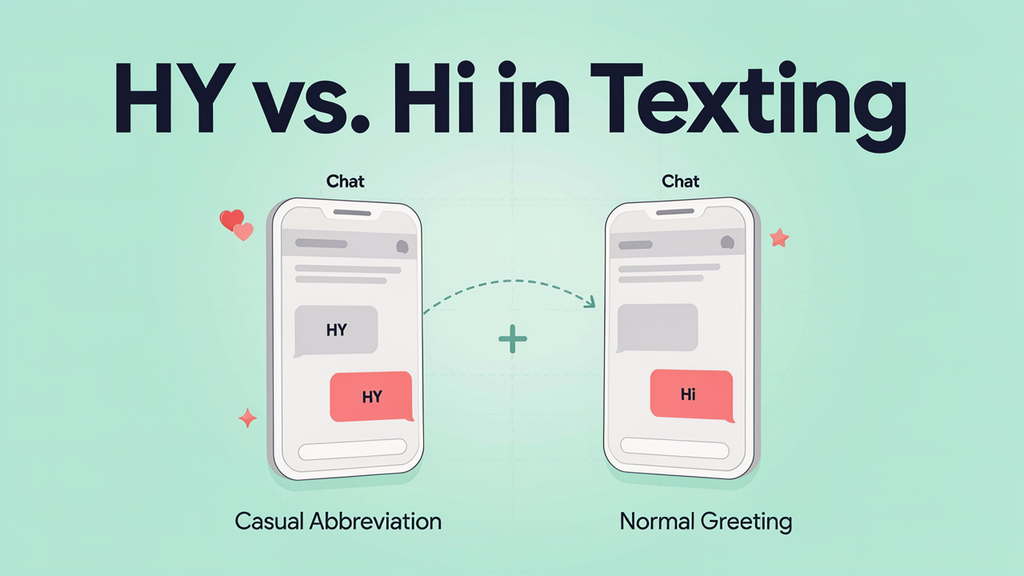
HY and HI can look similar, but they are not equally standard. “Hi” is a universally recognized greeting, while HY is more informal and context-dependent. HY may represent a personal texting habit, a deliberate shortcut, or simply a typing error.
- 👋 “Hi” is the conventional spelling of the greeting, while HY is an informal alternative. If clarity matters, “Hi” is generally the safer choice.
- 💬 Someone writing “HY” may intend exactly the same thing as someone writing “Hi.” The difference often lies in spelling style rather than conversational purpose.
- 😊 “Hi, how are you?” is immediately understood by virtually every English speaker. “HY, how are you?” may also be understood, but it depends more heavily on context.
- 📱 In quick chats, a person may prefer HY because it feels shorter. However, the saved keystrokes are minimal, so the choice may simply reflect personal habit.
- 🔤 HY can sometimes be a typo rather than an intentional abbreviation. If the sender rarely uses shorthand, this possibility becomes more likely.
- 😄 Friends often understand unusual spellings without needing clarification. Shared communication habits allow people to interpret abbreviations that might confuse strangers.
- 🌟 HI is appropriate in casual, academic, professional, and many formal situations. HY is better limited to informal environments where unconventional texting is acceptable.
- 🧠 Context matters when distinguishing an intentional abbreviation from a mistake. Repeated use by the same person is stronger evidence than seeing HY only once.
- 🗨️ If someone writes “HY bro,” the casual wording supports the interpretation of HY as a greeting. The phrase clearly resembles “Hi bro” or “Hey bro.”
- 👀 If HY appears in an otherwise formal email, it may be a typing mistake or an inappropriate shortcut. Professional writing should generally use standard language.
- 🤝 Friends may not notice the difference between HY and HI at all. Both can successfully begin a friendly conversation when the meaning is obvious.
- ✨ HY may feel more informal because it does not follow conventional spelling. That unusual appearance can give a message a distinctly casual or playful character.
- 📲 Autocorrect does not always recognize personal abbreviations. A sender may intentionally type HY even if their phone suggests a different word.
- 🌸 A person who frequently sends abbreviations may use HY naturally without considering whether it is standard. Their goal is communication, not dictionary accuracy.
- 💡 When teaching someone English texting conventions, it is useful to explain that “Hi” is standard and HY is context-dependent. This distinction helps learners communicate more clearly.
- 😎 HY may be appropriate among close friends but less suitable when messaging a teacher, manager, customer, or professional contact. Audience should influence your choice of language.
- 🌐 Online language changes quickly, and abbreviations can gain or lose popularity. A term that feels familiar in one community may be unfamiliar somewhere else.
- 🗣️ If you want to avoid misunderstanding, choose “Hi” rather than HY. The standard greeting requires no interpretation and works across a wider range of situations.
- 💖 In personal messages, the emotional tone usually comes from the words surrounding the greeting. HY itself does not automatically communicate affection, excitement, or romance.
- 🔎 Ultimately, HY and Hi may serve the same conversational purpose, but “Hi” is much more universally recognized. HY should be understood as an informal, context-dependent form rather than a fixed standard abbreviation.
HY Meaning on Snapchat, Instagram, and TikTok
Social media platforms encourage fast, informal communication, so users frequently experiment with abbreviations and shortened expressions. HY may appear in direct messages, comments, captions, or group conversations, but its interpretation still depends on context rather than the platform alone.
- 📸 On Snapchat, HY may appear as a quick greeting in a direct message. If someone sends it before asking a question, they may simply be starting a casual conversation.
- 💬 Instagram users may type HY in DMs when contacting a friend or follower. The abbreviation can function like “Hi,” especially in relaxed personal conversations.
- 🎵 TikTok users may use unusual shorthand in comments or private messages. HY could therefore reflect general internet texting habits rather than a TikTok-specific definition.
- 👋 A Snapchat message reading “HY!” is likely to be interpreted as a friendly opener. The surrounding conversation can confirm whether the sender is simply saying hello.
- 😊 Instagram DMs often contain informal spelling, emojis, and abbreviations. HY can fit naturally into that communication style when both people are comfortable with casual language.
- 📱 TikTok conversations can move quickly, encouraging users to shorten words. However, HY does not have one universally recognized TikTok meaning that applies to every message.
- 👀 If someone comments “HY” on a social post, interpretation may be less obvious than in a private conversation. The comment, video, and previous interaction can provide important clues.
- ✨ Social media communities often create their own slang. Before assigning a meaning to an unfamiliar abbreviation, consider whether the specific community uses it differently.
- 🌐 A person may use the same HY abbreviation across Snapchat, Instagram, WhatsApp, and ordinary texting. In that case, the platform does not necessarily change its meaning.
- 😄 Some users intentionally write words differently because informal spelling feels more natural online. HY can be part of that personal digital communication style.
- 💖 If HY appears in a romantic Instagram DM, the relationship may explain the tone better than the abbreviation itself. Look at the complete message before interpreting emotional meaning.
- 🗨️ A Snapchat friend might send HY before sharing a photo or asking where you are. In such cases, the abbreviation simply opens the conversation.
- 📲 Instagram users may combine HY with emojis to make the greeting more expressive. An emoji can communicate friendliness even when the abbreviated greeting is extremely short.
- 🎬 TikTok comments often use compressed language because users want to react quickly. HY could therefore be a personal shortcut rather than a platform-specific slang term.
- 🔎 If you encounter HY on social media and cannot determine its meaning, politely asking the sender can be more reliable than relying on a generic abbreviation list.
- 🤝 Different age groups and online communities may interpret shorthand differently. A phrase that seems obvious to one group can be unfamiliar to another.
- 🌟 Social platforms constantly introduce new expressions and communication trends. This makes context especially important when researching short two-letter combinations.
- 🧠 Do not assume that every abbreviation found on TikTok or Snapchat has a secret slang definition. Many unusual forms are simply personal spellings or ordinary typos.
- 😊 If HY is followed by “how are you?” or “what’s up?”, the greeting interpretation becomes especially strong. The rest of the message provides useful grammatical context.
- 💡 Across Snapchat, Instagram, and TikTok, HY is best treated as a context-dependent informal expression. In many personal chats, it may simply be a quick alternative to “hi.”
HY as a Text Abbreviation and Internet Slang
Internet slang includes shortened words, acronyms, intentional misspellings, and expressions that develop within online communities. HY can be described as informal texting shorthand in some conversations, but it is not as standardized as widely recognized terms such as LOL, IDK, or BTW.
- 🌐 Internet slang evolves through everyday communication. HY illustrates how people can shorten or alter ordinary words without creating a universally accepted abbreviation.
- 💬 A true acronym usually has a recognized expansion, while HY may have several interpretations. This is why context is especially important when discussing its slang meaning.
- 📱 Texting shorthand is often designed for speed and convenience. A user may type HY because they want a very quick greeting rather than because they are following a formal abbreviation system.
- 👋 When HY is used as slang, it may carry the informal feeling of “hi.” Its exact tone depends on the relationship between the sender and recipient.
- 😎 Internet users often create personalized spellings that become familiar within friend groups. HY may therefore be meaningful without being officially recognized by dictionaries.
- 🔤 Some shorthand forms are created intentionally, while others happen because of typing mistakes. HY can belong to either category depending on the sender.
- 🧠 It is important not to confuse an unusual spelling with established slang. A word appearing online does not automatically mean that it has a fixed internet definition.
- 🗨️ In casual chat, users rarely stop to define every abbreviation. Shared context allows people to understand short expressions that might look confusing to an outsider.
- ✨ Slang can also communicate identity and tone. Choosing a shortened greeting may make a message feel relaxed, playful, or conversational.
- 📲 Many internet abbreviations spread through social media and messaging apps. However, popularity can vary significantly between platforms, countries, age groups, and communities.
- 😊 If a friend writes HY regularly, you may quickly learn what it means from repeated interactions. Personal patterns can be more useful than general abbreviation lists.
- 👀 When an abbreviation seems ambiguous, examine punctuation and nearby words. “HY!” has a different level of clarity from an isolated “HY” appearing in an unrelated sentence.
- 🌟 Informal abbreviations can change over time. A current interpretation may become less common as online language develops and new expressions become popular.
- 🤝 Shared slang can create a feeling of familiarity between friends. Using the same shorthand may make conversations feel quicker and more natural.
- 💡 For professional communication, standard language is usually preferable. Informal slang such as HY may be misunderstood or appear careless when the audience expects formal writing.
- 📝 When explaining HY to someone, it is better to say that it is context-dependent rather than presenting one meaning as universally correct.
- 🌸 In personal conversations, informal shorthand can be harmless and convenient. The important thing is that both participants understand the intended message.
- 🔎 Searching the complete phrase surrounding HY can sometimes provide more useful clues than searching the abbreviation alone. Context reduces the chance of confusing unrelated meanings.
- 💬 Internet slang is fundamentally about shared understanding. If a recipient clearly understands HY as a greeting, the abbreviation has successfully served its communicative purpose.
- 🌐 Overall, HY can appear as informal texting shorthand, but it should not automatically be treated as a standardized slang acronym. Its meaning is best determined through context and usage patterns.
Common Examples of HY in Text Messages
Examples make unusual abbreviations easier to understand because they show how context changes interpretation. Looking at complete messages can reveal whether HY is functioning as a greeting, a personal shortcut, or potentially just a typing error.
- 👋 “HY, what are you doing?” is a simple example of HY functioning as an informal greeting. The question that follows makes the conversational purpose immediately clear.
- 😊 “HY! How have you been?” uses HY exactly where a normal greeting would appear. The message sounds friendly and suitable for an informal conversation.
- 💬 “HY bro, are you free?” demonstrates how HY can appear before casual language. The sender is likely greeting a friend before asking about availability.
- 🌟 “HY, I wanted to check something” shows how the abbreviation can introduce a practical question. The greeting itself remains brief while the second part carries the main purpose.
- 📱 “HY everyone, what’s happening?” could appear in a group chat. The sender is acknowledging multiple people and opening a general conversation.
- 😄 “HYyy, guess what!” uses extended spelling to create excitement. The unusual form makes the greeting feel playful rather than formal.
- 🤝 “HY, thanks for helping me” combines a greeting with appreciation. The example shows that HY can introduce positive or grateful messages just as easily as ordinary questions.
- 👀 “HY, did you get home?” begins a conversation about someone’s whereabouts. The context suggests a friendly check-in rather than a specialized slang definition.
- 💖 “HY love, how was your day?” demonstrates how relationship language can follow the abbreviation. The romantic feeling comes from “love” and the context, not automatically from HY itself.
- 🌼 “HY! It’s been ages” is suitable when reconnecting with someone after a long period. The phrase following the greeting establishes the reason for reaching out.
- 🗨️ “HY, can I ask you something?” is another common conversational structure. HY simply introduces the question and makes the message feel less abrupt.
- ✨ “HY! Hope everything is okay” shows how a short greeting can precede concern for another person. The emotional meaning comes primarily from the rest of the message.
- 📲 “HY, are you still awake?” is natural in an informal late-night conversation. The sender uses a quick greeting before asking a simple question.
- 😎 “HY dude, what’s new?” illustrates highly casual communication. The combination of HY and “dude” creates a relaxed tone appropriate for friends.
- 🌐 “HY, saw your post today” may appear in a social media DM. The sender uses the greeting before referring to something they noticed online.
- 🧠 “HY?” by itself is ambiguous because there is little context. The recipient may reasonably interpret it as a greeting, but they could also ask what the sender intended.
- 🔤 “HY, sorry for the late reply” shows that the abbreviation can appear when reconnecting after a delay. The apology explains the reason for the conversation.
- 😊 “HY! Ready for tonight?” combines a cheerful greeting with a plan-related question. This is typical of short messages exchanged between people who already know each other.
- 💬 “HY, just checking in” uses the abbreviation before a brief personal update. It demonstrates how casual greetings can introduce almost any everyday topic.
- 🌟 “HY! Nice hearing from you” makes the greeting part of a warm response. The surrounding words provide the emotional meaning that the two-letter abbreviation alone cannot communicate.
How to Respond to HY in a Text

Responding to HY is usually simple because the abbreviation often functions like a greeting. You can answer with “Hi,” “Hey,” or another friendly opener. If the meaning is unclear from the conversation, asking a brief clarification is also perfectly acceptable.
- 👋 If someone sends “HY,” replying “Hey!” is an easy and natural response. It acknowledges the greeting without making the conversation unnecessarily complicated.
- 😊 You can answer “Hi! How are you?” when you want to return the greeting and encourage the sender to continue. This works especially well with friends and acquaintances.
- 💬 “Hey, what’s up?” is another relaxed response. It matches the informal tone of a short greeting and gives the other person an opportunity to explain why they contacted you.
- 🌟 If you know the sender well, you can mirror their casual style. A response such as “HY! What’s going on?” keeps the interaction friendly and informal.
- 📱 If you suspect HY was a typo, there is usually no reason to point it out. Simply responding naturally allows the sender to continue without embarrassment.
- 🧠 If the abbreviation appears in a confusing sentence, context may not be enough. In that case, asking “What do you mean by HY?” can prevent a misunderstanding.
- 😄 A playful response such as “Heyyy! 😊” can work when the relationship is informal. Matching the sender’s energy often makes conversations feel more natural.
- 🤝 If HY comes from a professional contact, consider responding with standard language. “Hi, how can I help?” is clearer and more appropriate for workplace communication.
- 💖 In a romantic conversation, you might respond warmly while considering the relationship. A simple “Hey, good to hear from you” can communicate friendliness without overinterpreting the abbreviation.
- 👀 If someone sends only “HY” with no context, you can simply answer “Hi!” and wait. Their next message will usually clarify what they wanted to discuss.
- 🌼 If the sender is reconnecting after a long time, “Hey! It’s been a while” can create a welcoming opening. It acknowledges the greeting while recognizing the history between you.
- 📲 On social media, a concise response is often best. “Hey! What’s up?” fits naturally into DMs and avoids making a simple greeting feel overly formal.
- ✨ If you are unsure whether HY means “hi,” responding with “Hey!” is still generally safe in a casual conversation. It addresses the likely greeting without requiring certainty.
- 😎 Friends may appreciate a response that matches their shorthand. However, you do not need to imitate every abbreviation someone uses to maintain a friendly conversation.
- 🗨️ When replying to HY in a group chat, you can acknowledge the sender while addressing the wider discussion. The appropriate response depends on what the group is currently talking about.
- 🔎 If HY appears alongside unfamiliar slang, focus on the complete sentence. Responding to the main topic can often be more useful than trying to decode every abbreviation individually.
- 🌐 Different communities use different forms of internet slang. If you communicate with people from different backgrounds, choosing clear language can reduce unnecessary confusion.
- 💡 A simple “Hi!” is almost always an acceptable response when HY is being used as a greeting. It is short, friendly, and universally understood.
- 😊 If you want to continue the conversation, add an open-ended question. “Hi! How’s your day going?” gives the sender an easy reason to respond.
- 👋 The best response depends on the sender, relationship, and surrounding conversation. When HY clearly means a greeting, treat it like one rather than searching for a complicated hidden meaning.
When HY May Be a Typo or Have Another Meaning
Not every occurrence of HY should automatically be interpreted as “hi.” People make typing mistakes, abbreviations can have different meanings, and specialized communities may use the same letters differently. Examining the complete sentence is therefore essential.
- 🔤 A person typing quickly may accidentally enter HY instead of HI. If the sender normally uses standard spelling, a simple typo may be the most likely explanation.
- 📱 Phone keyboards can produce unexpected letters when someone types quickly. A short message containing HY may therefore have no special slang meaning at all.
- 🧠 If HY appears in a technical or specialized conversation, the letters could represent something unrelated to a greeting. Context should always come before assumptions.
- 💬 A business, gaming, school, or hobby community may have its own abbreviations. The same two letters can mean different things in different environments.
- 👀 If the words surrounding HY do not resemble a greeting, pause before deciding that it means “hi.” The sentence structure may point toward another interpretation.
- 🌐 Online abbreviations often have multiple possible expansions. Search results can provide possibilities, but the sender’s actual context is more reliable than a generic list.
- 😄 Sometimes users intentionally create private shorthand with friends. HY could therefore have a meaning known only within a particular social group.
- 🗨️ If someone sends “HY” after discussing a technical subject, the meaning may depend on that subject. Do not automatically transfer a casual texting interpretation into every conversation.
- 🔎 Repeated usage can help identify meaning. If the person sends HY at the start of nearly every conversation, the greeting interpretation becomes increasingly likely.
- ✨ Punctuation can also provide clues. “HY!” looks more like a greeting than HY appearing inside a long technical sentence.
- 📲 Autocorrect and predictive text can sometimes change intended words. If HY appears unexpectedly, consider asking the sender rather than assuming they deliberately used slang.
- 🤝 The relationship between participants matters. Friends often use personal abbreviations that would be confusing to coworkers or strangers.
- 🌟 A phrase like “HY everyone” strongly suggests a greeting because the word “everyone” naturally follows an opening salutation. Sentence structure can provide powerful clues.
- 💡 If you cannot confidently determine the meaning, clarification is better than guessing. A short question can prevent an awkward or incorrect response.
- 😊 Misunderstanding an abbreviation is usually easy to resolve in casual conversation. Simply asking what someone meant can keep communication clear and friendly.
- 🧩 Two-letter combinations are particularly ambiguous because they can represent many things. The shorter the abbreviation, the more important surrounding information becomes.
- 👋 If HY appears at the very beginning of a personal message, a greeting interpretation is often reasonable. Still, it should be treated as a likely meaning rather than an absolute rule.
- 📝 In professional writing, unusual abbreviations can cause unnecessary confusion. Standard words are preferable when the audience may not share your texting habits.
- 🌐 Slang meanings can change with time, location, and community. A definition found online may not perfectly describe how an individual sender uses HY.
- 🧠 The most reliable approach is simple: read the entire message, consider the relationship, examine the platform, and then interpret HY. Context is more dependable than a single fixed definition.
HY Meaning in Different Online Conversations

The meaning of HY can shift depending on the conversation, audience, and communication style. A message between close friends may be interpreted differently from a workplace chat or specialized online community. Understanding these differences makes digital communication easier and more accurate.
- 👋 In a conversation between friends, HY will often be understood as a quick greeting. Informal relationships allow people to use shortened spellings without needing formal explanations.
- 💬 In a family group chat, HY may simply mean “hi” or “hello.” The appropriate interpretation depends on how the family members normally communicate with one another.
- 📱 In a gaming chat, HY could potentially have a specialized meaning if the community uses those letters as shorthand. Always examine the topic before assuming it is a greeting.
- 🧑💻 In a workplace conversation, HY may look informal or unusual. A professional communicator would generally choose “Hi” or “Hello” to make the message immediately clear.
- 🎓 In a student group, abbreviations are common because classmates often communicate quickly. HY may therefore function as a casual greeting among peers.
- 💖 In romantic messages, HY can introduce affectionate conversation. However, the romantic meaning comes from the surrounding relationship and language rather than the letters themselves.
- 🌐 In an online forum, unfamiliar abbreviations may belong to the community’s internal vocabulary. Reading previous posts can help reveal whether HY has a specialized meaning.
- 😄 In a group of close friends, HY may be part of an established personal shorthand. Shared experience makes unusual abbreviations easier to understand.
- 👀 In a public comment, HY may be harder to interpret because there is less private context. The post itself and other comments may provide additional clues.
- ✨ During a casual social media conversation, HY can work as a quick way to begin chatting. Its purpose may be no more complicated than attracting someone’s attention.
- 🤝 When communicating with a new acquaintance, standard language is usually safer. “Hi” removes ambiguity and ensures the recipient immediately understands the greeting.
- 📲 In rapid messaging, short greetings can save only a tiny amount of time but may still feel natural. HY can reflect the sender’s personal preference for informal communication.
- 🧠 When the conversation changes topics, the meaning of abbreviations can also become harder to infer. Always evaluate the words around HY before assigning a definition.
- 🌼 If someone writes “HY, hope you’re okay,” the phrase clearly begins with a greeting. The following words establish that the sender is checking on you.
- 💡 If someone uses HY repeatedly, their personal pattern can become the strongest clue. You may understand their shorthand even if it is unfamiliar to other readers.
- 🗨️ In text messages, punctuation, capitalization, emojis, and nearby words all contribute to meaning. HY should therefore be interpreted as part of the complete message rather than alone.
- 🌟 Online communication is flexible because people are not always following formal writing rules. Shortened forms can be meaningful even when they are absent from standard dictionaries.
- 😊 A recipient should not feel embarrassed about asking for clarification. Digital slang changes quickly, and no one is expected to recognize every abbreviation.
- 🔎 If an online conversation contains several unfamiliar terms, identify the main topic first. Understanding the subject often makes individual abbreviations much easier to interpret.
- 🌐 Whether HY means “hi,” a typo, or something specialized depends on the conversation. The sender’s wording, audience, platform, and communication habits should all be considered together.
Is HY Appropriate to Use in Texting?
HY can be appropriate in casual personal conversations when both people understand informal shorthand. However, it is not the clearest choice for formal communication because its meaning is less standardized than “hi.” Choosing the right wording depends on the audience and situation.
- 👋 HY can be perfectly acceptable between close friends who already understand the sender’s texting style. Informal communication allows more flexibility than professional writing.
- 😊 If you are messaging someone casually on social media, HY may fit the relaxed atmosphere. Still, “Hi” remains clearer if you are communicating with someone for the first time.
- 💼 In workplace messages, it is usually better to write “Hi” or “Hello.” Standard greetings appear more professional and eliminate uncertainty about unusual abbreviations.
- 🎓 In school chats, HY may be acceptable among friends and classmates. However, messages to teachers, administrators, or formal groups should generally use standard language.
- 📱 In personal texting, abbreviations can make messages feel quick and conversational. HY may therefore work when the relationship already supports informal communication.
- 🗨️ If your recipient frequently uses slang, HY may feel natural in the conversation. Matching someone’s communication style can make an interaction feel more comfortable.
- 🌐 When communicating internationally, standard English can be especially useful. Not every English speaker will recognize HY as an informal greeting.
- 👀 If you want your message to be understood immediately, choose “Hi.” The extra letter does not cost much effort and provides considerably more clarity.
- ✨ HY can be useful when your goal is playful, casual communication. However, unusual spellings should not be used when clarity or professionalism is especially important.
- 🤝 Among close friends, the choice is mostly about personal style. If everyone understands the shorthand, there is little practical reason to avoid it.
- 💖 In romantic conversations, HY may be followed by affectionate language. The abbreviation itself does not determine whether the message sounds loving; your other words do.
- 📲 On social media, informal language is common. HY may therefore appear naturally in DMs, comments, and casual conversations without causing confusion among familiar users.
- 🧠 If you are unsure whether the recipient understands HY, use “Hi.” Clear language is particularly helpful when communicating with new contacts.
- 😄 Some people enjoy unusual texting spellings because they make conversations feel more personal. HY can be used this way when both participants recognize the style.
- 📝 Formal emails, applications, customer service messages, and professional notices should generally avoid HY. Conventional greetings create a more polished impression.
- 🌟 If someone sends HY to you, there is no need to judge their spelling. Informal digital language is common, and the intended meaning is often obvious from context.
- 💡 Good communication is not about using the shortest possible expression. It is about making sure the other person understands what you mean with the least unnecessary confusion.
- 🌼 HY may work well for quick greetings, but it is not necessary to use it simply because others do. Choose language that matches your own communication style and audience.
- 🔎 If you are writing for a broad audience, standard words are usually preferable. The wider the audience, the greater the chance that unusual shorthand will be misunderstood.
- 👍 Overall, HY is most suitable for informal conversations where context is clear. For professional or unfamiliar audiences, “Hi” and “Hello” remain safer, clearer, and more universally accepted choices.
Final Guide to Understanding HY in Text
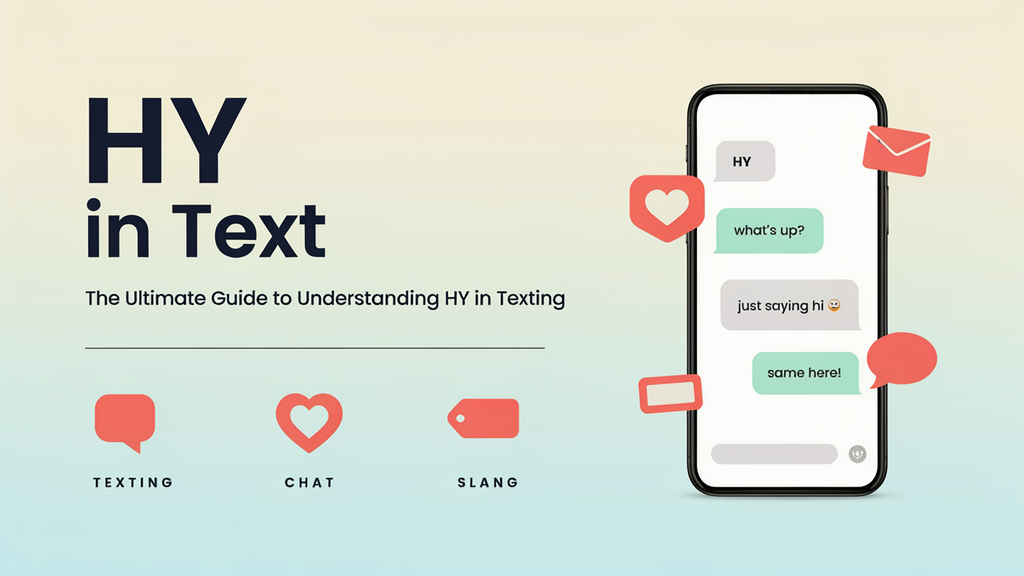
Understanding HY does not require memorizing a complicated definition. In many casual conversations, it can represent an informal “hi,” but the abbreviation may also be a typo or have another meaning. The safest interpretation always comes from examining the complete message.
- 👋 Start by checking whether HY appears at the beginning of the message. When it opens a personal conversation, it is more likely to function as an informal greeting.
- 🧠 Read the words surrounding HY before deciding what it means. Context provides information that a two-letter abbreviation cannot provide by itself.
- 💬 Consider the relationship between sender and recipient. Friends commonly use informal shorthand, while professional relationships generally require clearer communication.
- 📱 Think about the platform where HY appears. Social media and personal messaging encourage informal language more than formal documents or business correspondence.
- 🔎 Look for repeated usage from the same person. If HY consistently appears as their opening greeting, their personal pattern is strong evidence of its intended meaning.
- 😊 Do not assume every HY is intentional slang. Typing mistakes are common, particularly in short messages sent quickly from mobile devices.
- 🌐 Remember that online slang is not universal. Expressions can differ between communities, platforms, regions, age groups, and individual friend groups.
- 👀 If HY appears in a specialized conversation, investigate the topic before choosing a definition. Technical or community-specific meanings may exist outside ordinary texting.
- ✨ Standard language remains the safest option when writing your own messages. “Hi” is immediately recognizable and does not require the recipient to interpret shorthand.
- 🤝 If you receive HY and believe it is a greeting, respond naturally. “Hi!” or “Hey!” is usually enough to acknowledge the message.
- 💖 Do not assign emotional meaning to HY by itself. Whether a message is romantic, friendly, concerned, or excited depends on the words and relationship surrounding the abbreviation.
- 🗨️ Punctuation can provide useful clues. “HY!” is visually different from HY appearing inside a longer sentence, and the difference can help identify the sender’s intention.
- 📲 Emojis may also clarify tone. A smiling or waving emoji can make a short greeting feel warmer and more obviously friendly.
- 🌼 If you remain uncertain, asking for clarification is perfectly reasonable. A quick question can prevent a misunderstanding and keep the conversation honest.
- 😎 Informal spelling is not necessarily incorrect within casual communication. People often adapt language to suit speed, personality, humor, and social relationships.
- 💡 When explaining HY to another person, describe it as context-dependent rather than claiming that it always has one fixed definition. This provides a more accurate understanding of online language.
- 🌟 If you are learning English texting slang, focus on common expressions first. Highly context-dependent abbreviations can be harder to interpret because their usage varies between people.
- 🔤 Compare HY with HI when needed. HI is the standard greeting, while HY may be an informal spelling, personal shortcut, or typo.
- 🌐 Digital communication changes continuously. An abbreviation’s popularity or meaning can shift, so current context is often more useful than relying on an old slang list.
- 🧩 The simplest rule is to consider the whole conversation rather than the letters alone. HY may be a casual greeting in one message and something completely different in another context.
FAQs
What does HY mean in text?
HY commonly appears as an informal or shortened version of “hi” in casual texting. However, it can also be a typo or context-specific abbreviation, so the surrounding message should always be considered.
2. Is HY a slang word?
HY can be considered informal texting shorthand in some conversations, but it is not as standardized as widely recognized slang abbreviations such as LOL or IDK. Its meaning can vary between users.
Does HY mean hi?
In many casual personal messages, HY may be intended to mean “hi.” If it appears at the beginning of a friendly conversation, the greeting interpretation is particularly likely.
What does HY mean on Snapchat?
On Snapchat, HY may function as a quick greeting in a direct message. There is not necessarily one universal Snapchat-specific meaning, so the surrounding conversation remains important.
What does HY mean on Instagram?
HY may be used in Instagram DMs as an informal greeting similar to “hi.” Users sometimes shorten or alter words in casual social media conversations for convenience.
What does HY mean on WhatsApp?
On WhatsApp, HY can be used as a casual greeting, especially between friends and acquaintances. Its meaning may depend on the sender’s personal texting habits and the surrounding conversation.
How should I respond to HY?
If HY appears to mean “hi,” you can simply respond with “Hi!”, “Hey!”, or “Hey, what’s up?” If the message is unclear, asking the sender what they mean is also appropriate.
Is HY the same as HI?
HY and HI may serve the same purpose when HY is being used as an informal greeting. However, HI is the standard spelling and is much more universally recognized.
Can HY be a typo?
Yes. HY can be an accidental typing error, particularly if the sender normally writes “hi” and suddenly uses HY. Looking at their usual communication style can help determine whether it was intentional.
Should I use HY in professional messages?
It is generally better to use “Hi” or “Hello” in professional communication. HY is informal and may be unfamiliar to some readers, while standard greetings are clearer and more appropriate for workplace settings.
Conclusion
Understanding HY in text is mainly a matter of context. In many casual conversations, it can be an informal way to write “hi,” especially when it appears at the beginning of a friendly message. However, it can also be a typo, personal shorthand, or another abbreviation depending on the conversation.
When you see HY in a message, look at the surrounding words, the platform, the relationship between the people, and the sender’s usual communication style. If it clearly functions as a greeting, a simple “Hi” or “Hey” is usually the best response. For your own professional messages, standard greetings are generally clearer and safer.
Read More Grey Heart Emoji Meaning: What It Really Says in Chats and Social Media 2026