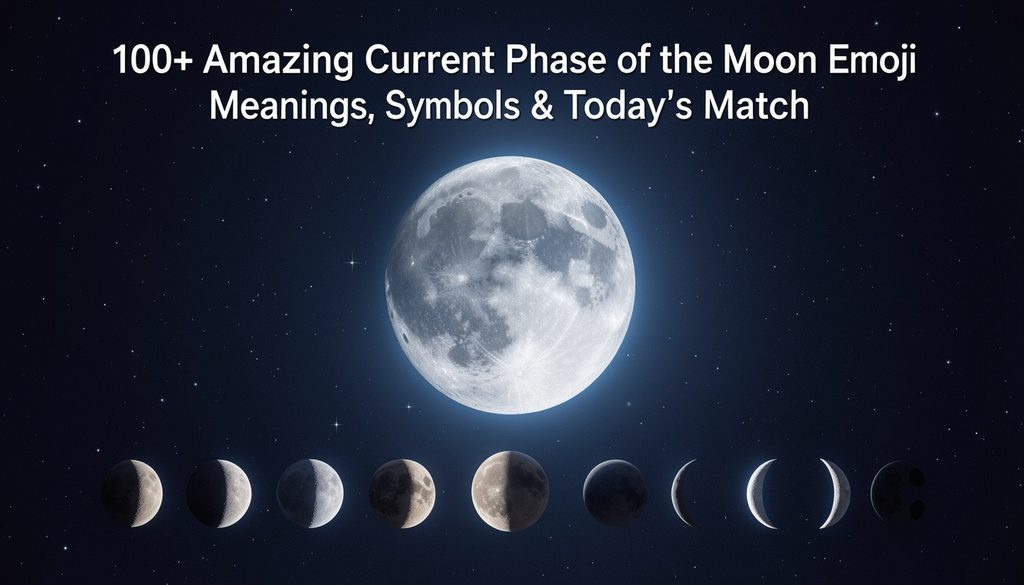
The Current Phase of the Moon Emoji can make lunar information much easier to understand, especially when you want to compare an emoji with the Moon you can actually see in the sky. From the dark 🌑 new moon to the bright 🌕 full moon, each symbol represents a different stage of the lunar cycle.
Moon emojis are also popular in texting, captions, astrology discussions, calendars, and social media posts. However, an emoji is a simplified visual symbol, so it does not always show the exact real-time lunar phase or illumination percentage. Understanding the eight lunar phases helps you choose the right symbol with confidence.
🌑 New Moon Emoji Meaning and Symbolism
The new moon marks the beginning of a lunar cycle and occurs when the Moon is positioned between Earth and the Sun, making the illuminated side mostly invisible from Earth. The 🌑 emoji commonly represents darkness, beginnings, reflection, mystery, and fresh starts.
🌑 The new moon emoji represents a quiet beginning rather than an ending. It is often used for fresh goals, private thoughts, and moments when you want to start again without announcing every detail. 🌙✨
🌌 A dark Moon can symbolize a blank page waiting for a new story. In conversations, 🌑 may express mystery, silence, privacy, or the peaceful feeling of beginning something completely new.
🌱 The new moon is often associated with intention-setting and personal reflection. Using 🌑 in a caption can suggest that you are planting an idea today and patiently waiting to see how it grows. ✨
🖤 When someone sends a new moon emoji, the meaning may feel mysterious or understated. It can communicate a dark aesthetic, calm mood, hidden emotions, or simply an appreciation for lunar symbolism.
🌑 The new moon does not mean the Moon has disappeared from space. It means the illuminated portion facing Earth is difficult or impossible to see, making this phase an interesting example of changing lunar illumination.
🌙 A new moon often feels like nature pressing a reset button. The 🌑 symbol works beautifully for messages about reflection, new chapters, quiet intentions, and leaving yesterday’s worries behind.
✨ In spiritual conversations, the new moon can represent renewal and intention. The emoji may therefore appear beside words about manifestation, planning, journaling, meditation, or creating a fresh direction.
🌑 The dark circular symbol is especially useful when discussing lunar calendars. It gives readers an immediate visual clue that the conversation concerns the beginning of the Moon’s approximately monthly cycle.
🕯️ A new moon mood can feel peaceful and private. The 🌑 emoji fits messages about turning inward, taking a break from noise, and giving yourself space to think before making your next move.
🌠 If you are creating a moon phase chart, 🌑 should appear first. It provides a simple visual starting point before the Moon gradually becomes more illuminated during the waxing phases.
🌑 The new moon can symbolize possibility because nothing appears fully formed yet. It is a useful emoji for describing plans that are still developing, quiet ambitions, or hopes that have not been revealed.
🌿 Many people connect the new moon with reflection and renewal. While these associations are cultural or spiritual rather than scientific definitions, they make 🌑 a popular symbol in modern lunar-themed content.
🌙 In texting, the new moon emoji can create a mysterious atmosphere without requiring many words. Pairing 🌑 with a short message can make a simple thought feel more thoughtful, calm, or intriguing.
✨ A new moon is an excellent symbol for a personal reset. Whether you are starting a project, changing a habit, or simply choosing a calmer mindset, 🌑 can visually represent the beginning of that journey.
🖤 The 🌑 emoji sometimes appears in aesthetic posts because its dark appearance works well with nighttime themes. It can complement photographs of stars, quiet landscapes, evening skies, or minimalist designs.
🌑 When discussing the actual lunar phase, remember that the emoji is symbolic. The precise astronomical phase depends on the Moon’s position and timing, not simply on how an emoji looks.
🌱 The new moon encourages a useful metaphor: growth begins before it becomes visible. That makes 🌑 especially meaningful for messages about patience, personal development, and goals that are still taking shape.
🌌 A dark Moon beside a night-sky message can communicate wonder without explaining everything. It is a simple symbol that invites curiosity about the lunar cycle and the changing appearance of our natural satellite.
🕊️ The new moon can represent quietness and emotional space. In a personal caption, 🌑 may suggest stepping away from distractions, listening to yourself, and preparing mentally for whatever comes next.
🌑 If you need one emoji to represent lunar beginnings, this is the clearest choice. It visually introduces the lunar cycle while also carrying popular themes of mystery, renewal, privacy, and possibility. ✨
🌒 Waxing Crescent Emoji Meaning and Symbolism
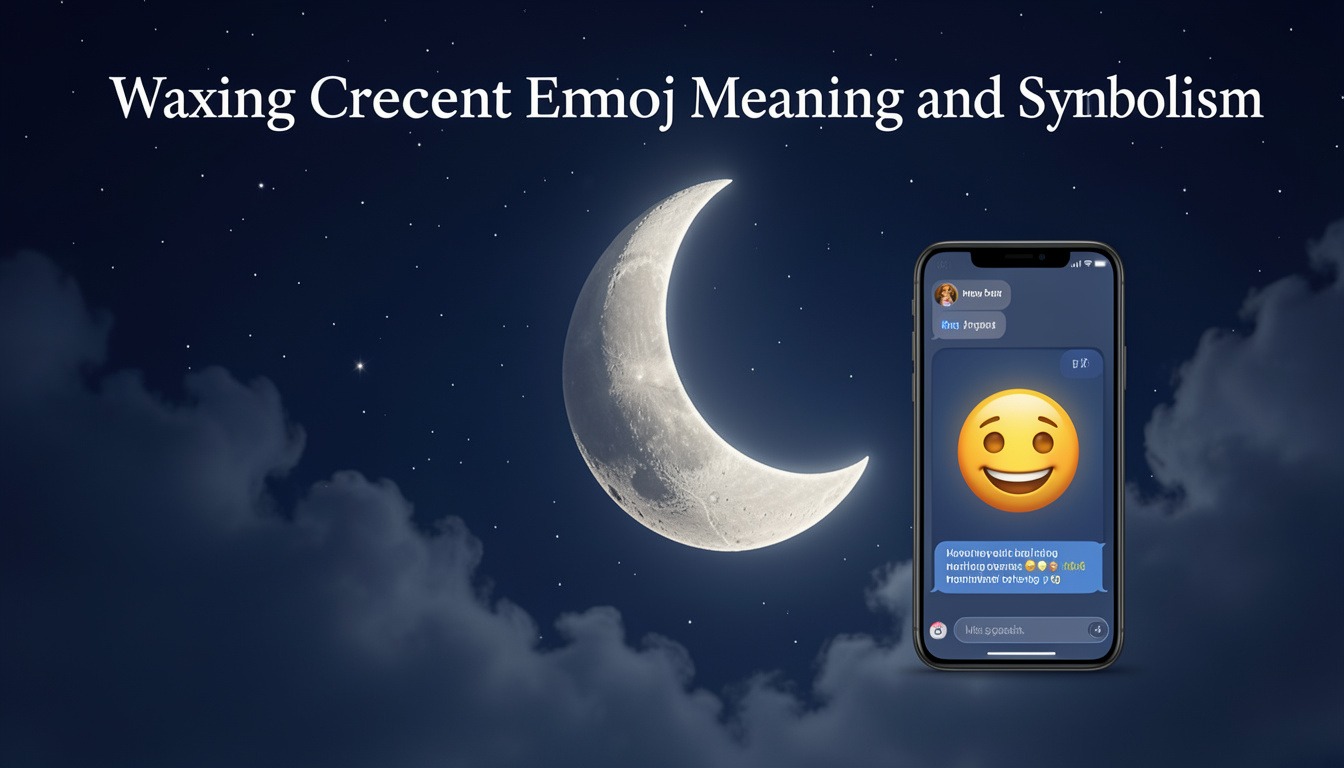
The waxing crescent follows the new moon as a small illuminated portion becomes visible. The 🌒 emoji is commonly associated with growth, progress, hope, and gradual change. Astronomically, “waxing” means the visible illuminated portion is increasing.
🌒 The waxing crescent represents the first visible steps after the new moon. It can symbolize progress that is still small but meaningful, reminding us that major changes often begin with something barely noticeable. 🌱
✨ A thin crescent can carry a strong message of hope. The 🌒 emoji works well when you want to show that light is returning, progress is happening, and better days may gradually be approaching.
🌙 The waxing crescent is a beautiful symbol for early growth. It reminds us that something does not need to be complete to be valuable, especially when a small beginning is moving in the right direction.
🌒 In social media captions, this emoji can represent a new journey. It fits posts about learning, personal goals, creative projects, fresh opportunities, and other experiences that are developing one step at a time.
🌱 The word “waxing” means increasing, so 🌒 is naturally connected with growth. It can be used metaphorically when discussing confidence, knowledge, relationships, or ambitions that are becoming stronger.
🌌 A crescent Moon often creates a peaceful nighttime aesthetic. The 🌒 emoji pairs naturally with posts about evening walks, quiet skies, thoughtful moments, and the beauty of watching the lunar cycle change.
💫 The waxing crescent can represent optimism because the visible light is increasing. It offers a gentle reminder that progress does not have to happen quickly to remain meaningful.
🌒 When someone uses this emoji in a message, the meaning depends on context. It might refer literally to the Moon, or it may simply communicate a mysterious, dreamy, nighttime, or celestial mood.
🌿 The waxing crescent is useful for describing gradual transformation. Just as the illuminated portion increases over several nights, personal change can happen quietly before anyone else notices the difference.
🌙 A moon phase chart usually places the waxing crescent shortly after the new moon. Its distinctive curved shape makes it one of the easiest lunar symbols to recognize.
✨ If your caption is about building something slowly, 🌒 can provide a natural visual metaphor. It suggests that the journey has started and that more development is still ahead.
🌒 The crescent shape is sometimes confused with a general “moon” symbol. However, a waxing crescent specifically indicates that the illuminated portion is increasing toward the first quarter phase.
🌱 The waxing crescent can symbolize patience because its progress is gradual. It reminds us that meaningful growth often happens through small actions repeated consistently rather than through one dramatic moment.
🌌 For astronomy content, 🌒 can introduce an explanation of lunar illumination. The Moon does not create its own visible light; sunlight illuminates its surface, producing the changing phases we observe.
💛 A growing Moon can also become a symbol of encouragement. Using 🌒 beside a supportive message suggests that even a small amount of progress deserves recognition.
🌒 In astrology-themed posts, people may use the waxing crescent to discuss intention, momentum, or development. These interpretations are symbolic rather than scientific descriptions of what the lunar phase causes.
🌙 The waxing crescent has a distinctive visual appeal because only a slim portion is illuminated. It works particularly well in minimalist designs, celestial artwork, planners, and lunar-themed captions.
✨ When comparing moon emojis with the actual sky, remember that the emoji may be standardized rather than location-specific. Your local Moon can have a different appearance depending on date, time, and viewing conditions.
🌒 The waxing crescent offers a simple message: keep going. The light may still be small, but it is moving toward a fuller appearance, making this emoji a natural symbol of continued progress.
🌱 Whether used literally or metaphorically, 🌒 suggests something is becoming more visible. It is ideal for captions about beginnings, hopeful change, steady growth, and the excitement of seeing a new possibility develop.
🌓 First Quarter Moon Emoji Meaning and Symbolism
The first quarter Moon occurs when roughly half of the Moon’s visible disk appears illuminated. Despite its name, the Moon is only one-quarter of the way through its orbital cycle. The 🌓 emoji commonly represents balance, progress, decision-making, and forward movement.
🌓 The first quarter Moon marks an important point in the lunar cycle. About half of the visible lunar disk appears bright, making this phase a natural symbol for balance between darkness and light. ⚖️
🌗 The half-lit appearance can represent a choice between two directions. In symbolic writing, 🌓 may suggest decision-making, personal balance, or standing between what has already happened and what comes next.
✨ The first quarter is a strong visual reminder that progress is not always complete. Half of the visible face may be illuminated, yet the lunar journey continues toward the full moon.
🌓 In astronomy discussions, this phase is especially easy to recognize. The Moon appears roughly half illuminated, providing a useful reference point when learning how the eight major lunar phases fit together.
🌙 The first quarter emoji works well for captions about momentum. It can represent reaching a meaningful checkpoint while still having more work, learning, or growth ahead.
🌱 A half moon can symbolize progress that has become visible. If the new moon represents the beginning, 🌓 suggests that your efforts are now producing results that others can see.
💭 In reflective conversations, 🌓 may represent mixed feelings. Its combination of light and darkness can visually express uncertainty, transition, or the idea that two truths can exist at the same time.
🌌 The first quarter phase is part of the waxing half of the lunar cycle. After this point, the illuminated portion continues increasing until the full moon appears.
🌓 For a moon phase chart, this symbol is an excellent midpoint marker. It helps readers understand the transition from a thin waxing crescent toward the larger illuminated shape of the waxing gibbous.
✨ A first quarter Moon can symbolize confidence because visible progress has already occurred. It is a fitting emoji for celebrating milestones without pretending the entire journey is finished.
🌓 When used in texting, the emoji may simply create a celestial aesthetic. Context matters because moon symbols can communicate literal astronomy, nighttime feelings, mystery, or personal symbolism.
🌙 The first quarter is not the same as a half moon caused by Earth’s shadow. The apparent division comes from our viewing angle as sunlight illuminates different portions of the Moon’s surface.
⚖️ The balanced appearance of 🌓 makes it popular for themes involving harmony. It can accompany thoughts about finding stability between work and rest, ambition and patience, or independence and connection.
🌱 The first quarter phase can remind us to evaluate progress. You may not have reached your goal yet, but the visible change can be evidence that consistent effort is working.
🌌 A first quarter Moon is often easier to observe than a new moon because its illuminated surface is clearly visible. This makes it useful for beginner skywatchers learning to identify lunar phases.
🌓 In symbolic captions, the half-lit Moon can represent an unfinished story. It suggests that some parts are already clear while other pieces are still waiting to reveal themselves.
✨ The first quarter emoji can fit milestone posts especially well. Whether you have completed half a project or simply reached an important checkpoint, 🌓 visually communicates movement and progress.
🌙 The lunar cycle is continuous, so the first quarter is not a permanent state. Its appearance changes as the Moon continues orbiting Earth and our viewing geometry shifts.
🌓 If you want a moon emoji that communicates “I am halfway there,” this symbol is a natural choice. It combines recognizable lunar imagery with an easy metaphor for progress and balance.
🌱 The first quarter phase encourages steady action. The Moon is brighter than before but not yet full, making 🌓 a useful reminder that meaningful achievements often happen through stages rather than instant transformation.
🌔 Waxing Gibbous Emoji Meaning and Symbolism
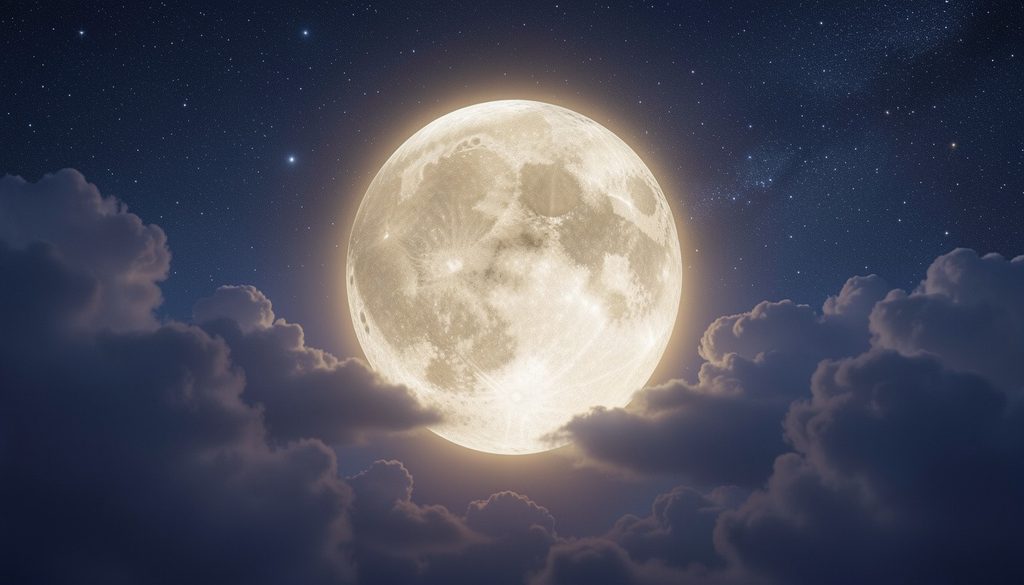
The waxing gibbous phase occurs after the first quarter and before the full moon. More than half of the visible Moon is illuminated, and the bright portion continues growing. The 🌔 emoji often represents preparation, momentum, anticipation, and increasing visibility.
🌔 The waxing gibbous Moon shows that illumination is continuing to increase. It can symbolize strong progress, growing confidence, and the exciting feeling that an important moment is getting closer. ✨
🌙 This phase appears fuller than the first quarter but has not yet reached the full moon. That makes 🌔 a useful metaphor for being close to a goal while still having a little distance to travel.
🌱 The waxing gibbous can represent development that is becoming obvious. A project, relationship, skill, or personal goal may have moved beyond its earliest stage and started showing clear results.
🌔 In a lunar phase chart, this symbol sits directly between the first quarter and full moon. Its larger illuminated portion makes it easy to identify once you understand the sequence of the lunar cycle.
💫 The anticipation associated with a growing Moon makes 🌔 suitable for exciting captions. It can express the feeling that something important is approaching and that your preparation is finally beginning to pay off.
🌌 For skywatchers, a waxing gibbous Moon can be especially noticeable in the evening. Its bright surface provides a striking sight against a darker sky, depending on local conditions and timing.
🌔 The symbol can communicate “almost there” without suggesting completion. It is ideal for messages about reaching the final stages of a project, preparing for an event, or approaching a personal milestone.
✨ A growing lunar disk reminds us that change can happen gradually. The Moon does not suddenly become full; its visible illumination increases night after night.
🌙 In texting, 🌔 may simply mean that someone loves the Moon or nighttime atmosphere. The exact emotional meaning comes from the surrounding conversation rather than from a universal emoji definition.
🌱 The waxing gibbous phase can represent building momentum. When your efforts begin producing consistent results, this emoji can serve as a visual reminder to keep moving forward.
🌔 The word “gibbous” describes a Moon that appears more than half illuminated but less than completely illuminated. It is an important term for anyone learning the eight primary lunar phases.
🌌 A waxing gibbous Moon is scientifically connected to increasing visible illumination, not to the Moon physically growing larger. The Moon’s actual size remains essentially the same while our viewing angle changes.
💛 Symbolically, 🌔 can represent confidence that is still developing. You have already come far enough to see meaningful progress, but there remains room to improve before reaching the desired outcome.
🌔 For social media captions, this emoji pairs naturally with themes of ambition and anticipation. It can add a subtle celestial touch without distracting from the main message.
✨ The waxing gibbous phase reminds us that nearly complete is still valuable. Waiting for perfection can hide the progress already achieved, while 🌔 celebrates the stage just before completion.
🌙 If you are matching emojis to actual phases, use 🌔 when the Moon is between first quarter and full moon. For precise matching, always check the date and local lunar data rather than relying only on appearance.
🌱 A waxing gibbous can represent preparation before a major reveal. The bright surface is becoming dominant, creating a natural metaphor for ideas, plans, and achievements moving toward visibility.
🌔 The emoji has a balanced visual appearance because darkness remains while light dominates. That contrast can support messages about resilience, transformation, and continuing forward even when some uncertainty remains.
💫 The waxing gibbous phase carries a sense of approaching completion. It works beautifully for captions celebrating progress, upcoming achievements, new opportunities, and goals that are finally beginning to feel within reach.
🌔 If the first quarter says “I have made progress,” the waxing gibbous can suggest “I am nearly there.” It is a useful symbol for momentum, anticipation, preparation, and visible growth.
🌕 Full Moon Emoji Meaning and Symbolism
The full moon occurs when the Moon’s Earth-facing side is fully illuminated from our perspective. The 🌕 emoji is widely recognized as a bright full moon and can symbolize completion, clarity, celebration, beauty, mystery, and nighttime.
🌕 The full moon is the most recognizable lunar symbol because its visible disk appears completely illuminated. It often represents completion, clarity, celebration, and the beauty of a bright night sky. ✨
🌕 A full moon marks the midpoint of the lunar cycle’s visible progression from new moon toward waning phases. Its bright appearance makes it especially popular in moon photography, captions, calendars, and artwork.
🌌 The full moon emoji can create an instant nighttime atmosphere. Add 🌕 to a caption about evening walks, peaceful skies, stargazing, or quiet moments outdoors for a simple celestial effect.
✨ Many traditions attach symbolic meanings to the full moon, including renewal, reflection, and celebration. These cultural interpretations vary, so they should not be confused with scientific explanations of lunar phases.
🌕 In texting, the full moon emoji may communicate beauty or fascination with the night. Sometimes it is simply an aesthetic choice, especially when someone wants a message to feel dreamy or celestial.
🌙 The full moon occurs when Earth is positioned approximately between the Sun and Moon, allowing the Earth-facing lunar hemisphere to receive sunlight. The exact geometry is more precise than the simple diagram suggests.
💫 A bright full moon can symbolize reaching a goal. Its complete appearance makes 🌕 a natural metaphor for finishing a long journey, celebrating progress, or finally seeing an idea clearly.
🌕 When people search for a moon phase today emoji, they may expect the emoji to show the exact current Moon. However, 🌕 should only be used for the actual full moon phase.
🌌 Full moons are excellent opportunities for skywatching because the illuminated lunar surface is easy to recognize. Binoculars can reveal details, although the brightness can make some subtle surface features harder to observe.
🌕 The full moon is not the largest physical size the Moon reaches during its orbit. Its apparent brightness and shape change mainly because of illumination geometry and viewing conditions.
✨ In social media captions, 🌕 can represent a memorable night. It works naturally with photography, travel posts, peaceful reflections, romantic messages, and descriptions of beautiful evening scenery.
🌙 A full moon can also represent emotional intensity in literature and popular culture. Such associations are creative or cultural rather than evidence that the Moon directly creates particular human emotions.
🌕 If you are creating a moon emoji chart, this symbol belongs at the center between waxing gibbous and waning gibbous. It provides the clearest visual marker of maximum apparent illumination.
💛 The full moon can symbolize clarity after uncertainty. A bright lunar disk emerging after several changing phases provides an appealing metaphor for understanding something that once felt confusing.
🌌 The phrase “bright full moon” describes what many observers notice immediately. Urban lighting, clouds, atmospheric conditions, and viewing location can still affect how impressive the Moon looks.
🌕 In lunar calendars, the full moon is an important recurring marker. Different cultures have historically given particular full moons names connected with seasons, weather, agriculture, or local traditions.
✨ The full moon emoji is especially effective when you want one simple symbol to communicate “night.” Its round, bright appearance is immediately recognizable even without additional context.
🌙 A full moon does not stay perfectly full for several nights, although it may look nearly full around the exact date. Astronomically, the precise full moon is a specific moment in the lunar cycle.
🌕 For captions about achievement, this emoji can suggest that your hard work has reached its brightest stage. It carries a sense of completion without requiring a long explanation.
💫 Whether you use it scientifically or creatively, 🌕 remains one of the most versatile moon symbols. It can represent lunar illumination, nighttime beauty, celebration, clarity, completion, or simple admiration for the Moon.
🌖 Waning Gibbous Emoji Meaning and Symbolism
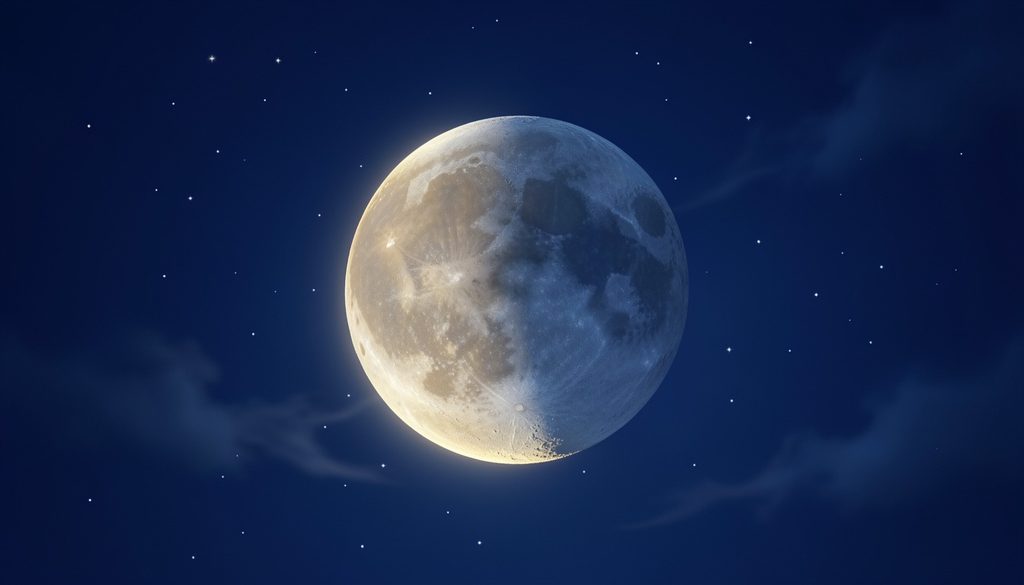
The waning gibbous follows the full moon as the visible illuminated portion begins decreasing. The 🌖 emoji shows more than half of the Moon illuminated, but the bright portion is shrinking. It can symbolize reflection, release, maturity, and gradual transition.
🌖 The waning gibbous marks the beginning of decreasing visible illumination after the full moon. Symbolically, it can represent reflection, slowing down, release, and appreciating progress before moving into a new phase. 🌙
🍂 A waning Moon can provide a natural metaphor for letting go. The 🌖 emoji works well beside messages about releasing old habits, making peace with the past, or creating space for something new.
🌖 Although the Moon still appears mostly illuminated, its brightness is gradually decreasing. This makes the phase a reminder that change does not always mean immediate disappearance; transformation can happen slowly.
🌌 The waning gibbous is easy to confuse with the waxing gibbous because both show more than half illumination. The key difference is direction: waxing means increasing light, while waning means decreasing light.
🌖 In a moon phase chart, this phase appears directly after the full moon. Its position makes it an important step in understanding how the lunar cycle gradually returns toward darkness.
✨ A waning gibbous can symbolize wisdom gained after reaching a peak. Once a major milestone has passed, there is value in pausing, reflecting, and understanding what the experience taught you.
🌙 In texting, 🌖 may create a calm and thoughtful mood. It can accompany messages about quiet nights, reflection, personal growth, or simply appreciation for changing lunar shapes.
🍃 The decreasing illumination can represent simplifying life. Instead of always adding more, a waning Moon can inspire the idea of removing distractions and keeping what genuinely matters.
🌖 The astronomical meaning is straightforward: the visible illuminated portion is decreasing. The symbolic meanings attached to this phase depend on personal, cultural, or spiritual interpretation.
🌌 For astronomy learners, distinguishing waxing from waning is an important skill. Looking at the direction of the illuminated portion in relation to your location can help, although orientation differs between hemispheres.
🌖 This emoji can represent a period after achievement when reflection becomes important. Reaching a goal is meaningful, but understanding the journey can be equally valuable.
✨ A waning gibbous does not mean the Moon is becoming physically smaller. The apparent change comes from the changing angle between the Sun, Earth, and Moon as the lunar cycle continues.
🌙 If your caption discusses slowing down after a busy period, 🌖 provides a fitting celestial image. It communicates transition without making the message feel overly dramatic.
🍂 The phase can symbolize graceful endings. Some chapters naturally become quieter after reaching their peak, and the waning gibbous offers a visual reminder that change is part of every cycle.
🌖 The Moon remains bright during this stage, which makes the symbolism especially interesting. Something can be changing or decreasing while still holding substantial beauty, strength, and visibility.
🌌 In a lunar calendar, the waning gibbous helps users understand that the full moon has passed. It provides context for planning observations and recognizing the Moon’s changing appearance.
✨ A thoughtful message beside 🌖 can encourage people to appreciate what they have learned. Growth is not only about reaching a peak; it is also about understanding what comes afterward.
🌖 For social media, the emoji works with photographs of late-night skies and reflective captions. Its shape instantly communicates that the Moon is in a later stage of its monthly cycle.
🌿 The waning gibbous can represent gentle release rather than sudden endings. It suggests allowing unnecessary things to fade naturally while making room for greater clarity and peace.
🌖 If the waxing gibbous represents approaching fullness, the waning gibbous represents moving away from it. Together, these phases show how the lunar cycle continually changes between increasing and decreasing illumination.
🌗 Last Quarter Moon Emoji Meaning and Symbolism
The last quarter Moon occurs when approximately half of the visible lunar disk is illuminated again, but the opposite side is bright compared with the first quarter. The 🌗 emoji can represent transition, review, balance, and preparation for renewal.
🌗 The last quarter Moon visually resembles the first quarter but has illumination on the opposite side. This difference marks an important transition as the lunar cycle moves toward another new moon. 🌙
⚖️ The half-lit appearance makes 🌗 a natural symbol of balance. It can represent reviewing your choices, weighing experiences, and deciding what deserves attention during the next stage.
🌗 In astronomy, the last quarter is not the end of the Moon’s existence or orbit. It is simply another recognizable stage in the repeating lunar cycle.
🍂 The last quarter can symbolize release because the Moon is moving toward the waning crescent. It fits reflective messages about simplifying priorities, completing unfinished work, and preparing for a fresh beginning.
🌙 A moon phase chart becomes easier to understand when first quarter and last quarter are compared side by side. Their similar half-lit shapes differ because the illuminated side faces opposite directions.
✨ The last quarter is useful as a metaphor for evaluation. You have already experienced much of the cycle, so this phase can represent pausing to consider what worked and what should change.
🌗 In texting, this emoji can communicate a quiet nighttime aesthetic. It may also express a thoughtful mood without necessarily carrying a specific symbolic meaning.
🌌 The last quarter Moon is visible during a different part of the day than the first quarter. Its timing reflects its changing position relative to Earth and the Sun.
🌿 A waning half moon can suggest simplifying rather than expanding. It works well for messages about decluttering, setting boundaries, resting, or removing commitments that no longer serve you.
🌗 The scientific meaning is based on illumination geometry, not Earth’s shadow. Moon phases occur because we see different portions of the sunlit lunar surface as the Moon orbits Earth.
🍃 The last quarter can represent a checkpoint before renewal. It offers a useful reminder that finishing one stage can create the space needed for the next stage to begin.
🌗 When used in captions, this symbol can give a calm and mature tone. It suits reflective writing more naturally than highly energetic messages about new beginnings.
✨ A half-lit Moon can represent partial understanding. Sometimes you know enough to move forward while still accepting that certain answers will become clearer with time.
🌙 The last quarter is one of the eight major lunar phases. Learning its position helps distinguish the full sequence from new moon through waxing and waning stages.
🌗 For moon photography, the last quarter can reveal strong contrasts along the lunar surface. The boundary between light and darkness, called the terminator, can make surface details visually interesting.
🍂 The phase can symbolize mature change because the Moon has already passed its brightest point. It encourages reflection without suggesting that the journey has stopped.
🌌 If you are matching an emoji to an actual phase, 🌗 should correspond to the last quarter rather than the first quarter. Checking reliable lunar data is best when accuracy matters.
🌗 The last quarter also reminds us that lunar cycles repeat. A period of decreasing illumination eventually leads to another new moon and the beginning of another cycle.
✨ This emoji can fit a message about closing a chapter thoughtfully. It suggests that endings can be intentional, peaceful, and useful rather than something to fear.
🌙 Whether used literally or symbolically, 🌗 represents transition with remarkable simplicity. It shows that the Moon can look half illuminated while still moving through a larger continuous cycle.
🌘 Waning Crescent Emoji Meaning and Symbolism
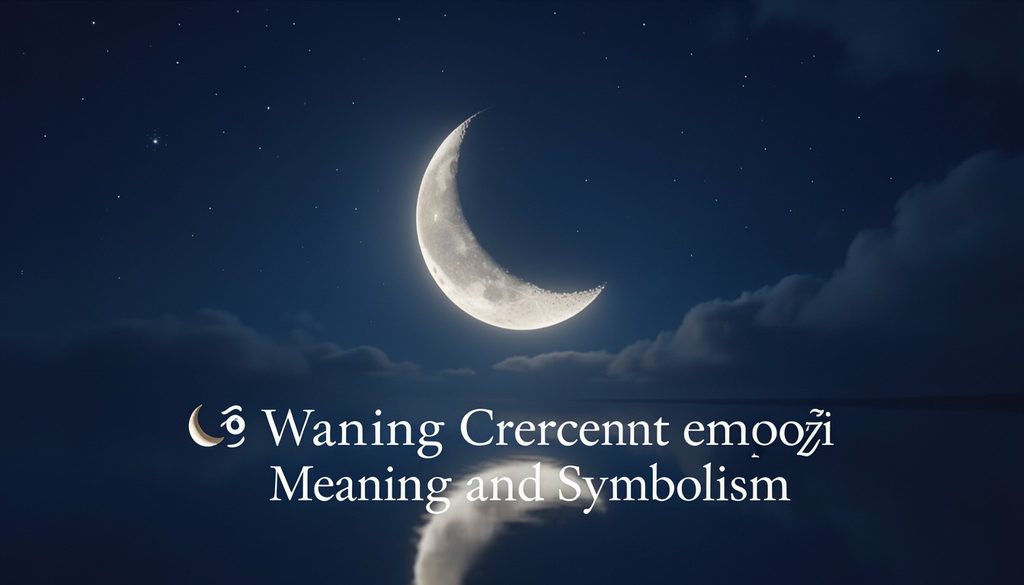
The waning crescent is the final major phase before the new moon. Only a thin portion of the lunar surface appears illuminated, and the visible light is decreasing. The 🌘 emoji often represents closure, rest, reflection, and preparation.
🌘 The waning crescent is the final visible stage before the new moon. Its thin illuminated edge can symbolize closure, rest, quiet reflection, and preparing yourself for another beginning. 🌙
🍃 A fading crescent provides a gentle metaphor for letting go. It can represent releasing unnecessary worries, finishing a chapter, and allowing an old phase of life to become quieter.
🌘 The Moon is still present even when only a small portion appears illuminated. This makes the emoji a useful reminder that something can become less visible without completely disappearing.
🌌 In the lunar cycle, the waning crescent comes after the last quarter. Its illumination continues decreasing until the Moon reaches the new moon phase again.
🌙 The thin crescent shape is visually delicate, making 🌘 popular in nighttime aesthetics. It can complement captions about peaceful evenings, reflection, solitude, dreams, and quiet moments.
✨ A waning crescent can represent preparation rather than an absolute ending. The lunar cycle is about to restart, so the darkness ahead also contains the possibility of a new beginning.
🌘 When used in texting, the emoji may express a dreamy or mysterious mood. Its exact meaning depends on the conversation and may have little connection to astronomy.
🍂 The final crescent can symbolize simplifying your life. As the visible light decreases, the metaphor encourages focusing on essentials rather than carrying every old responsibility forward.
🌌 For beginner astronomers, recognizing the waning crescent completes the basic eight-phase sequence. It helps connect the late lunar cycle with the upcoming new moon.
🌘 The scientific meaning is based on decreasing visible illumination. The Moon itself is not becoming less physically substantial; only the portion lit and visible from Earth is changing.
🌙 A waning crescent works beautifully for reflective captions. It can suggest taking time to breathe, review your experiences, and prepare emotionally before starting another chapter.
✨ The final crescent may symbolize peaceful closure instead of dramatic endings. Some changes happen quietly, gradually, and naturally, much like the Moon’s slow transition toward darkness.
🌘 In a moon phase chart, this emoji should appear immediately before the new moon. It visually completes the sequence and connects the end of one cycle to the beginning of another.
🍃 The waning crescent can represent rest after a long journey. It offers a symbolic invitation to slow down before committing energy to another round of goals and responsibilities.
🌌 The thin crescent may be visible shortly before sunrise depending on the time and location. Local conditions, horizon visibility, and weather all affect whether observers can see it clearly.
🌘 If you are writing about the lunar cycle meaning, this phase demonstrates that endings and beginnings are connected. The Moon does not simply stop; it continuously moves through repeating stages.
✨ A fading Moon can symbolize emotional release. It may fit a message about forgiving yourself, moving forward, and leaving behind something that no longer belongs in your current chapter.
🌙 The waning crescent is sometimes called a thin crescent because only a small portion appears lit. This visual description helps distinguish it from the brighter waxing crescent.
🍂 For social media captions, 🌘 can communicate a soft nighttime mood without requiring elaborate symbolism. It works particularly well with minimalist photographs and reflective personal writing.
🌘 The final crescent offers one of the lunar cycle’s most meaningful visual transitions. It reminds us that quiet endings can create room for new beginnings, making change feel natural rather than frightening.
🌙 Moon Phase Emojis, Symbols, and Today’s Match
Moon phase emojis are useful visual shortcuts, but they should not automatically be treated as precise astronomical indicators. The eight common symbols correspond to major lunar phases, while an accurate “today’s match” requires checking the current date, local time, and lunar illumination.
🌙 Moon emojis are excellent visual symbols, but they are not automatically live moon trackers. If you need today’s exact lunar phase, compare the emoji with reliable astronomical data for your date and location. 🔭
📅 A lunar calendar can tell you when major phases occur, while an emoji chart helps you understand their visual appearance. Using both together makes it easier to identify the correct symbol.
🌑🌒🌓🌔🌕🌖🌗🌘 The eight common phase emojis provide a simple sequence from new moon to waning crescent. They are useful for educational content, captions, planners, and quick visual references.
🔭 A moon phase calculator can provide more precise information than an emoji alone. It can account for the date and location needed to determine the Moon’s current stage.
🌙 When someone searches for the current moon phase emoji, they may want the symbol that best matches what is visible today. That requires checking current astronomical information rather than guessing from the emoji sequence.
📱 Moon phase apps can display changing illumination and upcoming lunar events. They are especially useful for people who want regular reminders instead of checking a lunar calendar manually.
🌕 The Moon’s appearance changes continuously, even though the traditional system divides the cycle into eight major phases. This means an emoji can only provide a simplified representation of a more gradual process.
🌗 The same lunar phase can appear oriented differently depending on where you are on Earth. Observers in the Northern and Southern Hemispheres can see the illuminated side oriented differently in the sky.
🔭 “Today’s match” should therefore be treated as a location-sensitive question. Date, local time, and viewing location can affect which lunar appearance you should expect.
🌙 Emoji symbols are designed for communication, not astronomical measurement. They are convenient visual icons, but they do not normally display an exact moon illumination percentage.
📊 If accuracy matters, check the Moon’s phase and illumination separately. Two dates can both be described as crescent phases while having noticeably different percentages of visible illumination.
🌑 A new moon emoji is appropriate when the Moon is at or extremely close to the new moon phase. It should not be used simply because the Moon is difficult to see because of clouds or city conditions.
🌕 Likewise, a full moon emoji should describe the full moon phase rather than any night when the Moon appears bright. The actual full moon is defined by lunar geometry.
📱 A moon tracker can be helpful for planning photography, outdoor activities, or astronomy observations. It provides more context than simply selecting an attractive emoji from a keyboard.
🌙 If you are creating a moon emoji chart, label the symbols clearly. Include the phase names so readers understand that a crescent is not automatically waxing and a gibbous is not automatically waning.
🔭 Real lunar phases are determined by the Moon’s position relative to Earth and the Sun. Emoji designs simplify those appearances into recognizable icons for everyday digital communication.
📅 A lunar calendar is especially useful when you want to know upcoming new moons, full moons, first quarters, and last quarters. It can also help you compare dates across different months.
🌌 The actual lunar phase can be more precise than what the emoji suggests. For example, the Moon can be 60% illuminated while still fitting broadly into the waxing gibbous category.
🌙 For casual captions, choosing a visually similar emoji is usually enough. For educational or astronomy content, however, verify the actual phase before claiming that an emoji represents today’s Moon.
🔭 The best approach is simple: use moon emojis for communication and astronomical tools for precision. Combining both gives you a visually appealing symbol while keeping your information accurate and trustworthy.
🌙 Moon Emoji Meanings in Texting, Astrology, and Social Media

Moon emojis have meanings that extend beyond astronomy. In texting, they can create moods or express mystery; in social media, they add visual style; and in astrology-themed content, they may represent emotional or symbolic ideas. Context always determines the intended meaning.
🌙 In texting, moon emojis often create a nighttime feeling without requiring a literal discussion about astronomy. A simple 🌙 can suggest goodnight, calmness, dreams, relaxation, or appreciation for the evening.
🌑 The dark moon can add mystery to a message. Someone might use it when discussing privacy, hidden thoughts, a quiet mood, or simply an aesthetic preference for darker celestial symbols. 🖤
🌕 A full moon emoji can make a message feel brighter and more celebratory. It works naturally with compliments, beautiful-night captions, photography posts, and conversations about memorable evenings.
🌒 Crescent emojis often appear in aesthetic social media posts because their shapes are visually distinctive. They can complement stars, clouds, landscapes, poetry, and short reflective captions without dominating the design. ✨
🌗 In astrology-themed conversations, moon phases may be given symbolic meanings related to emotions, intentions, reflection, or personal cycles. These interpretations are cultural or spiritual frameworks, not established astronomical effects.
🌙 Moon emojis can also be used in romantic messages. A nighttime symbol may create a gentle atmosphere when someone wants to express affection, peaceful thoughts, or the feeling of thinking about another person before sleep.
✨ On social media, a moon emoji can make a caption feel more poetic. It works especially well with posts about travel, nighttime photography, personal reflections, quiet moments, and dreamy experiences.
🌘 A waning crescent may appear in posts about closure or moving forward. Its decreasing light creates an intuitive metaphor for releasing something and making room for a fresh beginning.
🌔 A waxing gibbous can represent anticipation in symbolic writing. Because the Moon is approaching fullness, it can accompany captions about upcoming goals, celebrations, launches, or personal milestones.
🌙 Emoji meanings are not fixed like dictionary definitions. The same moon symbol can mean “night,” “mystery,” “beauty,” “astrology,” “sleep,” or simply “I like this emoji,” depending on the surrounding words.
🌕 In romantic captions, the full moon can represent beauty and emotional warmth. It adds a recognizable celestial image while allowing the writer to create a poetic atmosphere without becoming overly complicated.
🌑 Dark moon symbols can also support minimalist aesthetics. Their simple appearance works well with black-and-white photography, quiet quotes, nighttime themes, and designs focused on contrast.
🌒 If you want a symbol for gradual growth, a waxing crescent is a stronger choice than a generic moon. Its increasing illumination gives the caption a visual sense of movement and development.
🌗 For reflective content, the last quarter can suggest transition. Its half-lit appearance can represent looking back, evaluating choices, and preparing mentally for another chapter.
🌘 A waning crescent is useful when the message focuses on rest. It can suggest slowing down, taking care of yourself, closing unfinished loops, and preparing for renewed energy.
🌙 Moon emojis can also support educational posts. Pairing each symbol with the correct lunar phase name helps readers learn the difference between new moon, crescent, quarter, gibbous, and full moon stages.
✨ In astrology content, avoid presenting symbolic interpretations as scientific facts. You can clearly describe them as traditional, spiritual, or personal interpretations while keeping the astronomical explanation separate.
🌌 The moon emoji symbolism often comes from human associations with nighttime and the sky. Because people have observed lunar changes for thousands of years, the Moon naturally appears in art, stories, calendars, and cultural traditions.
🌙 For captions, less can be more. One carefully chosen moon emoji can communicate a nighttime mood more effectively than filling a sentence with many unrelated celestial icons.
✨ Ultimately, moon emojis are flexible communication tools. Their strongest meaning comes from context, while their astronomical value comes from matching each symbol with the correct lunar phase and understanding its place in the lunar cycle.
Frequently Asked Questions
What does the current moon phase emoji mean?
The current moon phase emoji is a visual representation of one of the Moon’s major stages, such as new moon, waxing crescent, full moon, or waning crescent. It simplifies the real lunar appearance for easy digital communication.
What are the eight phases of the Moon?
The eight commonly recognized phases are new moon, waxing crescent, first quarter, waxing gibbous, full moon, waning gibbous, last quarter, and waning crescent. Together, they describe the repeating lunar cycle.
What does 🌑 mean?
🌑 represents the new moon emoji. It commonly shows a completely dark lunar disk and can symbolize the beginning of a lunar cycle, mystery, reflection, or a fresh start.
What does 🌕 mean?
🌕 represents the full moon emoji. It shows a completely illuminated-looking lunar disk and is commonly associated with nighttime, brightness, completion, beauty, and the full moon phase.
Is a moon emoji the same as the real Moon phase?
Not necessarily. Moon emojis are simplified symbols, while the real lunar phase changes continuously and depends on astronomical geometry. For an exact match, use a reliable moon phase calculator or lunar calendar.
How can I find today’s actual Moon phase?
Check a reliable astronomical source, moon tracker, or lunar calendar using the current date and your location. This provides more accurate information than selecting an emoji based only on appearance.
What is the difference between waxing and waning?
Waxing means the visible illuminated portion of the Moon is increasing, while waning means it is decreasing. This distinction applies to the crescent and gibbous phases during the lunar cycle.
Why do the first quarter and last quarter both look like half moons?
Both phases show approximately half of the visible lunar disk illuminated, but the illuminated side is opposite. They occur at different points in the lunar cycle and have different orientations.
Can moon emojis have meanings in texting?
Yes. Depending on context, moon emojis can represent nighttime, sleep, mystery, beauty, dreams, calmness, romance, astrology, or a general love of celestial imagery.
Are moon phase meanings in astrology scientifically proven?
Astrological interpretations of moon phases are symbolic or spiritual traditions rather than established scientific explanations. Astronomically, lunar phases are caused by the changing positions of the Moon, Earth, and Sun.
Conclusion
Understanding the Current Phase of the Moon Emoji is easier when you first learn the eight major lunar phases and then compare their appearances with the available symbols. Each emoji provides a convenient visual shortcut, but the actual Moon follows a continuous astronomical cycle that changes from night to night.
The Current Phase of the Moon Emoji can be useful for texting, captions, educational charts, lunar calendars, and social media. For casual communication, the symbol may be all you need; for accurate “today’s match” information, always verify the real lunar phase, date, time, and viewing location.
Read More 10 Perfect Teacher Retirement Card Messages for 2026