
Quick Answer
Japanese words are the vocabulary used in the Japanese language (Nihongo) to communicate ideas, emotions, greetings, objects, and actions. Each word has a unique meaning, pronunciation, and often cultural significance. Learning common Japanese words helps travelers, language learners, anime fans, and business professionals communicate more confidently in Japan. 🇯🇵✨
Japan is famous for its rich culture, advanced technology, delicious cuisine, breathtaking landscapes, and one of the world’s most fascinating languages. Whether you’re planning a trip to Tokyo, watching anime, studying Japanese, or simply curious about the language, learning Japanese words is one of the easiest ways to connect with Japanese culture.
Unlike English, many Japanese words carry deep emotional, historical, or cultural meanings. A single word can express respect, gratitude, harmony, or beauty in ways that have no exact English translation. That’s one reason why Japanese is admired by millions of learners around the world.
In this complete guide, you’ll discover 150+ Japanese words with their meanings, pronunciation tips, common phrases, travel vocabulary, beautiful expressions, and practical examples. By the end, you’ll know the most useful Japanese words for everyday conversations and understand when to use them naturally.
🌸 What Are Japanese Words? (Meaning Explained) 🇯🇵
Japanese words are the building blocks of the Japanese language (日本語 / Nihongo). Every word has a specific meaning, pronunciation, and purpose. Some words describe everyday objects, while others express feelings, greetings, actions, or respect.
Japanese uses three writing systems:
| Writing System | Purpose | Example |
| 📝 Hiragana | Native Japanese words | こんにちは |
| ✨ Katakana | Foreign words | コーヒー (Coffee) |
| 📚 Kanji | Chinese characters used in Japanese | 愛 (Love) |
📖 Meaning of Japanese Words
A Japanese word is any spoken or written term used to communicate in Japanese. These words can represent:
- 👋 Greetings
- ❤️ Feelings
- 🍣 Food
- 👨👩👧 Family
- 🌸 Nature
- 🎌 Culture
- ✈️ Travel
- 💼 Business
Examples
| Japanese Word | Meaning | Emoji |
| こんにちは (Konnichiwa) | Hello | 👋 |
| ありがとう (Arigatou) | Thank You | 🙏 |
| 愛 (Ai) | Love | ❤️ |
| 友達 (Tomodachi) | Friend | 🧑🤝🧑 |
| 花 (Hana) | Flower | 🌸 |
Quick Tip 💡: Learning just 20–30 common Japanese words can make traveling in Japan much easier and help you communicate politely with locals.
🌏 Why Learn Japanese Words?
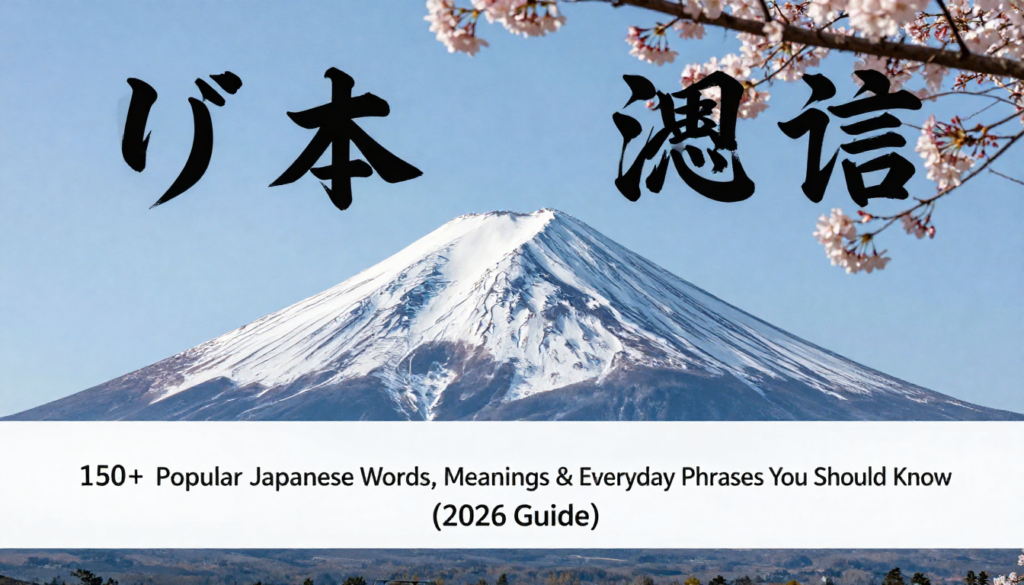
Learning Japanese words offers many benefits beyond speaking another language. It opens the door to Japanese traditions, travel experiences, career opportunities, and entertainment.
⭐ Benefits of Learning Japanese Words
| Benefit | Why It Matters |
| ✈️ Easier Travel | Read signs, order food, ask for directions |
| 🎌 Cultural Understanding | Appreciate Japanese customs and etiquette |
| 📺 Enjoy Anime & Manga | Understand common expressions without subtitles |
| 💼 Career Growth | Useful for international business and tourism |
| 🗣️ Better Communication | Speak confidently with native speakers |
| 🧠 Brain Exercise | Improves memory and language skills |
| 🤝 Build Friendships | Connect with Japanese people more naturally |
Who Should Learn Japanese Words?
- ✈️ Travelers visiting Japan
- 🎓 Students learning Japanese
- 📺 Anime and manga fans
- 🎮 Gamers
- 💼 Business professionals
- 🌏 Culture enthusiasts
- 📚 Language learners of all ages
📊 Comparison Table: Learning Japanese Words vs. Learning Full Japanese
| Feature | Learning Japanese Words | Learning Full Japanese |
| ⏱️ Time Required | Low | High |
| ✈️ Useful for Travel | ⭐⭐⭐⭐⭐ | ⭐⭐⭐⭐⭐ |
| 🗣️ Basic Conversations | ✅ Yes | ✅ Yes |
| 📖 Reading Books | ❌ Limited | ✅ Yes |
| 💼 Professional Fluency | ❌ No | ✅ Yes |
| 😊 Easy for Beginners | ⭐⭐⭐⭐⭐ | ⭐⭐⭐ |
🍣 Common Japanese Greetings and Their Meanings 👋
Greetings are among the first Japanese words every beginner should learn. Using the correct greeting shows politeness and respect, which are important parts of Japanese culture.
🌅 Morning Greetings
| 🇯🇵 Japanese Word | 🔤 Pronunciation | 💬 Meaning | 😊 Emoji |
| おはよう | Ohayou | Good Morning | 🌅 |
| おはようございます | Ohayou Gozaimasu | Good Morning (Polite) | 🙇 |
Example
👤 A: おはようございます (Ohayou Gozaimasu)
👤 B: おはようございます! 😊
Meaning: Good morning!
☀️ Afternoon & Evening Greetings
| Japanese Word | Pronunciation | Meaning | Emoji |
| こんにちは | Konnichiwa | Hello / Good Afternoon | 👋 |
| こんばんは | Konbanwa | Good Evening | 🌙 |
🙏 Polite Expressions
| Japanese Word | Pronunciation | Meaning | Emoji |
| ありがとう | Arigatou | Thank You | 🙏 |
| ありがとうございます | Arigatou Gozaimasu | Thank You (Very Polite) | 🌸 |
| どういたしまして | Douitashimashite | You’re Welcome | 😊 |
| すみません | Sumimasen | Excuse Me / Sorry | 🙇 |
| ごめんなさい | Gomen Nasai | I’m Sorry | 😔 |
| お願いします | Onegaishimasu | Please | 🤝 |
🌟 Expert Tip
In Japan, saying Arigatou Gozaimasu instead of just Arigatou sounds more respectful, especially when speaking with strangers, elders, or staff.
🗣️ 50 Everyday Japanese Words and Their Meanings

These are some of the most useful Japanese words you’ll hear every day.
👨 People & Family
| Japanese Word | Meaning | Emoji |
| 家族 (Kazoku) | Family | 👨👩👧 |
| 友達 (Tomodachi) | Friend | 🧑🤝🧑 |
| お父さん (Otousan) | Father | 👨 |
| お母さん (Okaasan) | Mother | 👩 |
| 子供 (Kodomo) | Child | 👦 |
| 先生 (Sensei) | Teacher | 👨🏫 |
❤️ Feelings & Emotions
| Japanese Word | Meaning | Emoji |
| 愛 (Ai) | Love | ❤️ |
| 好き (Suki) | Like / Love | 😍 |
| 幸せ (Shiawase) | Happiness | 😊 |
| 悲しい (Kanashii) | Sad | 😢 |
| 嬉しい (Ureshii) | Happy | 😄 |
| 元気 (Genki) | Healthy / Energetic | 💪 |
🏠 Common Objects
| Japanese Word | Meaning | Emoji |
| 家 (Ie) | House | 🏠 |
| 車 (Kuruma) | Car | 🚗 |
| 本 (Hon) | Book | 📚 |
| 電話 (Denwa) | Phone | 📱 |
| 時計 (Tokei) | Clock | ⌚ |
| 鍵 (Kagi) | Key | 🔑 |
🌿 Nature Words
| Japanese Word | Meaning | Emoji |
| 花 (Hana) | Flower | 🌸 |
| 山 (Yama) | Mountain | ⛰️ |
| 海 (Umi) | Sea | 🌊 |
| 空 (Sora) | Sky | ☁️ |
| 雨 (Ame) | Rain | 🌧️ |
| 雪 (Yuki) | Snow | ❄️ |
🐾 Animals
| Japanese Word | Meaning | Emoji |
| 猫 (Neko) | Cat | 🐱 |
| 犬 (Inu) | Dog | 🐶 |
| 鳥 (Tori) | Bird | 🐦 |
| 魚 (Sakana) | Fish | 🐟 |
| 馬 (Uma) | Horse | 🐴 |
| 熊 (Kuma) | Bear | 🐻 |
✈️ Japanese Travel Words Every Tourist Should Know
If you’re planning a trip to Japan, these Japanese words will make your journey much smoother.
| Japanese Word | Meaning | Emoji |
| 駅 (Eki) | Train Station | 🚉 |
| 空港 (Kuukou) | Airport | ✈️ |
| 切符 (Kippu) | Ticket | 🎫 |
| ホテル (Hoteru) | Hotel | 🏨 |
| 地図 (Chizu) | Map | 🗺️ |
| 出口 (Deguchi) | Exit | 🚪 |
| 入り口 (Iriguchi) | Entrance | 🚶 |
| トイレ (Toire) | Toilet | 🚻 |
| 水 (Mizu) | Water | 💧 |
| 助けて (Tasukete) | Help! | 🆘 |
🧳 Useful Travel Phrases
| Phrase | Meaning | Emoji |
| 英語を話せますか? (Eigo o hanasemasu ka?) | Do you speak English? | 🗣️ |
| これはいくらですか? (Kore wa ikura desu ka?) | How much is this? | 💴 |
| 駅はどこですか? (Eki wa doko desu ka?) | Where is the station? | 🚉 |
| 写真を撮ってもいいですか? (Shashin o totte mo ii desu ka?) | May I take a photo? | 📸 |
| 助けてください (Tasukete Kudasai) | Please help me | 🆘 |
🍱 Japanese Food Words and Their Meanings
Japanese cuisine is famous worldwide. Knowing these food-related Japanese words can make ordering meals easier.
| Japanese Word | Meaning | Emoji |
| 寿司 (Sushi) | Sushi | 🍣 |
| ラーメン (Ramen) | Ramen Noodles | 🍜 |
| 天ぷら (Tempura) | Fried Seafood/Vegetables | 🍤 |
| 弁当 (Bento) | Lunch Box | 🍱 |
| おにぎり (Onigiri) | Rice Ball | 🍙 |
| 抹茶 (Matcha) | Green Tea | 🍵 |
| 刺身 (Sashimi) | Raw Fish | 🐟 |
| 味噌汁 (Miso Shiru) | Miso Soup | 🥣 |
| ご飯 (Gohan) | Cooked Rice / Meal | 🍚 |
| お茶 (Ocha) | Tea | 🍵 |
🍣 Example Restaurant Conversation
👤 Customer: お願いします。ラーメンをください。 🍜
Meaning: Please, I’d like a bowl of ramen.
👤 Staff: ありがとうございます。😊
Meaning: Thank you.
📋 Quick Checklist: Learn Everyday Japanese Words
Use this checklist to build your vocabulary faster.
- ✅ Learn 10 greetings 👋
- ✅ Memorize 20 everyday words 📖
- ✅ Practice pronunciation daily 🔊
- ✅ Learn food vocabulary 🍣
- ✅ Learn travel phrases ✈️
- ✅ Watch Japanese videos with subtitles 📺
- ✅ Practice with flashcards 📝
- ✅ Speak a few words every day 🗣️
❤️ Beautiful Japanese Words and Their Meanings

One of the most fascinating parts of the Japanese language is its ability to express deep emotions, nature, and life experiences with just one word. Many Japanese words have meanings that cannot be translated perfectly into English.
🌸 Popular Beautiful Japanese Words
| 🇯🇵 Japanese Word | 🔤 Pronunciation | 💬 Meaning | 😊 Emoji |
| 愛 | Ai | Love | ❤️ |
| 希望 | Kibou | Hope | 🌟 |
| 平和 | Heiwa | Peace | ☮️ |
| 夢 | Yume | Dream | 🌙 |
| 光 | Hikari | Light | ✨ |
| 心 | Kokoro | Heart / Spirit | 💖 |
| 永遠 | Eien | Eternity | ♾️ |
| 奇跡 | Kiseki | Miracle | 🌈 |
| 幸運 | Kouun | Good Luck | 🍀 |
| 美 | Bi | Beauty | 🌺 |
🌸 Words Inspired by Nature
| Japanese Word | Meaning | Emoji |
| 桜 (Sakura) | Cherry Blossom | 🌸 |
| 森 (Mori) | Forest | 🌲 |
| 川 (Kawa) | River | 🏞️ |
| 星 (Hoshi) | Star | ⭐ |
| 月 (Tsuki) | Moon | 🌙 |
| 太陽 (Taiyou) | Sun | ☀️ |
| 風 (Kaze) | Wind | 🌬️ |
| 空 (Sora) | Sky | ☁️ |
| 海 (Umi) | Sea | 🌊 |
| 雪 (Yuki) | Snow | ❄️ |
🎌 Japanese Words Used in Anime
Anime has introduced millions of people to common Japanese words. Here are some of the expressions you’ll hear most often.
| Japanese Word | Meaning | Emoji |
| はい (Hai) | Yes | 👍 |
| いいえ (Iie) | No | 👎 |
| すごい (Sugoi) | Amazing | 🤩 |
| かわいい (Kawaii) | Cute | 🥰 |
| かっこいい (Kakkoii) | Cool / Handsome | 😎 |
| 頑張って (Ganbatte) | Do Your Best | 💪 |
| 大丈夫 (Daijoubu) | It’s Okay | 😊 |
| 本当? (Hontou?) | Really? | 😲 |
| もちろん (Mochiron) | Of Course | ✔️ |
| さようなら (Sayounara) | Goodbye | 👋 |
Fun Fact 🎉: The word Kawaii has become so popular that it’s now recognized around the world as a symbol of Japanese pop culture.
💬 Common Japanese Phrases for Daily Conversations
Learning complete phrases is just as important as learning individual Japanese words.
| Japanese Phrase | Meaning | Emoji |
| はじめまして (Hajimemashite) | Nice to meet you | 🤝 |
| 元気ですか? (Genki desu ka?) | How are you? | 😊 |
| 元気です。 (Genki desu.) | I’m fine. | 😄 |
| お元気で。 (Ogenki de.) | Take care. | ❤️ |
| おやすみなさい (Oyasuminasai) | Good Night | 🌙 |
| いただきます (Itadakimasu) | Said Before Eating | 🍽️ |
| ごちそうさまでした (Gochisousama Deshita) | Thank You for the Meal | 🙏 |
| またね (Mata Ne) | See You Later | 👋 |
| わかりません (Wakarimasen) | I Don’t Understand | 🤔 |
| ゆっくり話してください (Yukkuri Hanashite Kudasai) | Please Speak Slowly | 🗣️ |
❌ Common Mistakes When Learning Japanese Words
Many beginners make the same mistakes while studying Japanese. Avoiding these habits will help you learn faster.
| ❌ Mistake | ✅ Correct Approach |
| Memorizing words without context | Learn words in complete sentences |
| Ignoring pronunciation | Listen to native speakers daily |
| Learning too many words at once | Learn 5–10 words each day |
| Skipping revision | Review vocabulary every week |
| Translating word-for-word | Understand the meaning and context |
| Being afraid to speak | Practice speaking from day one |
| Ignoring polite forms | Learn respectful expressions early |
🚫 Avoid These Beginner Errors
- ❌ Forgetting pronunciation
- ❌ Mixing Hiragana and Katakana
- ❌ Not practicing listening skills
- ❌ Depending only on translation apps
- ❌ Trying to memorize hundreds of words overnight
💡 Expert Tips for Learning Japanese Words Faster
Language experts recommend combining reading, listening, speaking, and writing to remember vocabulary more effectively.
🌟 Top Tips
📖 Learn Words in Context
Instead of memorizing random vocabulary, learn complete phrases.
Example:
- ✅ ありがとう (Thank You)
- ✅ ありがとうございます (Thank You Very Much)
🎧 Listen Every Day
Watch:
- 📺 Japanese TV shows
- 🎌 Anime
- 🎙️ Podcasts
- 🎵 Japanese songs
Listening helps improve pronunciation and comprehension.
📝 Practice Writing
Write new Japanese words in:
- Hiragana
- Katakana
- Kanji (as you progress)
Writing strengthens memory.
🗣️ Speak Aloud
Repeat words several times.
Example:
👤 “Konnichiwa”
👤 “Arigatou”
👤 “Sumimasen”
Speaking out loud improves confidence and pronunciation.
📱 Use Flashcards
Flashcards are excellent for remembering vocabulary.
Include:
- 🇯🇵 Japanese Word
- 🔤 Pronunciation
- 💬 English Meaning
- 😊 Emoji
Example:
🌸 Sakura → Cherry Blossom 🌸
⚖️ Pros and Cons of Learning Japanese Words
| 👍 Pros | 👎 Cons |
| Easier travel in Japan ✈️ | Pronunciation requires practice 🎧 |
| Better understanding of Japanese culture 🎌 | Three writing systems can be challenging ✍️ |
| Enjoy anime and manga more 📺 | Kanji takes time to master 📚 |
| Improves memory and language skills 🧠 | Requires regular practice ⏰ |
| Useful for work and study 💼 | Vocabulary can be forgotten without review 🔄 |
✅ Japanese Words Learning Checklist
| ✔️ Task | Status |
| Learn basic greetings 👋 | ☐ |
| Memorize 50 common words 📖 | ☐ |
| Learn travel vocabulary ✈️ | ☐ |
| Practice pronunciation daily 🎧 | ☐ |
| Watch Japanese videos 📺 | ☐ |
| Learn food vocabulary 🍣 | ☐ |
| Review flashcards weekly 📝 | ☐ |
| Practice speaking every day 🗣️ | ☐ |
| Read simple Japanese signs 🚉 | ☐ |
| Learn polite expressions 🙏 | ☐ |
🔗 Internal Linking Opportunities (Travel Website)
Add internal links to related travel content such as:
- 🗼 Best Places to Visit in Tokyo
- ⛩️ Best Temples in Kyoto
- 🍣 Traditional Japanese Foods to Try
- 🚄 Complete Japan Travel Guide
- 🎌 Japanese Culture & Etiquette Guide
- 🌸 Best Cherry Blossom Spots in Japan
- 🚅 Japan Rail Pass Guide
- 🏯 Best Castles in Japan
- 🧳 Japan Packing Checklist
- ✈️ First-Time Japan Travel Tips
📚 Suggested External Authority Sources
For credibility, reference information from these trusted organizations (without inserting links in the article):
- 🇯🇵 Japan National Tourism Organization (JNTO)
- 🎌 Japan Foundation
- 📖 NHK World Japan
- 🏛️ Japanese Ministry of Foreign Affairs
- 🎓 Tofugu (Japanese language learning)
- 📚 Jisho Japanese Dictionary
- 🌏 Britannica
- 📘 Oxford Languages
FAQs
🇯🇵 What are Japanese words?
Japanese words are the vocabulary used in the Japanese language (Nihongo) to communicate ideas, emotions, greetings, actions, and objects. They are written using Hiragana, Katakana, and Kanji and often carry deep cultural meanings. 🌸
🌸 What are the most common Japanese words?
Some of the most common Japanese words include:
| Japanese Word | Meaning | Emoji |
| こんにちは (Konnichiwa) | Hello | 👋 |
| ありがとう (Arigatou) | Thank You | 🙏 |
| はい (Hai) | Yes | 👍 |
| いいえ (Iie) | No | 👎 |
| すみません (Sumimasen) | Excuse Me / Sorry | 🙇 |
| お願いします (Onegaishimasu) | Please | 🤝 |
✈️ Which Japanese words should tourists learn first?
If you’re traveling to Japan, start with these essential words:
- 👋 Konnichiwa — Hello
- 🙏 Arigatou — Thank You
- 🤝 Onegaishimasu — Please
- 🙇 Sumimasen — Excuse Me
- 🚉 Eki — Train Station
- 🚻 Toire — Toilet
- 💧 Mizu — Water
- 🆘 Tasukete — Help
These words make everyday travel much easier.
📚 Is Japanese difficult to learn?
Japanese can be challenging because it uses three writing systems, but learning common Japanese words and phrases is surprisingly easy for beginners. Practicing a few words every day can quickly build your confidence. 💪
🎌 Why do Japanese words have different writing systems?
Japanese uses:
- 📝 Hiragana for native Japanese words
- ✨ Katakana for foreign loanwords
- 📖 Kanji for meanings and concepts
Using all three writing systems makes written Japanese more precise and easier to read.
📺 Can anime help me learn Japanese words?
Yes! Watching anime can help you recognize everyday Japanese words and improve your listening skills. However, some anime characters use casual or exaggerated speech, so it’s best to combine anime with reliable learning resources. 🎬
❤️ What is the most beautiful Japanese word?
Many people consider these among the most beautiful Japanese words:
- 🌸 Sakura — Cherry Blossom
- ❤️ Ai — Love
- 💖 Kokoro — Heart
- ✨ Hikari — Light
- 🌙 Yume — Dream
Each word reflects an important aspect of Japanese culture and emotion.
📱 What’s the best way to memorize Japanese words?
You can learn faster by:
- 📝 Using flashcards
- 🎧 Listening to native speakers
- 🗣️ Speaking aloud daily
- 📖 Reading simple Japanese texts
- 📺 Watching Japanese videos
- ✍️ Writing new vocabulary regularly
Consistency is more effective than memorizing large lists at once.
🌏 How many Japanese words do beginners need?
Learning 200–500 common Japanese words is enough to understand many everyday conversations, travel situations, and simple interactions with native speakers.
🏆 Are Japanese words useful outside Japan?
Absolutely! Japanese words are commonly encountered in:
- 🎮 Gaming
- 📺 Anime and manga
- 🍣 Japanese cuisine
- 💼 International business
- 🎓 Language studies
- 🌏 Cultural exchange
Knowing basic vocabulary helps you appreciate Japanese culture wherever you are.
🎯 Key Takeaways
✅ Learn common greetings before advanced vocabulary. 👋
✅ Practice Japanese words every day instead of memorizing hundreds at once. 📖
✅ Listen to native speakers to improve pronunciation. 🎧
✅ Use flashcards and spaced repetition for long-term memory. 📝
✅ Learn words in real conversations and everyday situations. 🗣️
✅ Combine reading, writing, listening, and speaking for the fastest progress. 🚀
Conclusion
Learning Japanese words is one of the easiest and most rewarding ways to explore Japan’s language and culture. Whether you’re preparing for a trip, enjoying anime, studying the language, or simply expanding your vocabulary, knowing everyday Japanese words will help you communicate with confidence and appreciate the traditions behind each expression.
Start with basic greetings like Konnichiwa (Hello 👋) and Arigatou (Thank You 🙏), then gradually build your vocabulary with travel phrases, food names, emotions, and beautiful cultural expressions. Practicing just a few words each day can make a big difference over time.
Remember, language learning is a journey—not a race. Stay consistent, enjoy the process, and celebrate every new word you master.
Word Weaver Award Meaning: The Complete Guide to Its Definition, Symbolism & Importance (2026)