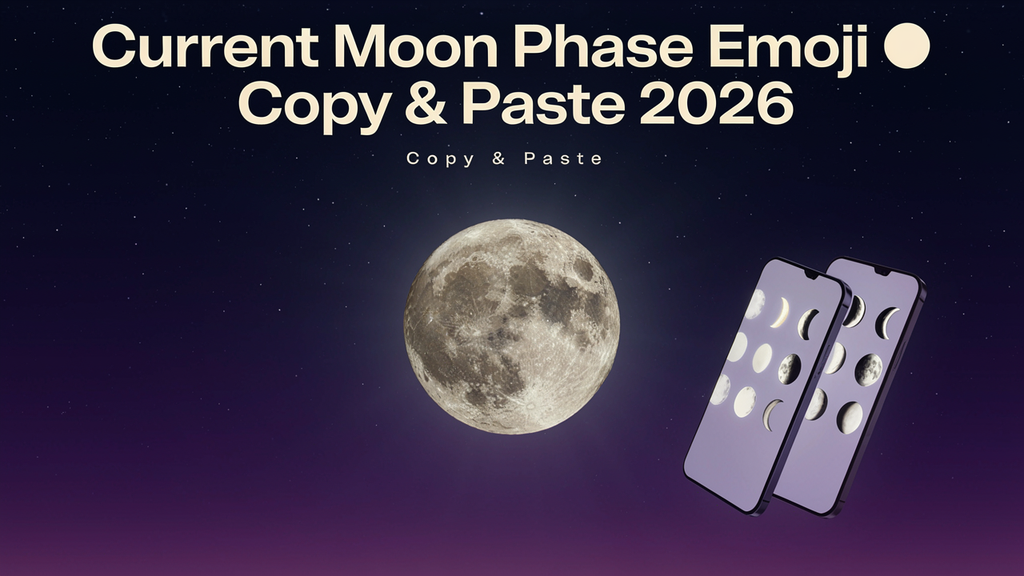
The current moon phase emoji is a simple way to represent what the Moon looks like at a particular point in its monthly cycle. People use moon emojis in texts, captions, social media posts, calendars, astronomy notes, and even online games. However, an emoji is a visual symbol, not a precise astronomical measurement.
Knowing the difference between a real moon phase and its Unicode emoji can make your posts much more accurate. The Moon moves through eight recognizable phases during a lunar cycle of about 29.53 days, while digital symbols provide convenient visual shortcuts. This guide explains the symbols, meanings, copy-and-paste options, and ways to choose the right moon emoji.
What Is the Current Moon Phase Emoji?
A current moon phase emoji is a Unicode symbol chosen to visually represent one stage of the lunar cycle. Common options include 🌑, 🌒, 🌓, 🌔, 🌕, 🌖, 🌗, and 🌘. These symbols are useful for communication, but they should not automatically be treated as real-time astronomical displays.
On September 14, 2026, the Moon is in a waxing crescent stage, with about 12% illumination in Pakistan-based moon-phase tables. The exact illumination and viewing conditions change continuously, so astronomy resources are better for precise observations.
🌙 The current moon phase emoji can quickly show whether you mean a crescent, quarter, gibbous, or full Moon. It adds visual context to short messages without requiring a lengthy astronomical explanation.
🌒 A waxing crescent symbol usually suggests that the illuminated portion is increasing. It is especially useful when discussing early lunar-cycle evenings, sky watching, fresh starts, or changing nighttime conditions.
✨ Moon emojis are popular because they combine astronomy with everyday communication. A single symbol can make a calendar reminder, social caption, or nighttime message feel more visual and expressive.
🔭 An emoji should not be confused with a real-time astronomical image. The actual Moon changes continuously, while Unicode symbols represent standardized visual concepts designed for digital communication.
🌕 The full moon emoji is one of the easiest symbols to recognize. It represents a completely illuminated-looking lunar disk and is often associated with nighttime, beauty, astronomy, celebrations, and mystery.
🌑 The new moon emoji shows a dark circular Moon. Astronomically, a new Moon occurs when the Moon is positioned so that its illuminated side generally faces away from Earth.
🌓 The first quarter moon emoji represents a half-illuminated appearance. Despite its name, first quarter means the Moon has completed roughly one quarter of its orbit around Earth.
🌗 The last quarter moon emoji also looks half illuminated, but it belongs to the waning half of the lunar cycle. The direction of illumination distinguishes it from the first quarter.
🌔 A waxing gibbous emoji represents a Moon that is more than half illuminated and still growing toward full. It is often associated with anticipation and approaching brightness.
🌖 A waning gibbous emoji shows more than half illumination while the visible bright portion is decreasing. It follows the full Moon and leads toward the last quarter.
🌘 A waning crescent emoji represents the final visible crescent before new Moon. It is commonly connected with quiet mornings, endings, reflection, and the closing part of a lunar cycle.
📅 Moon phase emojis work especially well in calendars and planners. They can provide a quick visual reminder of important lunar dates without occupying much space on a page.
📱 In texting, the moon emoji can communicate nighttime without explicitly saying “good night.” The exact symbol can also add emotional tone, mystery, calmness, or a celestial theme.
🌌 Social media creators frequently use lunar symbols in astronomy posts, photography captions, spiritual content, travel posts, and nighttime photography. The symbols make celestial topics easier to recognize while scrolling.
🌓 The eight major moon phase symbols form a useful visual sequence. Learning their order makes it much easier to select an appropriate emoji when creating educational or personal content.
🔎 If accuracy matters, compare your chosen emoji with a moon phase calendar. The calendar can tell you the astronomical phase, while the emoji provides an attractive shorthand for readers.
🌙 The phrase “moon phase today emoji” usually refers to finding the symbol that best matches today’s lunar appearance. It does not necessarily mean that Unicode automatically updates the emoji every day.
💫 Moon symbols can also represent moods and aesthetics rather than astronomy. Writers may use them to suggest peacefulness, dreams, solitude, mystery, romance, or nighttime atmosphere.
🌠 A current lunar phase emoji is most useful when readers understand that it is an approximation. For scientific work, use measured illumination, phase angle, and reliable astronomical calculations instead.
📋 When you need a quick copy-and-paste symbol, Unicode moon emojis are convenient. Keeping all eight phases together makes it easier to select the closest symbol for your message.
Moon Phase Emoji Chart and Copy-and-Paste Symbols
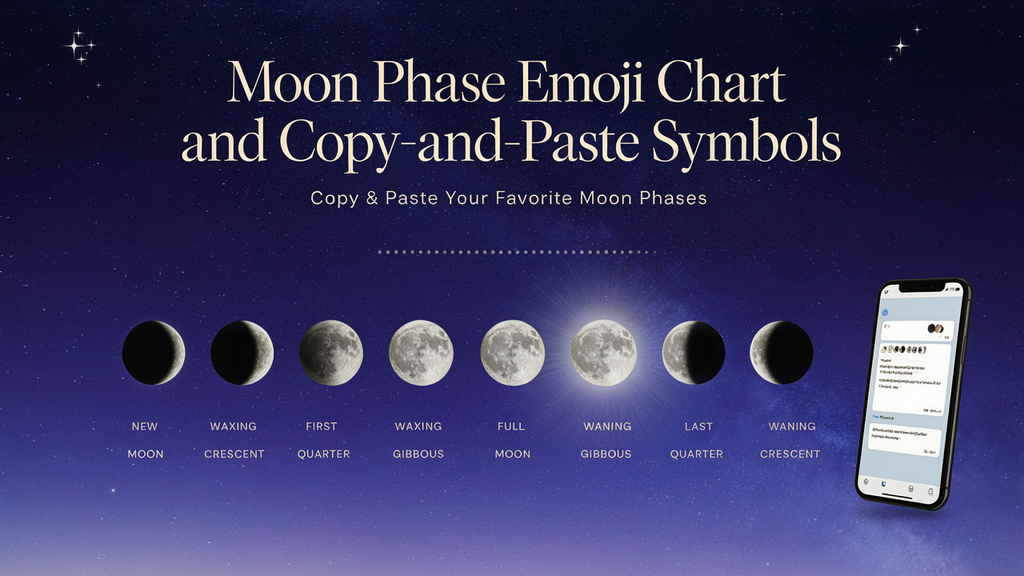
The eight moon phases provide the basic structure for understanding moon emoji symbols. They move from new Moon through waxing crescent, first quarter, waxing gibbous, full Moon, waning gibbous, last quarter, and waning crescent. The sequence then returns to new Moon.
| Moon Phase | Emoji | General Meaning |
| New Moon | 🌑 | Beginning of lunar cycle |
| Waxing Crescent | 🌒 | Illuminated portion increasing |
| First Quarter | 🌓 | About half illuminated |
| Waxing Gibbous | 🌔 | More than half illuminated |
| Full Moon | 🌕 | Nearly fully illuminated |
| Waning Gibbous | 🌖 | Illumination decreasing |
| Last Quarter | 🌗 | About half illuminated |
| Waning Crescent | 🌘 | Final visible crescent |
🌑 New Moon: Copy this symbol when you want to represent the beginning of the lunar cycle. It also works beautifully for themes involving darkness, renewal, hidden beginnings, or quiet reflection.
🌒 Waxing Crescent: This symbol represents a thin Moon becoming increasingly illuminated. Use it for early lunar-cycle references, evening sky observations, growth themes, or posts about the Moon after new Moon.
🌓 First Quarter: The first quarter symbol represents a half-lit Moon. It is a useful choice when discussing the midpoint of the waxing half of the lunar cycle or explaining lunar astronomy.
🌔 Waxing Gibbous: This emoji depicts a mostly illuminated Moon that is still growing. It works particularly well for posts about the days leading toward a full Moon.
🌕 Full Moon: The full moon emoji is instantly recognizable and easy to copy. Use it for astronomy posts, nighttime captions, lunar calendars, photography, celebrations, and general Moon-related conversations.
🌖 Waning Gibbous: This symbol represents a bright Moon after full Moon. It can describe the period when illumination begins decreasing while most of the lunar disk remains visible.
🌗 Last Quarter: The last quarter emoji represents another half-lit stage. It belongs to the waning portion of the cycle and is useful for educational explanations about lunar progression.
🌘 Waning Crescent: This emoji shows a narrow crescent approaching new Moon. It can symbolize closure, transition, quietness, early morning skies, and the final stage before the cycle begins again.
📋 Copying moon emojis is easy because they are standard Unicode characters supported across many modern platforms. However, their exact appearance can vary slightly depending on the operating system.
💻 A moon emoji may look different on Windows, Android, iPhone, or a social media platform. The underlying Unicode character remains the same even when its visual design changes.
📱 Mobile keyboards often group moon symbols with nature, weather, or nighttime emojis. Searching “moon” can reveal several options without requiring users to memorize Unicode names.
🔤 Unicode provides standardized character definitions rather than one universal artistic design. That means the same moon phase symbol may have a slightly different graphic appearance on different devices.
🌕 The full moon symbol is often used more frequently than less familiar phases. Its simple circular shape makes it immediately understandable, even to people who know little about astronomy.
🌒 Crescent symbols are particularly useful when a post needs to communicate that the Moon is visible but not yet near full. They provide more information than a generic night-sky emoji.
🌗 Quarter symbols are valuable in educational content because they help distinguish two visually similar stages. First quarter belongs to waxing, while last quarter belongs to waning.
🌔 Gibbous emojis are useful for explaining that the Moon is more than half illuminated. They fill the visual gap between quarter phases and the full Moon.
🌙 If you are unsure which exact symbol matches today’s Moon, check a reliable moon phase calendar first. Then select the Unicode emoji that most closely represents the astronomical phase.
✨ Copy-and-paste collections are especially helpful for bloggers, teachers, social media managers, and students. Keeping the eight symbols together saves time when creating lunar content.
📚 A moon emoji chart can also make astronomy lessons more approachable. Students can visually connect each Unicode symbol with the corresponding stage of the lunar cycle.
🌌 Using the complete emoji sequence gives readers a quick reference. It also helps prevent the common mistake of treating every crescent or half-moon symbol as the same astronomical phase.
Understanding the Eight Moon Phases
The eight moon phases describe the changing appearance of the Moon as it orbits Earth. These phases are caused by changing viewing geometry between the Sun, Earth, and Moon. The Moon does not produce its own visible light; sunlight illuminates the portion we see.
The complete lunar cycle takes approximately 29.53 days from one new Moon to the next. Although the eight phases are convenient categories, the Moon’s illumination changes continuously between those named stages, so a real moon phase is more gradual than an emoji chart suggests.
🌑 New Moon begins the standard sequence. At this stage, the Moon is positioned approximately between Earth and the Sun, making the illuminated side difficult or impossible to see from Earth.
🌒 Waxing crescent follows new Moon. A small portion becomes visible, and the illuminated area gradually grows each day as the Moon continues moving through its orbit.
🌓 First quarter arrives when approximately half of the visible lunar disk is illuminated. The name describes orbital progress rather than the percentage of visible brightness.
🌔 Waxing gibbous follows first quarter. More than half of the visible Moon is illuminated, and the bright portion continues increasing until full Moon.
🌕 Full Moon occurs when Earth is positioned approximately between the Sun and Moon. The side facing Earth is then broadly illuminated, producing the familiar bright circular appearance.
🌖 Waning gibbous begins after full Moon. The Moon remains mostly illuminated, but the visible bright area starts shrinking as it continues around Earth.
🌗 Last quarter represents another approximately half-illuminated stage. It occurs during the waning portion of the cycle and is sometimes called third quarter.
🌘 Waning crescent is the final named stage. Only a thin illuminated portion remains visible before the Moon reaches new Moon and begins another cycle.
🔭 These phases are not created by Earth’s shadow covering the Moon. Ordinary lunar phases happen because of changing viewing geometry, while Earth’s shadow is involved specifically during lunar eclipses.
☀️ Sunlight is the fundamental reason the Moon appears bright. The Moon reflects sunlight, and the changing position of the Moon relative to Earth and Sun changes how much illuminated surface we can see.
🌍 The same lunar phase occurs globally at essentially the same astronomical moment, although local viewing conditions differ. Observers in different places may see the Moon at different heights or times.
🌓 The visible shape can also appear reversed between hemispheres. This is because observers view the Moon from different orientations, even though the underlying lunar phase is the same.
📐 Astronomers can describe lunar appearance using illumination, phase angle, and other measurements. These provide greater precision than choosing one of eight simple emoji categories.
🌙 A moon phase emoji simplifies continuous astronomy into recognizable visual steps. That makes it excellent for communication, but not ideal as a substitute for scientific data.
📅 Moon phase calendars are useful because they provide dates and times for major phases. They can help photographers, observers, travelers, educators, and anyone planning around lunar visibility.
✨ The lunar cycle is sometimes described as lasting 29.53 days. This is the approximate synodic month, measured from one corresponding lunar phase to the next.
🌌 Because the Moon is always moving, its appearance changes gradually rather than jumping instantly between emojis. The named phases are convenient milestones within that continuous change.
🔎 Comparing an actual Moon photograph with an emoji chart can make this concept easier to understand. The photograph shows natural detail, while the emoji highlights the general illuminated shape.
🌗 The words “waxing” and “waning” are essential when identifying phases. Waxing means the illuminated portion is increasing, while waning means the visible illumination is decreasing.
🌠 Understanding the eight phases gives context to every moon emoji. Once the sequence is familiar, choosing the right symbol becomes much easier and more meaningful.
Moon Emoji Meaning in Texting and Social Media
Moon emojis have meanings beyond astronomy. In texting, they can communicate nighttime, calmness, mystery, romance, sleep, dreams, or simply an interest in the sky. Their interpretation depends heavily on the surrounding words and the specific emoji selected.
A full Moon can feel dramatic or magical, while a crescent may suggest quietness or subtle beauty. Because digital communication has no facial expression or voice tone, visual symbols often add emotional context to otherwise simple messages.
🌙 A moon emoji in a good-night message can make the conversation feel warmer. Instead of simply writing “sleep well,” someone might add a moon symbol to create a peaceful nighttime mood.
🌕 The full moon emoji often feels bold and visually complete. People may use it when discussing beautiful nights, lunar photography, astronomy, celebrations, or moments that feel mysterious and memorable.
🌒 A crescent moon can communicate subtlety rather than intensity. It works well in messages about quiet evenings, reflection, peaceful routines, or watching the sky after sunset.
✨ Moon emojis can make social media captions more atmospheric. Pairing a lunar symbol with words about stars, dreams, or nighttime scenery can create a recognizable celestial aesthetic.
🌌 Some people use moon symbols simply because they like astronomy. In that context, the emoji may have no hidden emotional meaning and simply identify the subject of the conversation.
😴 A moon symbol can suggest bedtime or sleep, especially when combined with sleeping-related language. However, the meaning depends on the conversation rather than the emoji alone.
💫 In romantic conversations, a moon emoji may create a dreamy or affectionate tone. It does not automatically mean romance, but surrounding words can give the symbol that interpretation.
🖤 Dark-colored moon symbols may sometimes fit mysterious or dramatic themes. Their meaning can range from aesthetics and nighttime imagery to personal expression, depending on the platform and context.
📱 Social media users frequently combine moon emojis with stars, clouds, or sparkle symbols. These combinations are often decorative rather than astronomical and can simply create a nighttime visual style.
💬 In texting, the exact moon phase usually matters less than the overall mood. Someone may choose 🌙 because it looks attractive rather than because it matches the real lunar phase.
🔭 Astronomy-focused accounts should use moon emojis more carefully. When discussing a specific phase, matching the symbol with the actual astronomical stage helps maintain credibility.
🌕 A full moon symbol can also represent a specific event in a calendar. For example, creators may use it to mark a full Moon date or organize a lunar photography schedule.
🌘 A waning crescent can carry a reflective feeling because it appears near the end of the lunar cycle. Writers may use it when discussing endings, transitions, rest, or preparation for renewal.
🌱 A waxing moon can symbolically suggest growth. Although that symbolism is cultural or personal rather than an astronomical fact, it is common in journaling and creative writing.
🌑 New Moon symbols are often connected with beginnings and fresh intentions. This is especially common in lifestyle content, although the symbolic interpretation should not be confused with scientific meaning.
📸 Photographers may use moon emojis in captions to identify lunar subjects. Adding the actual date and phase can make the caption more informative for readers interested in astronomy.
🌠 A moon emoji can make a short social post more recognizable at a glance. This is especially useful when the topic concerns nighttime travel, sky watching, photography, or lunar events.
📝 When writing educational content, explain the emoji’s astronomical meaning rather than assuming readers know it. A short definition can make the post both accessible and more useful.
🌙 The safest interpretation of a moon emoji is always contextual. The same symbol can mean astronomy in one conversation, sleep in another, and pure decoration in a third.
✨ Moon emojis are flexible communication tools. Their popularity comes from their ability to combine recognizable celestial imagery with emotional, aesthetic, and conversational meanings.
How to Choose the Right Moon Emoji for Today
Choosing the correct moon emoji starts with identifying the actual astronomical phase. A reliable moon phase calendar can show whether the Moon is new, waxing crescent, first quarter, waxing gibbous, full, waning gibbous, last quarter, or waning crescent.
On September 14, 2026, moon tables for Pakistan show a waxing crescent with approximately 11.8% illumination. The Moon reaches first quarter on September 19, so the most appropriate simple emoji around September 14 is 🌒 rather than 🌕.
🔎 Start by checking the date and location. Lunar illumination changes continuously, and a phase calendar provides a much better answer than guessing from the appearance of yesterday’s Moon.
🌒 If the illuminated portion is small and increasing, a waxing crescent emoji is generally the closest visual match. This is especially appropriate shortly after new Moon.
🌓 Choose first quarter when the Moon is approximately half illuminated during the waxing stage. The symbol is a useful visual shorthand for this important lunar milestone.
🌔 Use waxing gibbous when more than half the Moon is illuminated and brightness is increasing. It belongs between first quarter and full Moon.
🌕 Choose full moon when the lunar disk is essentially fully illuminated. This is the simplest phase to recognize visually and the most familiar lunar emoji.
🌖 After full Moon, use waning gibbous while most of the visible disk remains bright. The key difference is that illumination is now decreasing rather than increasing.
🌗 Last quarter is appropriate for the half-lit waning phase. It can be confusing because it resembles first quarter, so checking whether the Moon is waxing or waning is important.
🌘 Use waning crescent near the end of the lunar cycle. Only a small portion remains illuminated, and the Moon is approaching new Moon.
🌑 The new moon emoji is appropriate when the astronomical phase is new Moon. Remember that the new Moon is generally not visibly illuminated from Earth’s perspective.
📅 A moon phase calendar can prevent incorrect emoji choices. It provides a chronological view of lunar stages and is particularly useful when preparing scheduled social posts.
📱 For casual texting, exact accuracy may not matter. If the message is simply about nighttime, any attractive moon emoji may work without claiming to represent today’s actual phase.
🔭 For astronomy articles, accuracy matters more. Match the emoji to the named phase and, when appropriate, include illumination percentage and date to provide additional context.
🌍 Location can influence when the Moon rises and sets, even though the lunar phase itself is global. This means two people can see the same phase at different local times.
🌙 The phrase “moon phase today emoji” is therefore best understood as a request for a visual approximation of today’s astronomical phase rather than an automatically updating symbol.
✨ If you need a symbol for a website, check how it renders across devices. Emoji artwork varies, so the visual appearance may not be identical for every reader.
🧭 Travelers should consider local moonrise and moonset times when planning observations. Knowing the phase alone does not guarantee that the Moon will be above the horizon.
📸 Photographers should use phase information alongside local rise and set times. A beautiful crescent may be difficult to photograph if it appears close to the horizon during daylight.
🌌 Stargazers can also consider how much moonlight is present. A bright Moon can make faint stars harder to see, while darker lunar phases often provide darker skies.
🗓️ If publishing scheduled content, check the astronomical date before posting. Lunar phases occur at specific moments, so a symbol selected weeks earlier may no longer match the actual sky.
🌒 The simplest rule is to identify the phase first and choose the matching emoji second. This small habit keeps lunar content visually attractive while remaining scientifically responsible.
Moon Illumination Percentage and Real Moon Phase
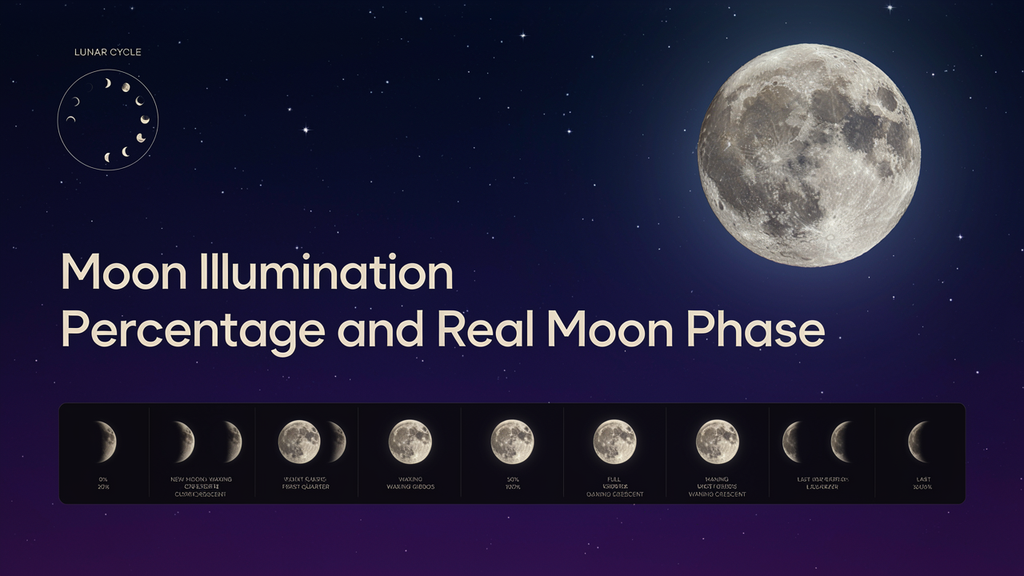
Moon illumination describes the percentage of the lunar disk that appears illuminated from Earth. It provides more precision than a basic emoji because the Moon can have many intermediate appearances between the eight named phases.
For example, a waxing crescent might have only a small percentage illuminated shortly after new Moon, while a later waxing crescent may be much brighter. The emoji stays the same category even though the actual appearance continues changing.
📊 Illumination percentage tells you how much of the Moon’s visible disk is lit. It is one of the easiest numerical measurements for understanding how bright the lunar phase appears.
🌒 A waxing crescent can have very different illumination percentages on different days. This is why one crescent emoji cannot perfectly represent every real crescent Moon.
🌕 A full Moon is near maximum visible illumination. Even then, the precise percentage can vary slightly around the exact full-moon moment because lunar geometry changes continuously.
🌑 New Moon is associated with extremely low visible illumination. During this stage, the Moon’s sunlit side generally faces away from Earth.
📈 Waxing means the illuminated percentage is increasing. If yesterday’s Moon was a thin crescent and today’s is slightly brighter, the Moon is continuing through its waxing stage.
📉 Waning means the illuminated percentage is decreasing. The Moon can remain visually large and bright while still being classified as waning.
🔭 Real moon phase calculations can be much more precise than selecting an emoji. Astronomical services can provide exact phase times, illumination, distance, and rise or set information.
🌙 Moon age is another way people describe where the Moon is within its cycle. It generally refers to the time elapsed since the most recent new Moon.
⏱️ Because the lunar cycle lasts about 29.53 days, moon age changes continuously. It is not identical to the calendar day of the month.
📐 Illumination is especially useful for photographers. Knowing whether the Moon is only a few percent illuminated or close to full can help determine exposure, contrast, and viewing conditions.
🌌 Stargazers may prefer low illumination when looking for faint celestial objects. A bright Moon can increase sky brightness and reduce the visibility of subtle stars and deep-sky targets.
📷 A thin crescent can create dramatic landscape photographs because the bright lunar edge contrasts strongly with a darker sky. The best opportunities depend on local timing and weather.
🧮 Moon phase calculations use the positions of the Sun, Earth, and Moon. Modern astronomical software can calculate these relationships with much greater precision than visual guessing.
🔎 A real moon phase is therefore more than an emoji. The emoji communicates a category, while astronomical calculations describe the actual geometry and illumination at a particular time.
🌍 The same illumination percentage is broadly applicable worldwide at a given moment, but the Moon’s orientation and local position in the sky can appear different to observers.
🌒 A waxing crescent may appear like a thin curved shape in one location and be difficult to observe from another because of local horizon, weather, and twilight conditions.
📅 Moon calendars often combine phase names with illumination percentages. This creates a more complete picture than using moon phase symbols alone.
✨ If accuracy is important, avoid writing that an emoji itself measures illumination. Emojis are characters, while illumination is an astronomical quantity calculated from lunar geometry.
🔭 The phrase “accurate moon phase emoji” can be slightly misleading. An emoji can be an accurate representation of a phase category, but it cannot display continuously changing astronomical precision.
🌙 Combining an emoji with a percentage is a strong approach for educational content. The symbol provides instant visual recognition, while the percentage adds useful scientific detail.
Waxing and Waning Moon Emojis Explained
The terms waxing and waning are essential for understanding moon emoji phases. Waxing means the visible illuminated portion is increasing after new Moon, while waning means it is decreasing after full Moon.
The four waxing and waning stages create a logical progression: waxing crescent, first quarter, waxing gibbous, full Moon, waning gibbous, last quarter, and waning crescent. Recognizing this sequence makes moon symbols much easier to interpret.
🌒 Waxing crescent is the first visible stage after new Moon. The illuminated portion grows gradually, making the crescent increasingly noticeable in the evening sky.
🌓 First quarter marks an important transition within the waxing half. The Moon appears approximately half illuminated and continues toward a larger visible bright portion.
🌔 Waxing gibbous means more than half the Moon is illuminated while the bright area continues growing. It is the phase immediately before full Moon.
🌕 Full Moon separates waxing from waning. After the full phase, the illuminated portion begins decreasing, although the Moon can remain bright for several nights.
🌖 Waning gibbous follows full Moon. More than half the lunar disk remains illuminated, but the visible bright portion is gradually shrinking.
🌗 Last quarter occurs during the waning half. It looks approximately half illuminated, making it visually similar to first quarter.
🌘 Waning crescent is the final visible crescent. The illuminated portion becomes thinner as the Moon approaches the next new Moon.
🌑 New Moon begins the sequence again. From there, the Moon transitions into another waxing crescent as its visible illuminated portion starts increasing.
📈 Think of waxing as “growing” brightness. This simple memory trick helps beginners identify whether a crescent or gibbous symbol belongs to the first or second half of the cycle.
📉 Think of waning as “shrinking” brightness. Once the Moon passes full, the visible illuminated portion gradually decreases until the next new Moon.
🌙 The difference between waxing and waning is not simply whether the Moon looks bright. It describes the direction of change in the illuminated portion.
🌍 Hemisphere orientation can make the bright side appear differently positioned. This visual difference does not mean that the Moon is in a different astronomical phase.
📱 Emoji designs may not make the distinction equally obvious on every platform. When accuracy matters, combine the symbol with the written phase name.
🔭 Astronomers can identify the phase precisely using lunar geometry. Casual users can usually rely on the eight standard phase categories and a reliable calendar.
✨ Waxing moon imagery is often associated with growth in creative or cultural contexts. That interpretation is symbolic rather than a scientific property of the Moon.
🌘 Waning moon imagery can similarly suggest completion or release in creative writing. The symbolism varies between cultures and personal traditions.
📚 Teaching waxing and waning with emojis can make astronomy easier for beginners. Visual symbols provide a simple bridge between technical terminology and everyday communication.
🌓 First quarter and last quarter are especially important to compare. Both appear approximately half illuminated, but they occur at different points in the lunar cycle.
🌔 Gibbous means more than half illuminated but not fully illuminated. Remembering this definition makes waxing and waning gibbous symbols much easier to identify.
🌌 Once the waxing-to-waning sequence becomes familiar, every moon emoji has a clear place. The symbols then become more than decorative icons; they become useful visual astronomy references.
Moon Phase Symbols, Unicode, and Copy-Paste Use
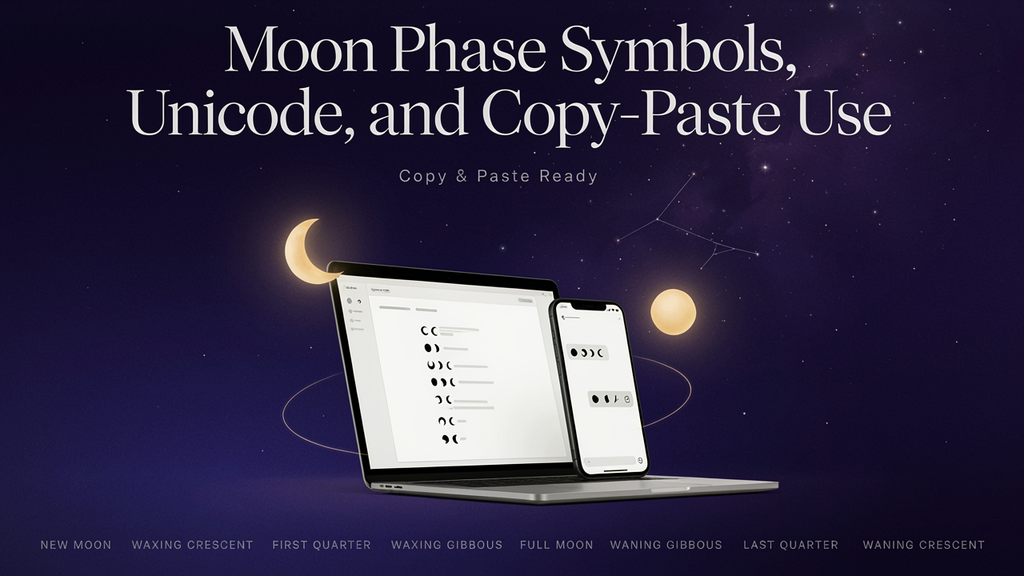
Moon phase symbols are standardized Unicode characters that allow computers and phones to display recognizable lunar imagery. The Unicode standard defines the characters, while individual platforms decide how those characters look visually.
The commonly used sequence includes 🌑 new moon, 🌒 waxing crescent, 🌓 first quarter, 🌔 waxing gibbous, 🌕 full moon, 🌖 waning gibbous, 🌗 last quarter, and 🌘 waning crescent. These are convenient for copying into messages, websites, and social posts.
🌑 U+1F311: The new moon symbol is a standard Unicode emoji character. It provides a simple dark circular representation that is widely recognized across modern digital platforms.
🌒 U+1F312: The waxing crescent moon symbol represents a narrow illuminated crescent. It is commonly used when the Moon is increasing in visible illumination.
🌓 U+1F313: The first quarter moon symbol visually represents a half-lit lunar disk. It belongs to the waxing portion of the standard eight-phase sequence.
🌔 U+1F314: The waxing gibbous symbol represents a mostly illuminated Moon before full Moon. It is useful for both astronomy content and decorative nighttime communication.
🌕 U+1F315: The full moon symbol is one of the most familiar lunar Unicode characters. Its circular appearance makes it especially useful for calendars, captions, and nighttime messages.
🌖 U+1F316: The waning gibbous symbol represents the post-full-Moon stage. It shows more than half illumination while the visible bright portion is decreasing.
🌗 U+1F317: The last quarter symbol represents the waning half-lit stage. Its visual similarity to first quarter makes the written phase name useful when precision matters.
🌘 U+1F318: The waning crescent symbol shows the final narrow illuminated portion before new Moon. It is often useful in lunar calendars and astronomy explanations.
📋 Copying Unicode moon symbols is generally straightforward. Select the desired character, copy it, and paste it into your message, article, caption, document, or social media post.
💻 Unicode support means these characters can be used across many digital environments. However, older devices or unsupported systems may display a replacement box instead of the intended emoji.
📱 Different operating systems can render the same character differently. The underlying Unicode identity remains consistent, but the artistic design, shading, and orientation may vary.
🔤 Unicode names help developers and researchers identify characters consistently. This is useful when building websites, applications, search tools, keyboards, or databases containing moon symbols.
🌕 Copy-and-paste moon emojis are especially convenient for casual users. You do not need to remember Unicode codes when a ready-made character is available.
✨ Bloggers can use moon symbols in headings, captions, tables, and social media promotions. Moderation is recommended so the page remains readable and professional.
📚 Teachers can place moon emojis beside phase names to create visually friendly study materials. This can help beginners connect vocabulary with recognizable shapes.
🌙 Social media creators can use lunar symbols as visual separators. They can make a caption more attractive while still keeping the main written message easy to understand.
🔎 Search engines can understand textual context better when an emoji is supported by descriptive words. For SEO content, do not rely on emojis alone to communicate important information.
🧑💻 Developers should remember that emoji rendering depends on fonts and platforms. Testing symbols across common devices can prevent unexpected visual differences.
📄 In professional articles, use moon emojis as supporting visuals rather than replacing important terminology. Writing “waxing crescent 🌒” is clearer than presenting the emoji without explanation.
🌌 Unicode makes digital lunar communication simple and consistent. Whether you are creating a calendar, blog, caption, or text message, these symbols provide an easy visual language for Moon phases.
Moon Phase Emoji Differences by Hemisphere
The Moon itself does not enter a different astronomical phase depending on whether you are in the Northern or Southern Hemisphere. However, the Moon can appear rotated differently because observers are viewing the sky from different orientations.
This is important when using moon phase emojis because the artwork of a Unicode symbol has a fixed visual orientation. A symbol may look like a convenient representation on one device without perfectly matching how the Moon appears from every location.
🌍 The lunar phase is fundamentally the same worldwide at a given moment. What changes from place to place is the Moon’s position, orientation, and visibility in the local sky.
🧭 Northern Hemisphere observers may see the illuminated portion oriented differently from Southern Hemisphere observers. This is a perspective effect rather than a change in lunar phase.
🌒 A crescent emoji has one fixed digital appearance on most platforms. The real crescent may appear oriented differently depending on where you are observing it.
🌓 Quarter Moon emojis also simplify the real sky. A half-lit Moon seen from one hemisphere can appear visually reversed compared with the same phase viewed elsewhere.
🌔 Gibbous Moon orientation can similarly vary. The important astronomical information is whether the Moon is waxing or waning, not simply which side appears brighter in an emoji.
🌕 Full Moon is the easiest phase to represent consistently. Because the lunar disk appears broadly circular, hemisphere-related orientation differences are much less noticeable.
📱 Unicode emojis are designed for digital communication, not location-specific astronomical simulation. Their fixed appearance should therefore be treated as symbolic rather than geographically exact.
🔭 When accuracy matters, written phase names are helpful. Saying “waxing crescent” communicates the astronomical stage even if the emoji’s orientation differs from what a viewer sees.
🌌 Astronomy applications can provide more detailed local information. They can show the Moon’s position, altitude, azimuth, rise time, set time, and appearance for a specific observer.
📸 Photographers should rely on local sky information rather than emojis. The orientation and position of the Moon can affect composition significantly.
🗺️ Travelers crossing hemispheres may notice that the Moon looks unfamiliar. This is normal and results from viewing the same celestial object from a different geographic orientation.
🌙 The phrase “hemisphere moon emoji difference” therefore refers mainly to visual representation. The emoji does not automatically rotate itself to match the observer’s location.
✨ A crescent can appear like a “C” shape in one orientation and more like a reversed curve elsewhere. Both views can represent the same waxing or waning stage.
📚 This distinction is useful when teaching astronomy. Students should learn that phase and orientation are separate concepts.
🌗 First and last quarter symbols can be especially confusing because both represent approximately half illumination. Their phase names and orbital positions provide more information than the visual shape alone.
🔎 If a website claims one fixed emoji perfectly represents the Moon worldwide, treat that statement cautiously. Unicode artwork is standardized, but the real sky depends on observer location.
🌍 The Southern Hemisphere does not experience a different lunar cycle. The Moon follows the same orbital process, while perspective changes how its illuminated shape is viewed.
📅 Lunar calendars can provide global phase dates while local observing guides provide location-specific rise and set times. Using both gives a much more complete picture.
🌕 Full Moon events are particularly easy to communicate globally because the phase name is unambiguous. Local timing still matters when determining when the Moon is visible.
🌠 Understanding hemisphere differences makes moon emoji use more accurate. The best approach is to treat emojis as convenient symbols and astronomy tools as sources for precise local viewing information.
Moon Phase Emoji for Astronomy, Photography, and Stargazing
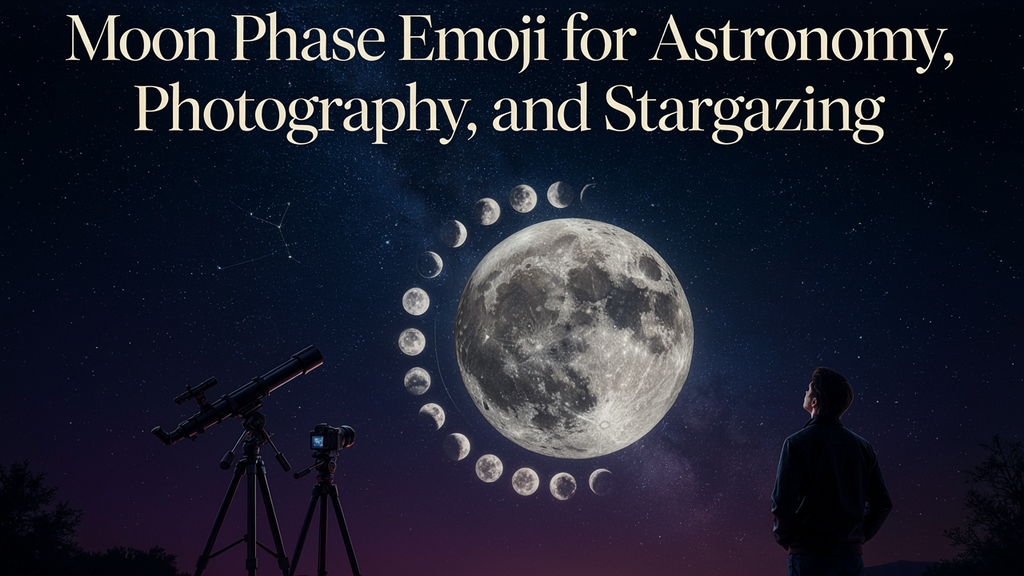
Moon emojis can be useful in astronomy communication, but they work best as visual labels rather than scientific measurements. Astronomers and photographers often need exact phase times, illumination, moonrise, moonset, distance, and sky conditions.
For casual sky watching, however, the emoji can be an excellent first step. It helps readers quickly recognize whether a post discusses a crescent, quarter, gibbous, or full Moon before they explore more detailed information.
🔭 Astronomy articles can use moon emojis beside written phase names to make technical explanations easier to scan. The symbol provides a visual cue while the text supplies accurate terminology.
📸 Photographers often plan around specific lunar appearances. A thin crescent creates a very different composition from a bright full Moon, especially when photographing landscapes.
🌌 Stargazers should consider lunar brightness before planning observations. A bright Moon can wash out faint stars, while darker lunar periods can provide better conditions for some deep-sky viewing.
🌒 Crescent photography can be particularly dramatic near sunset. The thin illuminated edge may appear alongside colorful twilight, buildings, mountains, or landscapes.
🌕 Full Moon photography requires different techniques. The Moon is bright enough that camera settings often need to prioritize lunar detail rather than the surrounding dark sky.
🌔 Gibbous phases can provide excellent opportunities for photographing surface features. The changing angle of sunlight creates shadows that emphasize lunar terrain.
🌓 Quarter Moon photography is often visually interesting because the terminator creates strong shadows. This boundary between lunar day and night can make craters appear more prominent.
🌗 The last quarter phase can be excellent for early-morning observers. Its visibility schedule differs from evening-friendly waxing phases, so planning around moonrise is important.
🌘 Waning crescent photography may require early mornings. The Moon can appear low in the sky, making local horizon conditions particularly important.
📅 Photographers can use moon phase calendars to plan shoots weeks ahead. Combining the phase with local moonrise and weather forecasts can improve the chances of getting the desired image.
🧭 Moonrise direction changes during the lunar cycle. A photographer planning a skyline shot should check the expected azimuth rather than assuming the Moon will appear in the same place every night.
🌙 Moon emojis can mark planned photography dates in personal calendars. This provides a simple visual system for organizing a lunar photography project.
📱 Social media photographers can use a phase emoji in captions while adding technical details such as date, location, camera settings, or illumination percentage.
✨ A moon emoji can also make educational photography posts more approachable. Readers may notice the symbol first and then explore the detailed explanation beneath it.
🔭 Serious astronomical observations should never rely solely on an emoji. Use dedicated astronomical calculations when exact timing, coordinates, or illumination is important.
🌠 The Moon can be a gateway into broader astronomy. A simple crescent symbol may encourage readers to learn about orbital motion, sunlight, eclipses, tides, and observational techniques.
📷 Photographing the Moon with a landscape requires balancing two subjects with very different brightness levels. Understanding the phase helps photographers anticipate how much lunar light will be present.
🌌 A dark lunar phase does not mean the Moon disappears physically. It simply means the sunlit portion facing Earth is difficult to see, especially around new Moon.
🧑🏫 Educators can use moon emojis as quick labels in classroom materials. Pairing them with diagrams and real photographs creates a stronger visual connection between symbols and observations.
🌙 For astronomy communication, the best practice is simple: use the emoji for recognition and the astronomical data for precision. Together, they make lunar content both attractive and trustworthy.
Moon Phase Calendar, Today’s Symbol, and Everyday Use
A moon phase calendar gives users a chronological view of lunar changes. It can show major phase dates, local moonrise and moonset, illumination, and sometimes lunar distance. This information makes it easier to choose an appropriate moon emoji for a specific date.
For everyday use, a calendar is more reliable than assuming the Moon looks the same for several nights. The lunar cycle changes continuously, so the best symbol can shift gradually even when there is no dramatic visual difference from one night to the next.
📅 A moon phase calendar helps answer the basic question, “What moon phase is today?” It gives a date-based reference that can be combined with the appropriate Unicode symbol.
🌒 If today’s calendar lists waxing crescent, the corresponding simple emoji is usually 🌒. The exact visual match depends on the platform, but the phase category remains clear.
🌕 If today’s phase is full Moon, 🌕 is the obvious symbolic choice. It can be used in calendars, captions, astronomy posts, and event reminders.
🌘 When the calendar lists waning crescent, 🌘 is generally the closest standard emoji. This symbol represents the final crescent before the next new Moon.
📊 Some calendars also provide illumination percentage. This information helps explain why two nights classified under the same broad phase can look noticeably different.
⏰ Exact phase times matter for astronomy content. A phase can occur at a particular moment, meaning the Moon’s appearance before and after that time gradually changes.
🌍 Local moonrise and moonset times vary by location. A calendar designed for one city may not provide identical observing times for another city.
🔭 Astronomy websites can provide more detailed data than an emoji chart. They may include Moon altitude, direction, distance, illumination, and the time of major phase transitions.
📱 Mobile users often want a quick answer for social posts. A calendar plus an emoji list provides a practical combination for selecting the correct symbol quickly.
📝 Bloggers can use a monthly moon phase calendar to plan content. Each major lunar event can receive its own article, social caption, photography guide, or educational post.
🌙 Moon calendars are also useful for personal journaling. Some people track the Moon visually and record how the sky changes throughout the month.
✨ A calendar can turn moon emojis into an organized visual system. For example, different phase symbols can be placed beside dates to make the monthly cycle easy to scan.
📸 Photographers can identify promising crescent, quarter, and full-moon dates before scheduling outdoor shoots. This is more efficient than waiting to discover the phase on the night itself.
🌌 Stargazers can use the calendar to anticipate brighter or darker nights. Lunar brightness can influence how many faint celestial objects are visible.
🧭 Travelers can combine phase calendars with local rise and set information. This is particularly helpful when planning nighttime landscapes, outdoor events, or astronomy experiences.
🔎 Searchers looking for “moon phase today emoji” should check both the date and location. The astronomical phase is shared globally, but local visibility and timing differ.
🌕 The phrase “current moon phase” should ideally be supported by a date and time. Because the Moon’s appearance changes continuously, a timeless answer can quickly become outdated.
📆 A monthly calendar is excellent for planning, while a real-time astronomy service is better for exact current conditions. Using the appropriate tool for the task improves accuracy.
🌙 Copy-and-paste symbols are best treated as visual labels. The calendar provides the factual phase, while the emoji communicates it in a compact and attractive form.
🌌 Combining calendars, astronomy data, and Unicode symbols creates a practical lunar toolkit. It works for bloggers, educators, photographers, travelers, social media users, and casual sky watchers alike.
How to Use Moon Emojis Correctly in 2026
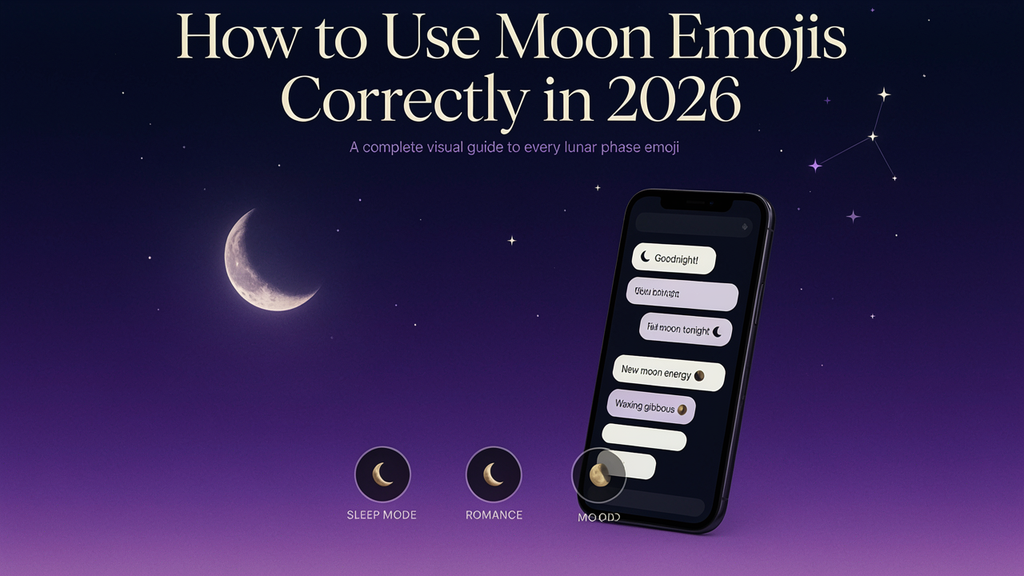
Moon emojis are easy to use, but accuracy improves when you understand what each symbol actually represents. The most important rule is to distinguish an emoji’s symbolic meaning from the Moon’s continuously changing astronomical appearance.
In 2026, lunar calendars remain useful for tracking new Moons, quarters, gibbous phases, and full Moons. For example, the September 2026 calendar shows a first quarter on September 19 and a full Moon later in the month, demonstrating how quickly the visible phase changes.
🌙 Use a moon emoji when you want a quick visual reference. It can make a message easier to understand without replacing the written explanation.
🔎 Always match the emoji to the written phase when creating educational content. This avoids confusion if the emoji artwork looks slightly different on a reader’s device.
📅 Check the date before publishing “today’s moon phase” content. Lunar information is time-sensitive, so an article or post can become inaccurate if its date is not updated.
🌒 Use the waxing crescent symbol for the growing crescent stage. It is especially useful during the first visible evenings following new Moon.
🌓 Use the first quarter symbol when the waxing Moon is approximately half illuminated. Do not assume every half-lit Moon is first quarter because last quarter also looks similar.
🌔 Use waxing gibbous when more than half the visible Moon is illuminated and the illuminated area is increasing. This stage leads toward full Moon.
🌕 Use the full moon symbol around the full Moon stage. For precise astronomy content, include the exact full-moon date and time rather than relying only on the emoji.
🌖 Use waning gibbous after full Moon when the illuminated portion is decreasing. The Moon can still look very bright during this phase.
🌗 Use last quarter for the waning half-lit stage. Adding the words “last quarter” makes the meaning clearer than relying on the symbol alone.
🌘 Use waning crescent near the end of the lunar cycle. It is often visible before sunrise depending on the date and local observing conditions.
🌑 Use new moon when discussing the astronomical new Moon. Remember that the symbol represents the phase concept, not a guarantee that the physical Moon is invisible from every location.
📱 Avoid placing too many moon emojis together in professional content. One carefully chosen symbol usually communicates the idea more effectively than a long decorative sequence.
✍️ In SEO articles, pair moon emojis with descriptive text. Search-friendly phrases such as “waxing crescent moon” are clearer than relying on emoji characters alone.
🌌 For social media, a combination such as “Waxing Crescent 🌒” is concise and understandable. It provides both searchable text and visual appeal.
🔭 For scientific claims, cite or reference reliable astronomical data. Emojis should never be presented as the source of phase calculations.
📸 Photography posts can benefit from including the phase, illumination, and local observation time. This gives readers information they can actually use.
🌍 Remember that moon appearance varies with viewing location. A fixed emoji cannot reproduce every orientation, altitude, or local sky condition.
✨ Use symbolic meanings thoughtfully. While waxing and waning phases are sometimes connected with personal themes, those interpretations are cultural or creative rather than scientific facts.
🗓️ Update time-sensitive lunar content regularly. A page about the current phase should clearly indicate the date so readers understand when the information was checked.
🌕 The best moon emoji practice combines accuracy and simplicity. Choose the correct phase, explain it in words when necessary, and use the symbol as a helpful visual shortcut.
Moon Emoji Copy-and-Paste Guide for Texts, Posts, and Games
A copy-and-paste moon emoji guide is useful when you need a lunar symbol quickly. The eight main symbols can be inserted into texts, blog posts, captions, calendars, study notes, and other digital content without manually drawing a Moon.
Some users also search for moon emojis in online games and puzzles, including situations where a specific Unicode symbol is required. In those cases, copying the exact character is more reliable than choosing a visually similar alternative.
🌑 New Moon 🌑 Copy this symbol when you need a dark lunar disk. It is commonly used for new Moon references, nighttime aesthetics, beginnings, and astronomy explanations.
🌒 Waxing Crescent 🌒 This is the standard choice for a growing crescent. Use it when the Moon is increasing in visible illumination after the new Moon stage.
🌓 First Quarter — 🌓 Copy this half-lit symbol for the first quarter stage. It represents the waxing half of the lunar cycle and is useful in educational charts.
🌔 Waxing Gibbous — 🌔 This symbol shows a mostly illuminated Moon before full Moon. It is useful for lunar calendars, astronomy posts, and celestial-themed social media captions.
🌕 Full Moon — 🌕 This is the most recognizable moon symbol. It works for full-moon announcements, nighttime messages, photography posts, astronomy discussions, and decorative captions.
🌖 Waning Gibbous — 🌖 Use this symbol after full Moon while most of the visible disk remains illuminated. It clearly represents the decreasing side of the lunar cycle.
🌗 Last Quarter — 🌗 This half-lit symbol represents the waning quarter stage. Pair it with the words “last quarter” when you want to avoid confusion with first quarter.
🌘 Waning Crescent — 🌘 Copy this symbol for the final crescent before new Moon. It works especially well for posts about early morning skies and the closing part of the lunar cycle.
📋 A complete copy-and-paste sequence is: 🌑 🌒 🌓 🌔 🌕 🌖 🌗 🌘. Keeping this sequence available makes selecting a lunar symbol fast and convenient.
📱 These emojis can be copied directly from supported devices. Their exact artwork may change between platforms, but the Unicode characters remain standardized.
💬 For texting, choose the emoji based on the mood or topic. A full Moon may feel dramatic, while a crescent can create a quieter and more subtle nighttime feeling.
📝 For articles, include the phase name alongside the emoji. This makes the content accessible to readers and gives search engines meaningful textual context.
🎮 In games that require a specific moon emoji, copy the exact character rather than recreating it manually. A visually similar symbol may not satisfy a character-based requirement.
🔐 Some online puzzles check Unicode characters rather than appearance. If a game requests a particular moon symbol, exact copy-and-paste usage can help prevent mistakes.
✨ Moon emojis can also decorate headings and lists. Use them selectively so the page remains professional and the important information stays easy to scan.
📚 Students can place emojis beside phase names when making study notes. The visual sequence can help reinforce the order of the lunar cycle.
🌌 Content creators can use a consistent moon symbol system throughout a series. This makes different articles or posts easier for readers to recognize and compare.
🔎 If you are searching for “moon phase copy paste,” a complete eight-symbol list is more useful than a single generic moon emoji because it covers the whole cycle.
🌙 When accuracy is important, confirm the phase before copying. A copy-and-paste list gives you the symbols, but it does not automatically tell you which one is correct today.
📋 The easiest complete reference remains: 🌑 New Moon, 🌒 Waxing Crescent, 🌓 First Quarter, 🌔 Waxing Gibbous, 🌕 Full Moon, 🌖 Waning Gibbous, 🌗 Last Quarter, 🌘 Waning Crescent.
FAQs
What is the current moon phase emoji?
The correct emoji depends on the actual lunar phase at the time you check. For September 14, 2026, the Moon is in the waxing crescent stage, making 🌒 the closest standard moon phase emoji.
What emoji represents a waxing crescent Moon?
The standard waxing crescent emoji is 🌒. It represents the early visible stage after new Moon, when the illuminated portion is increasing.
What are the eight moon phase emojis?
The common sequence is 🌑 new Moon, 🌒 waxing crescent, 🌓 first quarter, 🌔 waxing gibbous, 🌕 full Moon, 🌖 waning gibbous, 🌗 last quarter, and 🌘 waning crescent.
Can a moon emoji show the exact real moon phase?
No. An emoji represents a general phase category. The real Moon changes continuously, so exact illumination and phase timing require astronomical calculations or a reliable moon phase calendar.
What is the full moon emoji?
The full moon emoji is 🌕. It represents the visual concept of a fully illuminated Moon and is commonly used in astronomy, texting, social media, and nighttime-themed content.
What is the difference between waxing and waning moon emojis?
Waxing means the visible illuminated portion is increasing, while waning means it is decreasing. The Moon moves from new through waxing phases toward full, then through waning phases back toward new.
How long is the lunar cycle?
The synodic lunar cycle from one new Moon to the next averages about 29.53 days. The eight named phases divide this continuous cycle into convenient recognizable stages.
Can people in different hemispheres use the same moon emoji?
Yes, but the real Moon may appear oriented differently from different hemispheres. The astronomical phase remains the same, while the visual perspective can change.
How do I copy and paste a moon phase emoji?
Simply select the desired Unicode emoji, copy it, and paste it into your message or document. The main phase sequence is 🌑 🌒 🌓 🌔 🌕 🌖 🌗 🌘.
Is the moon phase emoji accurate for astronomy?
It is accurate as a general visual symbol for a phase category, but it is not a precision astronomical measurement. For exact illumination, timing, rise, set, or location-specific information, use a reliable astronomy source.
Conclusion
The current moon phase emoji is a convenient way to communicate lunar information in a compact and visually appealing format. The eight major symbols cover the complete lunar cycle, from 🌑 new Moon through waxing and waning stages to 🌘 waning crescent. They are useful for texting, social media, calendars, educational content, photography planning, and everyday digital communication.
For the most accurate results, treat the current moon phase emoji as a visual shortcut rather than a real-time astronomical instrument. Check a reliable moon phase calendar for the actual date, phase, illumination, and local viewing conditions, then choose the Unicode symbol that best matches the Moon. This approach keeps your content both attractive and scientifically responsible.
Read More What Does PMO Mean in Text? Meaning, Slang, Uses & Examples (2026)