
When choosing the right words for a card, email, message, or professional note, small differences in tone can matter. Best Wishes vs Good Wishes is a useful comparison because both expressions communicate kindness, support, and positive feelings, yet they can sound slightly different depending on the situation.
Understanding Best Wishes vs Good Wishes can help you select an expression that feels natural and appropriate. “Best wishes” is generally warmer and more established in written communication, while “good wishes” is understandable but less common in everyday modern English.
What Does Best Wishes Mean?
“Best wishes” is a friendly expression used to communicate hope that someone experiences happiness, success, health, or positive results. It works especially well at the end of letters, cards, emails, congratulations, farewells, and messages about important life events.
- 🌟 “Best wishes” expresses sincere hope for someone’s happiness, success, or future. It sounds warm without becoming overly personal, making it suitable for friends, colleagues, classmates, customers, and acquaintances in many everyday situations. 💌
- 💐 When someone begins a new job, “best wishes” is a natural way to show support. The phrase feels encouraging and positive while remaining professional enough for workplace emails, greeting cards, and congratulatory messages. 🌱
- ✨ “Best wishes” can work beautifully in farewell messages because it focuses attention on the person’s future. It communicates kindness and goodwill without requiring an emotional or highly personal statement. 👋
- 🎓 Graduation cards often use “best wishes” because graduates are entering a new chapter. The expression recognizes their achievement while also expressing hope for continued success, confidence, and happiness ahead. 📚
- 💍 For weddings, “best wishes” conveys warm congratulations and hopes for a happy marriage. It is respectful, cheerful, and appropriate when writing to close friends, relatives, coworkers, or couples you know casually. ❤️
- 🌸 “Best wishes” is also useful when someone moves to a new home or city. It gives the message a positive tone and shows that you genuinely hope the person enjoys their new beginning. 🏡
- 😊 In professional communication, “best wishes” can sound polished without being cold. It is particularly useful when ending an email to someone you respect but do not know on an intimate level. 💼
- 🎉 The expression can accompany congratulations for promotions, awards, business openings, or personal achievements. Its flexibility allows writers to celebrate success while keeping the wording simple, graceful, and universally understandable. 🏆
- 🌈 “Best wishes” does not always refer to a major event. You can use it when encouraging someone before an interview, examination, presentation, journey, or other moment that matters to them. 🍀
- 💖 The phrase carries a gentle emotional quality because “best” suggests the highest or most favorable hopes. It therefore sounds slightly more thoughtful than a basic statement of approval or acknowledgment. ✨
- 📩 At the end of a letter, “best wishes” functions as a warm closing. It is friendlier than a highly formal sign-off while remaining appropriate when the relationship is respectful and moderately familiar. 🌷
- 🌞 “Best wishes” can also be used independently as a short message. Even without additional explanation, the phrase communicates goodwill and leaves the recipient with a pleasant impression. 💛
- 🥳 Birthday messages frequently include “best wishes” because birthdays naturally involve hopes for happiness and memorable experiences. The wording is flexible enough for personal cards as well as workplace greetings. 🎂
- 🚀 When encouraging an entrepreneur, “best wishes” can recognize both present effort and future goals. It communicates confidence in the person without making unrealistic promises about what will happen next. 💼
- 🌿 “Best wishes” can sound especially considerate when someone faces a transition. Whether they are changing careers, relocating, retiring, or beginning studies, the phrase acknowledges the importance of their next chapter. 🕊️
- 💫 The expression is useful when you want warmth without excessive emotion. That balance explains why “best wishes” appears in many cards, emails, notes, announcements, and messages written for different kinds of relationships. 💌
- 🤝 In workplace settings, “best wishes” can create a friendly closing without sounding too casual. It is a practical choice when communicating with managers, clients, coworkers, applicants, or professional contacts. 📧
- 🌻 “Best wishes” is broad enough to fit many circumstances because it does not specify exactly what kind of success the recipient should experience. The reader can naturally interpret it according to their situation. ✨
- 🎁 A thoughtful message can become warmer when “best wishes” is followed by a specific hope. For example, mentioning happiness in a new home makes the expression feel more personal and meaningful. 🏠
- ❤️ Overall, “best wishes” is a versatile phrase for expressing positive intentions. Its combination of warmth, respect, and flexibility makes it one of the safest choices for general congratulatory and supportive communication. 🌟
What Does Good Wishes Mean?

“Good wishes” also communicates positive thoughts and goodwill, but it is less common as a routine closing in modern English. The phrase can still be correct when discussing sincere hopes, blessings, or positive intentions, especially in particular contexts or formal wording.
- 🌼 “Good wishes” literally suggests positive hopes directed toward another person. The meaning is easy to understand, although native speakers usually prefer more established expressions such as “best wishes” in everyday written communication. ✨
- 💌 You may encounter “good wishes” in formal, literary, ceremonial, or traditional language. It can sound sincere and respectful, particularly when the writer wants to emphasize goodwill rather than use a familiar email closing. 🌿
- 🌟 “Good wishes” can describe the positive intentions someone holds for another person. For example, a community may send good wishes to someone beginning an important journey, recovery, project, or personal transition. 🤝
- 🎓 In congratulatory writing, “good wishes” can express hope for future success. However, “best wishes” usually sounds more natural when directly addressing someone in a card, letter, or personal message. 📚
- 💍 A wedding message could include “good wishes” when the writer wants a traditional or slightly formal tone. Still, most contemporary wedding cards would normally choose “best wishes” or a more specific congratulatory expression. 💐
- 🌈 The phrase “good wishes” is not grammatically wrong simply because it is less common. English contains many expressions that are understandable and correct but differ in frequency, tone, or naturalness. 😊
- 📖 “Good wishes” may appear more naturally when the phrase itself is the subject of a sentence. For example, someone might say that they are sending good wishes to a colleague rather than using it as a sign-off. ✉️
- 🌱 When discussing kindness, “good wishes” can emphasize benevolent feelings. It suggests that the speaker genuinely wants positive outcomes for another person, even when the relationship is distant or formal. 💚
- 🎉 A community announcement might mention “good wishes” when acknowledging support from many people. In that context, the expression can sound collective and ceremonial rather than like an ordinary personal closing. 🤍
- 🕊️ “Good wishes” may also carry a slightly traditional flavor. Writers who want a gentle, old-fashioned, or ceremonial style may deliberately choose it instead of the more familiar “best wishes.” 🌸
- 💼 In business writing, “good wishes” is understandable but can feel unusual if used as the final email sign-off. “Best regards,” “kind regards,” or “best wishes” are generally more idiomatic choices. 📩
- 🌞 If someone asks whether “good wishes” is correct English, the answer is yes. The important issue is not basic correctness but whether the phrase fits the context and sounds natural to the intended audience. ✔️
- 💖 “Good wishes” can be meaningful when the writer wants to emphasize goodwill rather than rank the quality of their hopes. The wording focuses on positive intentions toward the recipient. 🌷
- 🎁 In a ceremonial message, “good wishes” may sound dignified and thoughtful. It can work particularly well when the surrounding language is formal, traditional, respectful, or deliberately elegant. ✨
- 🌍 English varies by region, culture, and context, so expressions can feel more or less familiar to different readers. “Good wishes” may therefore sound perfectly acceptable to some audiences while unusual to others. 🌐
- 🤗 If you want the safest general-purpose expression, “best wishes” is usually the stronger choice. If you deliberately want a traditional or less conventional phrase, “good wishes” can still communicate your meaning clearly. 💫
- 🌺 “Good wishes” works especially well when paired with a verb such as “send,” “offer,” or “extend.” These structures make the phrase feel more natural than using it alone as a routine closing. 📝
- 🚀 Someone might write, “We send our good wishes for your new venture.” This sounds more natural than simply writing “Good Wishes” at the bottom of a short business email. 💼
- 🌟 The emotional meaning of “good wishes” remains positive even when the phrase is less frequent. Readers generally understand it as a sincere expression of hope, goodwill, encouragement, or kindness. 💛
- 🌿 Ultimately, “good wishes” is best viewed as a valid but less conventional expression. Its usefulness depends on context, audience, and tone rather than on whether the phrase has a positive meaning. 😊
What Is the Main Difference Between Best Wishes and Good Wishes?
The main difference is usually naturalness and conventional usage rather than a completely different meaning. Both phrases express positive hopes, but “best wishes” is much more established as a closing and congratulatory expression in contemporary English.
- ⚖️ “Best wishes” and “good wishes” both communicate positive feelings, but they are not equally common. “Best wishes” is the more familiar expression, especially in letters, cards, emails, congratulations, and farewell messages. 💌
- 🌟 The word “best” gives the first phrase a stronger sense of offering one’s most favorable hopes. “Good” simply describes the wishes as positive, making the emotional emphasis slightly different. ✨
- 📩 In an email sign-off, “Best wishes” sounds natural and polished. “Good wishes” can sound unusual when placed alone at the end, even though readers will understand what the writer intends. 💼
- 🎓 For graduation congratulations, “best wishes” usually feels more idiomatic. It naturally connects achievement with hopes for a successful future, whereas “good wishes” may sound more formal or traditional. 📚
- 💍 Wedding cards commonly use “best wishes” because the expression has a warm, established association with celebrations. “Good wishes” is possible but is not usually the first phrase a modern writer chooses. 💐
- 🌿 “Good wishes” can sound more descriptive when used in sentences such as “We send our good wishes.” “Best wishes” can perform that role too, but it also works very naturally as a standalone closing. ✉️
- 😊 The difference is not that “best wishes” is kind and “good wishes” is unkind. Both are positive. The distinction mainly concerns conventional usage, tone, and how naturally each phrase fits particular situations. 🌈
- 💫 “Best wishes” tends to feel warmer in direct personal communication. “Good wishes” may feel more ceremonial, literary, or formal depending on the surrounding words and the purpose of the message. 🕊️
- 🤝 In professional correspondence, either phrase may communicate goodwill, but “best wishes” is generally safer if you want a friendly yet conventional closing. “Good wishes” may attract attention because it is less expected. 📧
- 🎉 When congratulating someone, “best wishes” combines recognition with encouragement. It can imply, “I hope things go wonderfully for you,” without requiring a longer explanation. 🌟
- 🌸 “Good wishes” does not necessarily sound less sincere. A thoughtful writer can make either expression meaningful by adding specific details about the recipient’s achievement, plans, or future. 💖
- 📖 Frequency matters in natural language. Expressions that native speakers encounter often can feel smoother, while less common combinations may sound formal or slightly unusual even when their meaning is clear. 🌍
- 🌞 If your goal is a simple, universally familiar phrase, choose “best wishes.” If your goal is a more distinctive, traditional, or ceremonial tone, “good wishes” may have a place. ✨
- 💼 The professional relationship can influence your choice. “Best wishes” is suitable for many colleagues and clients, while “good wishes” may require more context to avoid sounding oddly formal. 🤝
- 🥳 For birthdays and celebrations, “best wishes” is usually the natural option. It sounds cheerful without requiring the writer to specify exactly what they hope the recipient receives. 🎂
- 🚀 For future-oriented situations, both expressions can work, but “best wishes” usually feels more encouraging. It naturally accompanies phrases about new opportunities, journeys, careers, studies, and personal goals. 🌱
- 💛 The phrase “best wishes” has become a conventional social formula. Because readers recognize it immediately, it can communicate warmth efficiently without making the writer sound overly emotional. 💌
- 🌷 “Good wishes” can be preferable when the surrounding sentence already uses formal language. Its slightly less familiar character can contribute to a ceremonial or traditional style when used intentionally. 🕯️
- ✨ Neither phrase should be judged only by dictionary meaning. Good communication depends on context, audience, relationship, purpose, and the overall tone created by the complete message. 📝
- ❤️ In simple terms, “best wishes” is the more common and versatile choice, while “good wishes” is understandable and sometimes appropriate. Choosing between them is mainly a matter of natural usage and tone. 🌟
When Should You Use Best Wishes?

“Best wishes” is appropriate when you want to express goodwill, encouragement, congratulations, or hopes for someone’s future. It works across personal and professional situations, making it one of the most flexible expressions in written English.
- 🎓 Use “best wishes” when congratulating someone on graduation because it combines celebration with encouragement. The phrase naturally suggests that you hope their next stage brings rewarding opportunities, confidence, and continued success. 📚
- 💍 Wedding congratulations are another excellent setting for “best wishes.” The expression is warm and respectful, allowing you to celebrate the couple without sounding too personal if you are not especially close. 💐
- 💼 When a coworker starts a new job, “best wishes” offers friendly encouragement. It works particularly well in a farewell card, team email, professional message, or short note from a colleague. 🚀
- 🎂 “Best wishes” can accompany birthday greetings when you want something slightly more polished than a simple “Happy Birthday.” It leaves room for hopes of happiness, health, success, and memorable experiences. 🎉
- 🏡 Moving to a new home is another natural occasion. Writing “best wishes for your new home” creates a warm message that recognizes the excitement of beginning life in a different place. 🌿
- ✈️ Before someone travels, “best wishes” can communicate support for their journey. You can make it more personal by adding a hope for safe travels, wonderful experiences, or a smooth return. 🌍
- 📝 Use “best wishes” when someone is preparing for an important examination, interview, presentation, or competition. It provides encouragement without creating pressure or promising a particular result. 🍀
- 🌟 Retirement messages often use “best wishes” because retirement represents a significant transition. The phrase can express appreciation for the past while focusing positively on the recipient’s future. 🕊️
- 🥳 If someone launches a business or creative project, “best wishes” can show support. It is especially useful when you want to encourage the person without making exaggerated claims about their future success. 💼
- 💌 Use it at the end of an informal or semi-formal letter when you want a warm sign-off. It feels friendlier than some formal closings while remaining more polished than casual slang. 🌸
- 🤝 “Best wishes” is useful when you do not know the recipient extremely well. Its neutral warmth allows you to show kindness without assuming a level of personal closeness that may not exist. 😊
- 🌱 When someone begins university or a new course, “best wishes” expresses encouragement for the educational journey. Adding a sentence about enjoying the experience can make the message more personal. 📖
- 🏆 After someone receives an award, “best wishes” can follow congratulations. It helps shift the message from celebrating one achievement toward encouraging the recipient’s continued growth and accomplishments. ✨
- 💖 Use “best wishes” when writing to someone facing a major life change. Its broad meaning allows you to express support without needing to know every detail of their circumstances. 🌷
- 📧 In professional email, “Best wishes” is suitable when the relationship is friendly but still professional. It can soften a message while preserving a respectful and competent tone. 💼
- 🌞 A short “Best wishes!” can work when space is limited. Although brief, it still communicates positive intent and can be paired with a recipient’s name or a specific congratulations. 🎁
- 🌈 Use the phrase when you want your message to feel optimistic rather than dramatic. It communicates hope while allowing the recipient to interpret the exact kind of positive outcome that matters to them. ✨
- 💫 “Best wishes” is particularly useful when you want one phrase that works across different relationships. Friends, relatives, coworkers, teachers, neighbors, and acquaintances can all receive it appropriately. 🤗
- 🌻 If you are uncertain about the perfect wording for a card, “best wishes” is a dependable choice. It is familiar, respectful, positive, and adaptable to many occasions. 💌
- ❤️ The best use of “best wishes” is one that matches the occasion. Add a specific sentence whenever possible, because personal details turn a familiar expression into a message that feels genuinely thoughtful. 🌟
When Should You Use Good Wishes?
“Good wishes” is best used when its slightly formal, traditional, or descriptive tone fits the context. It can work naturally in sentences about sending or extending goodwill, although “best wishes” is usually preferable as a standard closing.
- 🌿 Use “good wishes” when discussing goodwill in a sentence rather than relying on it as a standalone sign-off. For example, “We send our good wishes” sounds more natural than simply writing “Good wishes.” 💌
- 🕊️ Ceremonial announcements may use “good wishes” because the phrase can sound respectful and traditional. It works particularly well when the surrounding language already has a formal or dignified style. ✨
- 🤝 A community group might send “good wishes” to someone beginning an important project. The wording emphasizes collective goodwill and can sound appropriate in an organizational announcement or public message. 🌟
- 🌍 In international communication, “good wishes” may appear because English expressions vary across cultures. If the phrase is common among your intended audience, it can be understood clearly and respectfully. 😊
- 📖 Writers sometimes choose “good wishes” for a literary or traditional tone. The phrase can contribute to a more formal voice when the writer intentionally avoids everyday conversational wording. 🕯️
- 💼 A business organization may write, “We extend our good wishes for your continued success.” This structure is more natural because the phrase is integrated into a complete sentence rather than used alone. 🚀
- 🎓 Graduation announcements can include “good wishes” when the message has a ceremonial style. However, if the goal is a natural personal greeting, “best wishes” will usually sound more familiar. 📚
- 💐 In wedding messages, “good wishes” can work when the writer prefers formal language. A more natural modern alternative would usually be “best wishes” or a specific expression of happiness. 💍
- 🌸 “Good wishes” can be useful when referring to positive intentions without emphasizing the idea of giving someone the very best possible outcome. The wording is gentle and broadly positive. 💖
- ✉️ If you are writing a formal announcement, consider using “good wishes” inside the body rather than at the end. This placement often makes the phrase feel smoother and more purposeful. 📝
- 🌞 “Good wishes” may suit a traditional card or ceremonial note where unusual wording is intentional. It can add a slightly old-fashioned character without changing the basic positive meaning. 🌷
- 💫 When communicating with someone from a culture where “good wishes” is familiar, there may be little reason to avoid it. Audience expectations should always influence language choices. 🌐
- 🎉 “Good wishes” can accompany a message of encouragement for a new beginning. For example, a writer might offer good wishes for a new role, new home, new business, or important journey. 🌱
- 🏆 In formal recognition messages, “good wishes” can follow congratulations. The expression then works as an additional statement of goodwill toward the recipient’s future. ✨
- 📩 If you are unsure whether “good wishes” sounds natural in your particular sentence, consider replacing it with “best wishes.” The alternative is generally more familiar and less likely to sound awkward. 😊
- 💛 “Good wishes” can still feel sincere when written thoughtfully. The phrase itself may be less common, but the surrounding message can communicate genuine warmth, appreciation, and encouragement. 🌼
- 🕯️ Traditional religious, ceremonial, or community writing may sometimes favor expressions such as “good wishes.” In these settings, tone and established local conventions matter more than everyday email habits. 🌿
- 🤗 If you want a conversational message between close friends, “good wishes” may not be the most natural option. More personal wording will usually communicate affection more directly. ❤️
- 🌟 When used intentionally, “good wishes” can distinguish a message from common formulas. The key is to make sure the phrase supports the desired tone rather than appearing accidentally unusual. 💌
- 🌈 Overall, choose “good wishes” when the context supports a formal, traditional, collective, or descriptive style. For ordinary cards and email closings, “best wishes” will usually be the smoother choice. ✨
Best Wishes vs Good Wishes in Professional Emails
Professional emails require a balance between friendliness and respect. “Best wishes” generally fits this balance well, while “good wishes” is better used within a complete sentence or when a formal, traditional tone is deliberately intended.
- 💼 “Best wishes” works well when ending a professional email because it sounds courteous without becoming excessively formal. It is particularly suitable when you have an established but friendly relationship with the recipient. 📧
- 🤝 When emailing a coworker who is leaving the company, “Best wishes” provides a warm closing. You can strengthen it by mentioning appreciation for their contribution or excitement about their next opportunity. 🌟
- 🚀 If a colleague has accepted a new position, “Best wishes” can follow congratulations naturally. It communicates support for their career while maintaining an appropriate professional tone. 💼
- 📩 “Good wishes” is possible in professional writing, but using it alone as a sign-off may sound less conventional. A complete sentence such as “We extend our good wishes” can feel more natural. ✨
- 🌿 When writing to a client, “Best wishes” can soften a message while preserving professionalism. It is especially helpful when the email concerns a positive development, completed project, or future collaboration. 🤝
- 🎓 If a professional contact is completing a qualification, “best wishes” provides a simple way to recognize their achievement. It avoids sounding overly personal while still expressing genuine encouragement. 📚
- 🌟 In a workplace farewell email, a short “Best wishes for the future” is clear and respectful. It acknowledges the transition and leaves the recipient with a positive impression. 👋
- 💌 “Best wishes” can be particularly useful when “Kind regards” feels too formal and “Take care” feels too casual. It occupies a comfortable middle ground for many professional relationships. 😊
- 📖 If your organization uses highly formal language, “good wishes” may occasionally fit inside an official statement. However, check the overall style so the phrase does not sound unexpectedly old-fashioned. 📝
- 🌞 A professional closing should match the relationship and purpose of the email. “Best wishes” is flexible because it communicates warmth without requiring the writer to reveal strong personal emotion. 💼
- 🌱 When a teammate begins parental leave, study leave, or another major transition, “Best wishes” can express support respectfully. Adding a specific sentence makes the message more thoughtful and memorable. 🌸
- 🏆 If a colleague receives an award or promotion, “Best wishes” works well after congratulations. It shifts attention toward continued success while keeping the message concise and professional. 🎉
- 💫 For a business opening or new professional venture, “best wishes” communicates encouragement without guaranteeing success. This makes it safer and more realistic than overly confident statements. 🚀
- ✉️ When closing an email to someone you have met only briefly, “Best wishes” can be warmer than a strictly formal sign-off. It still avoids the excessive familiarity of casual expressions. 🤝
- 🌍 International business communication benefits from familiar expressions. Because “best wishes” is widely understood, it can reduce ambiguity and help the message sound courteous across different professional backgrounds. 🌐
- 💖 “Good wishes” may be useful when representing an organization rather than yourself. A sentence such as “The team sends its good wishes” can create a collective and formal tone. 🏢
- 🌷 Avoid choosing a phrase simply because it sounds sophisticated. In professional communication, natural wording is usually more effective than unnecessarily unusual language. “Best wishes” succeeds largely because readers already recognize it. ✨
- 📧 A polished email can end with “Best wishes,” followed by your name. This simple format is appropriate for many semi-formal situations, particularly when the body of the message is friendly and respectful. 💼
- 🌈 If you are uncertain between the two expressions for business writing, “Best wishes” is usually the safer option. It is familiar, positive, and less likely to distract the reader from your actual message. 😊
- ❤️ Professional communication works best when tone feels intentional. Choose “Best wishes” for a warm conventional closing, and reserve “good wishes” for sentences or settings where its formal character feels natural. 🌟
Best Wishes vs Good Wishes for Cards and Special Occasions
Cards often allow more emotional freedom than professional emails. “Best wishes” is especially common for celebrations and transitions, while “good wishes” can work when the card has a traditional, ceremonial, or formal character.
- 💍 Wedding cards commonly use “best wishes” because it communicates happiness for the couple’s future. The phrase is warm enough for close relationships while remaining respectful when the writer is less familiar. 💐
- 🎓 Graduation cards benefit from “best wishes” because graduates are starting a new chapter. The expression combines celebration with encouragement for future education, career opportunities, personal growth, and success. 🌟
- 🎂 Birthday cards can use “best wishes” alongside “Happy Birthday.” This combination gives the message both an immediate celebration and a broader hope for happiness during the coming year. 🎉
- 🏡 New-home cards can say “Best wishes for your new home.” The wording feels welcoming and optimistic, especially when paired with a personal sentence about comfort, memories, or exciting beginnings. 🌿
- 🌸 Retirement cards are another natural setting for “best wishes.” It allows the writer to celebrate someone’s career while expressing hope that retirement brings enjoyable experiences and meaningful new routines. 🕊️
- 🚀 New-business cards can use “best wishes” to encourage an entrepreneur. It recognizes the courage involved in starting something new without making unrealistic claims about future financial success. 💼
- 💖 Anniversary cards often include “best wishes” when the writer wants a simple and respectful message. Couples who are close friends may prefer more personal wording, but the phrase remains universally understandable. 🌷
- ✈️ Travel cards can include “best wishes for your journey.” Adding a specific hope for safe and enjoyable travel makes the message more personal than using the phrase alone. 🌍
- 🎁 Congratulations cards can use “best wishes” after recognizing an achievement. This structure allows the writer to celebrate what happened while also encouraging the recipient’s future progress. 🏆
- 🌈 “Good wishes” may suit a traditional card where the writer wants a slightly formal style. However, “best wishes” will generally sound more natural to contemporary readers in ordinary celebration cards. ✨
- 📚 For academic achievements, “best wishes” feels supportive without becoming overly emotional. It works for school graduations, university completions, scholarships, certifications, and other educational milestones. 🎓
- 🌞 A simple card message can become more memorable when “best wishes” is followed by a specific detail. Mentioning the recipient’s new opportunity shows that the message was written thoughtfully rather than copied. 💌
- 🌟 If the recipient is a distant acquaintance, “best wishes” provides appropriate warmth without overstepping personal boundaries. It is a particularly safe choice for workplace, community, and social occasions. 🤝
- 🕯️ A ceremonial card may use “good wishes” if the overall wording is traditional. This choice can create a formal atmosphere, although it may sound less conversational than modern alternatives. 🌿
- 💐 When writing a wedding card, “Best wishes to you both” is concise and graceful. It focuses on the couple as a unit and expresses positive hopes without needing a lengthy message. 💍
- 🎉 For a birthday, “Best wishes for a wonderful year ahead” expands the phrase naturally. It gives the recipient a clear sense of optimism while remaining suitable for different relationships. 🎂
- 💫 For a farewell card, “Best wishes for your next chapter” offers a modern and encouraging tone. It recognizes change while focusing on possibility rather than sadness. 👋
- 🌱 For a new job, “Best wishes in your new role” is professional and personal at the same time. It shows encouragement without sounding overly familiar or emotional. 💼
- ❤️ The strongest card messages combine a familiar phrase with something specific. “Best wishes” becomes much more meaningful when followed by a sincere observation, memory, compliment, or hope. 🌷
- ✨ When choosing between the phrases for a card, consider the recipient first. “Best wishes” is normally the natural choice, while “good wishes” can be reserved for intentionally formal or traditional wording. 💌
Best Wishes vs Good Wishes: Examples in Sentences
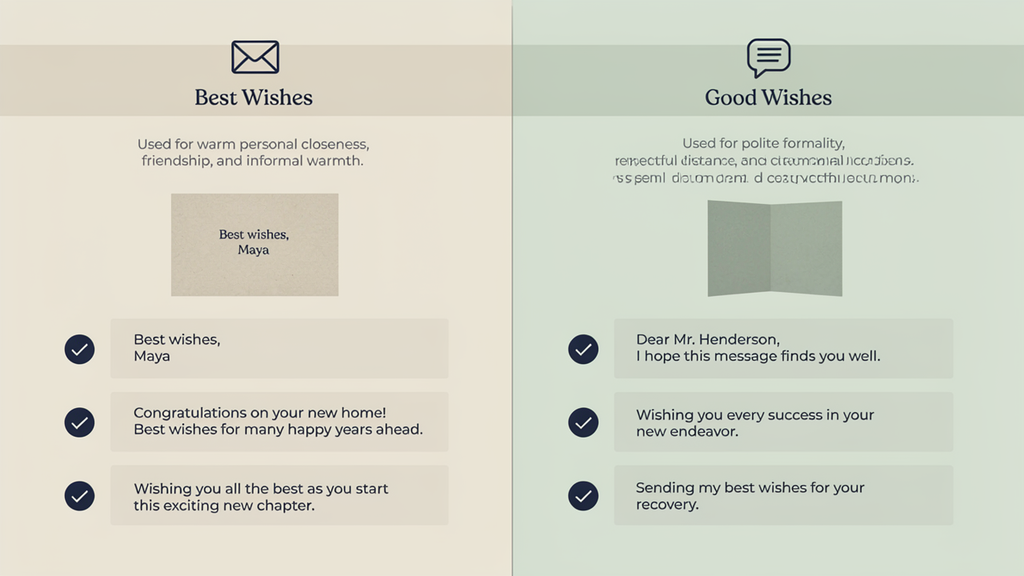
Seeing both expressions in complete sentences makes their difference easier to understand. “Best wishes” is generally more natural in direct greetings and closings, while “good wishes” often works better when describing or extending goodwill.
- 📝 “Best wishes for your new job” is a natural sentence because it directly communicates encouragement. The phrase works equally well in a card, email, text message, or professional farewell note. 💼
- 🎓 “Best wishes on your graduation” celebrates an achievement while looking toward the future. It is concise, friendly, and suitable for students, graduates, relatives, teachers, and professional acquaintances. 🌟
- 💍 “Best wishes to you both” is a simple wedding message. It avoids excessive detail while still communicating happiness, support, and positive hopes for the couple’s future together. 💐
- 🌱 “Best wishes for your new beginning” works for many transitions. It can accompany a new job, move, relationship, educational opportunity, business venture, or personal chapter without sounding overly specific. ✨
- 📧 “Best wishes” can stand alone as an email closing. Its familiarity makes it especially useful when the writer wants a professional message that feels warmer than a strictly formal sign-off. 🤝
- 🌿 “We send our good wishes for your continued success” uses “good wishes” naturally because the phrase is integrated into a complete sentence. The structure sounds more formal and collective than everyday conversation. 💼
- 🌟 “Please accept our good wishes for the future” has a ceremonial quality. It may suit an official message, organizational statement, or formal announcement more than a casual personal card. 🕊️
- 🎉 “Best wishes for a wonderful birthday” is natural and friendly. It adds a broad hope to the birthday greeting without repeating the same celebration words throughout the message. 🎂
- ✈️ “Best wishes for a safe and enjoyable journey” provides a specific purpose for the phrase. Adding the journey makes the message feel more personal and useful than a generic closing. 🌍
- 💖 “I’m sending my best wishes as you begin this new chapter” sounds warm and sincere. It works particularly well when someone is changing careers, moving, studying, or beginning another major life stage. 🌸
- 🏆 “Best wishes on your well-deserved promotion” combines recognition with encouragement. The wording feels appropriate for a coworker, manager, friend, or professional contact who has achieved career progress. 💼
- 🌞 “We extend our good wishes to the newly appointed team” sounds formal and organizational. Here, “good wishes” works because the sentence emphasizes collective goodwill rather than serving as a personal sign-off. 🤝
- 💌 “Best wishes for happiness in your new home” is warmer than simply writing “Best wishes.” The added detail tells the recipient exactly what positive outcome the writer hopes they experience. 🏡
- 📚 “Best wishes as you begin university” provides encouragement without making assumptions about the student’s specific career path. It is suitable for cards, messages, and short congratulatory notes. 🎓
- 🌈 “We send our good wishes for your successful event” can work in formal correspondence. The sentence sounds more official than “Best wishes for your event,” which would feel more personal. 🎉
- 🚀 “Best wishes with your new business” communicates support while leaving the future open. It encourages the entrepreneur without promising that the business will definitely become successful. 💼
- 🌷 “Best wishes for many happy years ahead” is a flexible phrase for anniversaries, retirements, weddings, and other milestones. Its broad wording allows the recipient to interpret happiness personally. 💖
- 🕯️ “Our good wishes are with you” can sound formal or traditional. It may be suitable in ceremonial writing, although a more conversational message would usually choose different wording. 🌿
- ✨ “Best wishes for everything that comes next” has a modern, open-ended quality. It works especially well for farewells and major transitions where the writer does not know exactly what the future holds. 🌱
- ❤️ Comparing examples shows that both expressions communicate goodwill, but their natural environments differ. “Best wishes” comfortably works as a greeting or closing, while “good wishes” often benefits from additional sentence structure. 💌
Which Is More Natural: Best Wishes or Good Wishes?
For most modern English communication, “best wishes” is the more natural choice. It is widely recognized as a greeting, congratulatory phrase, and sign-off. “Good wishes” remains understandable but generally needs a context that makes its wording feel intentional.
- 🌟 For a general-purpose message, choose “best wishes.” It is familiar enough for everyday readers and flexible enough to work in personal, social, educational, and professional communication. 💌
- 📧 As an email closing, “Best wishes” is clearly more natural. Readers recognize it immediately as a friendly sign-off, whereas “Good wishes” may sound slightly unusual when used by itself. 💼
- 🎉 In congratulations, “best wishes” also has a strong advantage. It naturally connects the achievement with hopes for future happiness, progress, confidence, or success. 🏆
- 💍 For weddings, “best wishes” is usually the conventional option. Its established association with celebration makes it feel appropriate without requiring the writer to explain the sentiment. 💐
- 🎓 For graduation, “best wishes” sounds supportive and optimistic. It recognizes that graduation is both an accomplishment and a beginning, making the phrase particularly suitable. 📚
- 🌿 “Good wishes” becomes more natural when placed inside a sentence. Expressions such as “We send our good wishes” provide enough structure to make the phrase feel deliberate and complete. 🤝
- 🌈 Naturalness does not mean that one phrase is correct and the other is incorrect. English speakers often choose among several grammatically acceptable expressions based on frequency, convention, tone, and context. 😊
- ✨ “Best wishes” is usually preferable when writing for a broad audience. Because the phrase is highly familiar, there is little risk that readers will wonder why you selected an unusual expression. 🌍
- 🕊️ “Good wishes” can be more suitable for formal or ceremonial writing. If the surrounding language is traditional, the phrase can contribute to an appropriately dignified tone. 🕯️
- 💼 In business communication, naturalness matters because unusual wording can distract from the main message. “Best wishes” generally communicates professionalism and friendliness without unnecessary complexity. 📩
- 🌞 For friends and relatives, “best wishes” is perfectly acceptable, although personal wording may sometimes be warmer. The phrase is a foundation that can be strengthened with specific memories or hopes. ❤️
- 🌱 For new beginnings, “best wishes” is particularly effective because it focuses naturally on the future. It communicates encouragement without specifying exactly what the recipient must achieve. 🚀
- 💫 If you are writing in a second language, “best wishes” is a useful phrase to remember. It is conventional, versatile, and easy to adapt to many common communication situations. 📖
- 🤝 For workplace relationships, “best wishes” can be warmer than “Regards” while remaining professional. It is especially useful when the email involves congratulations, farewell, encouragement, or positive news. 💼
- 🌸 If you want a traditional feel, “good wishes” may be worth considering. However, use it intentionally rather than assuming it is simply another interchangeable version of “best wishes.” ✨
- 🎁 The strongest choice depends on the sentence around the expression. A phrase that sounds slightly unusual alone may become perfectly natural when incorporated into a complete formal statement. 📝
- 🌍 Regional and cultural preferences can influence how expressions are received. When writing for an international audience, familiar formulas such as “best wishes” usually provide the safest communication. 🌐
- 💖 “Best wishes” is not necessarily more sincere than “good wishes.” Its advantage is that it has become a conventional way to communicate sincerity efficiently and naturally. 🌷
- 🌟 When editing your own writing, ask whether the phrase sounds like something your intended audience would normally read. This practical test often helps more than relying on dictionary definitions alone. 📚
- ❤️ In most situations, “best wishes” wins on naturalness, familiarity, and versatility. “Good wishes” remains valid, but it works best when the context intentionally supports its formal or traditional character. ✨
Best Wishes vs Good Wishes: Common Mistakes to Avoid
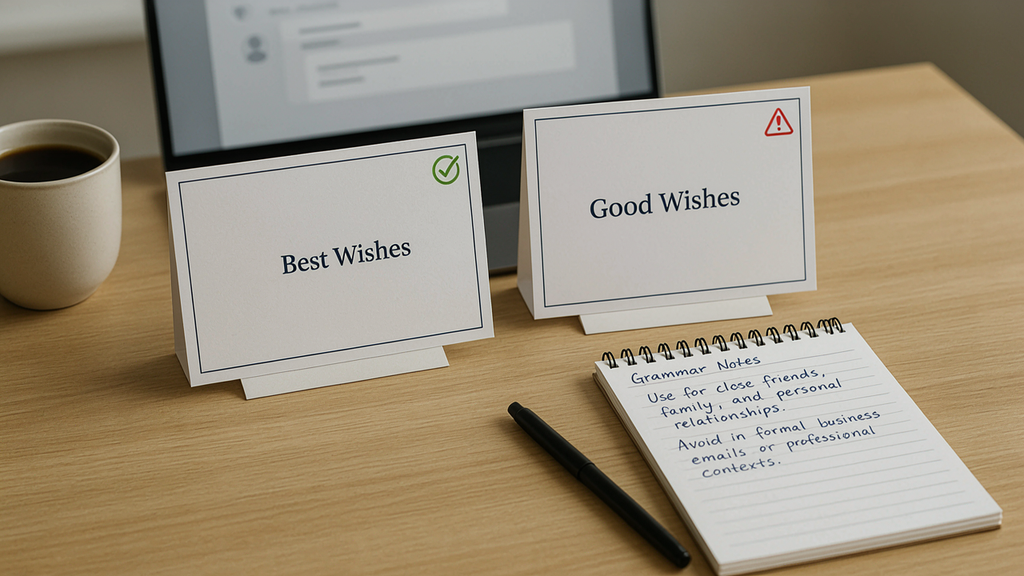
The biggest mistake is assuming that similar meanings always make expressions interchangeable. Choosing the right phrase requires attention to context, sentence structure, audience, relationship, and the level of formality you want to communicate.
- ⚠️ A common mistake is using “good wishes” automatically because it seems like a direct synonym for “best wishes.” While the meanings overlap, natural English depends on conventional usage as well. 📖
- 📧 Avoid using “Good wishes” as an email closing simply because it looks grammatically possible. “Best wishes” will generally sound more familiar, polished, and natural to contemporary professional readers. 💼
- 🌟 Another mistake is believing that “best wishes” must always be extremely personal. The phrase is actually broad enough for colleagues, clients, acquaintances, classmates, friends, and relatives. 🤝
- 💍 Do not assume wedding messages must use one exact formula. “Best wishes” is conventional, but a more personal sentence can make the card warmer and more memorable. 💐
- 🎓 Avoid repeating “best wishes” without adding relevant information in longer messages. The phrase works best when supported by a specific congratulations, observation, memory, or hope. 📚
- 🌿 Do not treat “good wishes” as incorrect English. The issue is usually naturalness and context rather than grammatical validity. Understanding this distinction helps you write more confidently. ✨
- 📝 Another mistake is choosing a phrase without considering the audience. A traditional expression may work in a ceremonial announcement but feel unusual in a casual text between close friends. 😊
- 💼 In professional writing, avoid overly emotional wording when a simple phrase will do. “Best wishes” often provides the right balance between friendliness and professional distance. 📩
- 🌈 Do not confuse “best wishes” with a guarantee of success. It expresses hope and goodwill rather than certainty about what will happen. This makes it appropriate for uncertain future situations. 🍀
- 💫 Avoid stuffing a short message with several similar expressions. Writing “Best wishes, good wishes, and every good hope” may sound repetitive rather than thoughtful. One strong phrase is usually enough. ✍️
- 🎉 When congratulating someone, avoid letting the closing phrase replace the actual congratulations. Mention what the person achieved first, then use “best wishes” to add future encouragement. 🏆
- 🏡 For a new home, do not simply copy a generic message if you know the recipient well. Mentioning comfort, happiness, family memories, or excitement can make the wording more genuine. 🌸
- 🚀 When writing about a new business, avoid promising guaranteed success. “Best wishes for your new venture” offers support while leaving room for the future to unfold naturally. 💼
- 🌞 Another mistake is thinking that a less common phrase automatically sounds more sophisticated. Natural language is often stronger than unnecessarily unusual vocabulary. ✨
- 💌 Avoid using “good wishes” in isolation if it feels awkward to you. Rewriting the sentence as “We send our good wishes” may make the intended formal tone clearer. 🌿
- 🌍 International readers may interpret expressions differently. If your audience is broad, familiar wording such as “best wishes” can reduce the possibility of confusion or unintended formality. 🌐
- 🤝 Do not ignore the relationship between writer and recipient. A close friend may appreciate personal affection, while a client may prefer concise professional warmth. 💼
- 📚 Avoid focusing only on dictionary definitions when choosing between similar expressions. Frequency, context, collocation, and social convention all influence whether a phrase sounds natural. 📝
- ❤️ A final common mistake is assuming that a short message cannot feel personal. Even “Best wishes” becomes meaningful when paired with one sincere, specific sentence about the recipient. 🌷
- 🌟 The easiest way to avoid mistakes is to read the complete message aloud. If the expression sounds natural for the relationship and occasion, your wording is likely heading in the right direction. 😊
Best Alternatives to Best Wishes and Good Wishes
Sometimes neither phrase perfectly matches your purpose. English offers several alternatives, including “best regards,” “kind regards,” “warm wishes,” “all the best,” and more specific expressions of congratulations, encouragement, or support.
- 🌟 “All the best” is a friendly alternative that works particularly well in emails, farewell messages, and informal professional communication. It sounds warm, modern, and slightly more conversational than “best wishes.” 💌
- 💼 “Best regards” is a stronger professional alternative when you want a polite and conventional email closing. It usually sounds more formal and businesslike than “best wishes.” 📧
- 🌷 “Kind regards” is another professional option. It communicates courtesy and respect while maintaining a relatively formal tone, making it suitable for clients, coworkers, and business contacts. 🤝
- 💖 “Warm wishes” feels more affectionate than “best wishes.” It works particularly well for personal cards, supportive messages, celebrations, and situations where you want to communicate genuine emotional warmth. 🌸
- 🎉 “Congratulations” is more specific when the recipient has achieved something. Instead of simply expressing future goodwill, it directly recognizes the accomplishment and can then be followed by “best wishes.” 🏆
- 🌱 “Wishing you success” is useful when the recipient is beginning a new job, business, project, course, or career stage. It makes the desired outcome more specific than a general wish. 🚀
- ✈️ “Safe travels” is a better choice when someone is leaving for a journey. It communicates a specific concern and can be followed by “best wishes for your trip” if additional warmth is desired. 🌍
- 🎓 “Wishing you all the best in your future” works well for graduates and people beginning new chapters. It combines encouragement with an open-ended hope for positive experiences. 📚
- 💐 “Wishing you happiness” can be more personal than either “best wishes” or “good wishes.” It is especially appropriate for weddings, anniversaries, new homes, and meaningful life transitions. ❤️
- 🌞 “Take care” is a more casual alternative. It works well with friends, relatives, and familiar coworkers but may be too informal for some business relationships. 😊
- 🕊️ “With warmest wishes” creates a more heartfelt tone. It is suitable for cards and personal notes when you want to express stronger affection without becoming overly emotional. 💌
- 💫 “Wishing you continued success” is particularly useful in professional communication. It recognizes previous achievements while expressing hope that the recipient will keep progressing. 💼
- 🌈 “Every good wish for your future” has a traditional feel. It can replace “best wishes” when the writer wants a slightly more formal or literary style. 📖
- 🤗 “Thinking of you” may be better when the main purpose is emotional support rather than congratulations. The phrase focuses on connection and care instead of future success. 💖
- 🎁 “Many happy returns” is a traditional birthday expression. It has a more specific purpose than “best wishes” and may sound especially natural in birthday cards depending on the audience. 🎂
- 🏡 “Wishing you happiness in your new home” is more detailed than either general wishes expression. Specific wording often feels more personal because it directly connects the sentiment to the recipient’s situation. 🌿
- 🚀 “Good luck” is appropriate when someone faces an uncertain challenge, such as an exam, interview, performance, or competition. It is more direct and informal than “best wishes.” 🍀
- ✨ “May your future be bright” offers a more expressive alternative. It can work in graduation, farewell, and new-beginning messages when a poetic tone is appropriate. 🌟
- 💼 “I wish you continued success” is a complete professional sentence that can sound polished in formal correspondence. It is more explicit than a simple “Best wishes” closing. 📩
- ❤️ The best alternative depends on your purpose. Choose “all the best” for friendly communication, “best regards” for formal business writing, and specific phrases when you want your message to address the occasion directly. 🌷
Final Guide to Choosing Best Wishes or Good Wishes
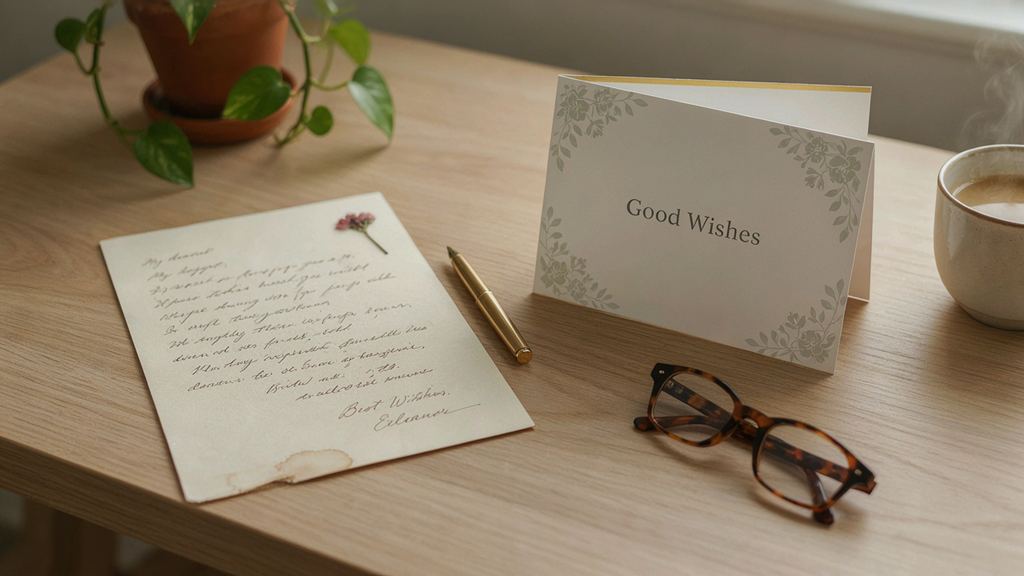
Choosing between the two phrases becomes simple when you focus on naturalness, context, and audience. In most everyday situations, “best wishes” is the safest and most idiomatic option, while “good wishes” has narrower stylistic uses.
- 🌟 Choose “best wishes” when you need a familiar expression that works in many situations. It is especially useful for congratulations, farewells, celebrations, professional emails, and future-oriented messages. 💌
- 🌿 Choose “good wishes” when you intentionally want a formal, traditional, collective, or descriptive expression. It works best when incorporated into a complete sentence rather than used as a routine closing. 📝
- 💼 For workplace emails, “best wishes” is usually the stronger choice because it balances warmth and professionalism. It feels friendly without crossing into unnecessary familiarity. 🤝
- 🎓 For graduation, use “best wishes” when you want to celebrate the achievement and encourage the graduate’s next chapter. The phrase naturally connects past accomplishment with future possibility. 📚
- 💍 For weddings, “best wishes” remains a conventional and graceful choice. You can make it more meaningful by adding a personal hope for happiness, companionship, or memorable years ahead. 💐
- 🎉 For birthdays, “best wishes” works as a general expression of positive hopes. Pairing it with “Happy Birthday” or a specific personal message creates a fuller and warmer greeting. 🎂
- 🚀 For new jobs and businesses, “best wishes” offers encouragement without guaranteeing success. This makes it both supportive and realistic when the future is still uncertain. 💼
- 📧 For professional sign-offs, “best wishes” is generally more natural than “good wishes.” If you need greater formality, “best regards” or “kind regards” may be better alternatives. ✨
- 🌍 For international audiences, familiar phrases are usually helpful. “Best wishes” is widely recognizable, so it can reduce the risk of a message sounding unnecessarily unusual or confusing. 🌐
- 💖 For close relationships, remember that the phrase itself is only part of the message. A specific memory, compliment, or sincere hope can make a short greeting feel much more personal. 🌷
- 🌞 If you want a modern conversational alternative, consider “all the best.” It is friendly, concise, and particularly common in informal and semi-formal written communication. 💌
- 🕊️ If your message is ceremonial, “good wishes” may fit better than it would in an ordinary text. Always consider whether the overall wording supports that traditional atmosphere. 🕯️
- 🌈 Do not worry that using “best wishes” sounds too generic. Familiar expressions are useful precisely because readers understand their positive intention immediately. 😊
- 💫 Do not force “good wishes” simply to avoid common language. Effective writing is not about sounding unusual; it is about choosing words that fit the purpose naturally. 📖
- 🤝 Consider your relationship with the recipient before choosing a closing. The same phrase can sound warm with one person, formal with another, and overly distant in a different situation. 💼
- 🌸 Consider the medium too. A greeting card may support more emotional language, while a business email usually benefits from concise and conventional wording. 📧
- 📝 Read the complete message rather than judging one phrase alone. Tone is created by the combination of greeting, body, closing, punctuation, relationship, and occasion. ✨
- 🏆 When celebrating an achievement, lead with the accomplishment. Then use “best wishes” or a specific future-oriented expression to complete the thought. 🎉
- ❤️ When uncertain, choose the expression that sounds most natural to your intended reader. For most contemporary English audiences, that will be “best wishes” rather than “good wishes.” 🌟
- 🌷 Ultimately, good communication is clear, sincere, and appropriate. Use “best wishes” for broad everyday usefulness, and use “good wishes” when its formal or traditional character genuinely suits the context. 💌
FAQs
What is the difference between “best wishes” and “good wishes”?
Both expressions communicate positive hopes and goodwill. However, “best wishes” is much more common and natural in modern English, especially for cards, congratulations, emails, farewells, and professional sign-offs.
Is “good wishes” correct English?
Yes, “good wishes” is understandable and grammatically valid. It is simply less common as a standalone greeting or closing, so context matters when deciding whether it sounds natural.
Is “best wishes” more common than “good wishes”?
Yes. “Best wishes” is a well-established expression in contemporary English and is widely used in personal and professional communication.
Can I use “best wishes” in a professional email?
Yes. “Best wishes” is appropriate for many semi-formal and friendly professional emails, especially when communicating congratulations, encouragement, farewell messages, or positive news.
Can I use “good wishes” at the end of an email?
You can, but it may sound less conventional. For most modern professional emails, “Best wishes,” “Best regards,” or “Kind regards” will usually sound more natural.
Is “best wishes” appropriate for weddings?
Yes. “Best wishes” is a common and respectful wedding expression. You can make it more personal by adding a specific hope for the couple’s happiness and future together.
Can “best wishes” be used for graduation?
Absolutely. “Best wishes” is particularly suitable for graduation because it celebrates the achievement while expressing positive hopes for the graduate’s next chapter.
Does “best wishes” mean “good luck”?
Not exactly. “Best wishes” expresses general goodwill and positive hopes, while “good luck” specifically wishes someone success in an uncertain or challenging situation.
What are good alternatives to “best wishes”?
Depending on the situation, alternatives include “all the best,” “best regards,” “kind regards,” “warm wishes,” “wishing you success,” “good luck,” and specific congratulations.
Which should I choose: “best wishes” or “good wishes”?
For most everyday communication, choose “best wishes.” Choose “good wishes” when you intentionally want a formal, traditional, collective, or ceremonial tone and the wording fits naturally.
Conclusion
The choice between these expressions becomes much easier once you understand how meaning and natural usage work together. Best Wishes vs Good Wishes is not mainly a question of right versus wrong; it is a question of which expression sounds most appropriate for your audience, relationship, and situation.
For most cards, congratulations, farewells, and professional messages, Best Wishes vs Good Wishes usually favors “best wishes” because it is familiar, flexible, and naturally understood. “Good wishes” still has value when a formal or traditional tone is intentional, so the best choice ultimately depends on context.
Read More 100+ Essential Japanese Words and Their English Meanings(2026)