
Learning Japanese becomes easier when you begin with words that you can use in real life. Essential Japanese Words help beginners understand common greetings, food, travel, family, numbers, and everyday conversations. Learning these practical words can build confidence and create a strong foundation for future language study.
This guide organizes useful vocabulary into simple topics with English meanings and example sentences. Whether you want to travel to Japan, understand Japanese culture, or start learning the language, Essential Japanese Words can help you communicate more naturally and improve your vocabulary step by step.
Japanese Greetings and Common Phrases for Beginners
Japanese greetings are among the first expressions every beginner should learn. They are useful for daily conversations, introductions, and polite interactions. Learning these phrases will help you start communicating with greater confidence.
| Japanese Word | English Meaning | Example Sentence |
| こんにちは (Konnichiwa) | Hello | こんにちは、元気ですか? (Hello, how are you?) |
| おはよう (Ohayou) | Good morning | おはよう!今日は早いね。 (Good morning! You’re early today.) |
| こんばんは (Konbanwa) | Good evening | こんばんは、お元気ですか? (Good evening, how are you?) |
| ありがとう (Arigatou) | Thank you | 手伝ってくれてありがとう。 (Thank you for helping me.) |
| ありがとうございます (Arigatou gozaimasu) | Thank you very much | 本当にありがとうございます。 (Thank you very much.) |
| どういたしまして (Douitashimashite) | You’re welcome | どういたしまして。 (You’re welcome.) |
| すみません (Sumimasen) | Excuse me / Sorry | すみません、駅はどこですか? (Excuse me, where is the station?) |
| ごめんなさい (Gomen nasai) | I’m sorry | ごめんなさい、遅れました。 (I’m sorry, I am late.) |
| はい (Hai) | Yes | はい、わかりました。 (Yes, I understand.) |
| いいえ (Iie) | No | いいえ、大丈夫です。 (No, I’m fine.) |
| さようなら (Sayonara) | Goodbye | さようなら、また会いましょう。 (Goodbye, let’s meet again.) |
| はじめまして (Hajimemashite) | Nice to meet you | はじめまして、よろしくお願いします。 (Nice to meet you.) |
| よろしくお願いします (Yoroshiku onegaishimasu) | Please treat me kindly | これからよろしくお願いします。 (I look forward to knowing you.) |
| 元気ですか (Genki desu ka) | How are you? | お元気ですか? (How are you?) |
| 元気です (Genki desu) | I’m fine | はい、元気です。 (Yes, I’m fine.) |
| お元気で (Ogenki de) | Take care | どうぞお元気で。 (Please take care.) |
| いってきます (Ittekimasu) | I’m leaving | 行ってきます! (I’m leaving now!) |
| ただいま (Tadaima) | I’m home | ただいま!帰りました。 (I’m home!) |
| おかえり (Okaeri) | Welcome home | おかえり、お疲れさま。 (Welcome home, good job today.) |
| またね (Mata ne) | See you later | またね、明日会おう。 (See you later, see you tomorrow.) |
Essential Japanese Food and Drinks Vocabulary
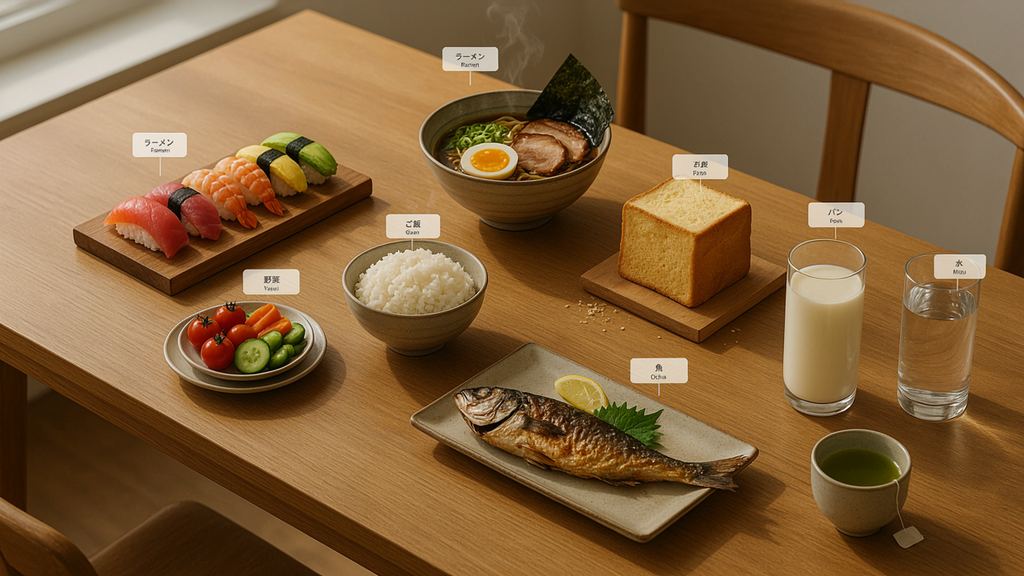
Food vocabulary is useful when eating at Japanese restaurants or visiting Japan. These common words help beginners understand menus, order meals, and talk about different foods and drinks.
| Japanese Word | English Meaning | Example Sentence |
| ご飯 (Gohan) | Rice / Meal | ご飯を食べます。 (I eat rice.) |
| 寿司 (Sushi) | Sushi | 寿司が大好きです。 (I love sushi.) |
| ラーメン (Raamen) | Ramen | ラーメンを食べたいです。 (I want to eat ramen.) |
| 水 (Mizu) | Water | 水をください。 (Please give me water.) |
| お茶 (Ocha) | Tea | お茶を飲みます。 (I drink tea.) |
| コーヒー (Koohii) | Coffee | 朝にコーヒーを飲みます。 (I drink coffee in the morning.) |
| 牛乳 (Gyunyuu) | Milk | 牛乳を買いました。 (I bought milk.) |
| パン (Pan) | Bread | パンを食べます。 (I eat bread.) |
| 果物 (Kudamono) | Fruit | 果物は健康にいいです。 (Fruit is good for your health.) |
| 野菜 (Yasai) | Vegetables | 野菜をたくさん食べます。 (I eat many vegetables.) |
| 魚 (Sakana) | Fish | 魚を料理します。 (I cook fish.) |
| 肉 (Niku) | Meat | 肉は食べません。 (I don’t eat meat.) |
| 卵 (Tamago) | Egg | 卵を二つください。 (Please give me two eggs.) |
| 食べ物 (Tabemono) | Food | 日本の食べ物が好きです。 (I like Japanese food.) |
| 飲み物 (Nomimono) | Drink | 冷たい飲み物がほしいです。 (I want a cold drink.) |
| 美味しい (Oishii) | Delicious | この料理は美味しいです。 (This food is delicious.) |
| 甘い (Amai) | Sweet | このケーキは甘いです。 (This cake is sweet.) |
| 辛い (Karai) | Spicy | このカレーは辛いです。 (This curry is spicy.) |
| 塩 (Shio) | Salt | 塩を少し入れます。 (I add a little salt.) |
| 箸 (Hashi) | Chopsticks | 箸を使います。 (I use chopsticks.) |
Useful Japanese Travel Words and Directions
Travel words can make a trip to Japan easier and more enjoyable. These useful terms cover transportation, directions, locations, and other situations that travelers commonly experience.
| Japanese Word | English Meaning | Example Sentence |
| 空港 (Kuukou) | Airport | 空港へ行きます。 (I am going to the airport.) |
| 駅 (Eki) | Station | 駅はどこですか? (Where is the station?) |
| 電車 (Densha) | Train | 電車で東京へ行きます。 (I go to Tokyo by train.) |
| タクシー (Takushii) | Taxi | タクシーを呼んでください。 (Please call a taxi.) |
| バス (Basu) | Bus | バスで学校へ行きます。 (I go to school by bus.) |
| ホテル (Hoteru) | Hotel | ホテルを予約しました。 (I reserved a hotel.) |
| 道 (Michi) | Road / Way | この道をまっすぐ行きます。 (Go straight on this road.) |
| まっすぐ (Massugu) | Straight ahead | まっすぐ行ってください。 (Please go straight.) |
| 左 (Hidari) | Left | 左へ曲がってください。 (Please turn left.) |
| 右 (Migi) | Right | 次の角を右へ曲がります。 (Turn right at the next corner.) |
| ここ (Koko) | Here | ここに座ってください。 (Please sit here.) |
| そこ (Soko) | There | そこは駅です。 (That is the station.) |
| あそこ (Asoko) | Over there | あそこにホテルがあります。 (There is a hotel over there.) |
| どこ (Doko) | Where | トイレはどこですか? (Where is the toilet?) |
| 切符 (Kippu) | Ticket | 切符を買いました。 (I bought a ticket.) |
| 旅行 (Ryokou) | Travel / Trip | 日本へ旅行します。 (I am traveling to Japan.) |
| 歩く (Aruku) | To walk | 駅まで歩きます。 (I walk to the station.) |
| 時間 (Jikan) | Time | 時間がありますか? (Do you have time?) |
| 地図 (Chizu) | Map | 地図を見ています。 (I am looking at a map.) |
| 日本 (Nihon) | Japan | 日本は美しい国です。 (Japan is a beautiful country.) |
Basic Japanese Family and Relationship Words
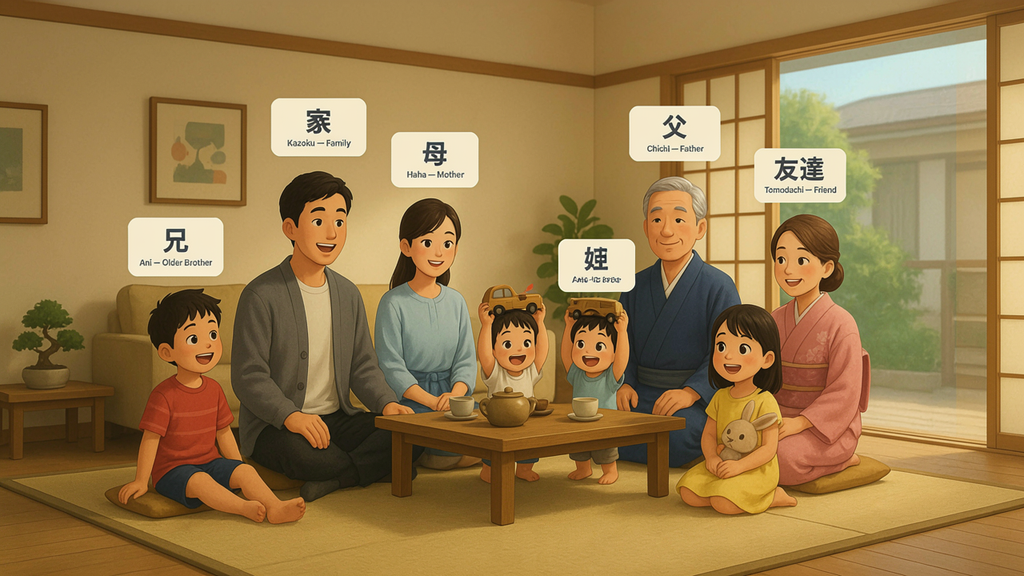
Family vocabulary helps learners talk about the people around them. These words are useful for introductions, conversations, and understanding relationships in Japanese daily life.
| Japanese Word | English Meaning | Example Sentence |
| 家族 (Kazoku) | Family | 私の家族は五人です。 (There are five people in my family.) |
| 父 (Chichi) | Father | 父は会社員です。 (My father is an office worker.) |
| 母 (Haha) | Mother | 母は料理が上手です。 (My mother is good at cooking.) |
| 息子 (Musuko) | Son | 私の息子は学生です。 (My son is a student.) |
| 娘 (Musume) | Daughter | 娘は学校へ行きます。 (My daughter goes to school.) |
| 兄 (Ani) | Older brother | 兄は東京に住んでいます。 (My older brother lives in Tokyo.) |
| 姉 (Ane) | Older sister | 姉は先生です。 (My older sister is a teacher.) |
| 弟 (Otouto) | Younger brother | 弟と遊びます。 (I play with my younger brother.) |
| 妹 (Imouto) | Younger sister | 妹は元気です。 (My younger sister is well.) |
| 祖父 (Sofu) | Grandfather | 祖父は優しいです。 (My grandfather is kind.) |
| 祖母 (Sobo) | Grandmother | 祖母に電話します。 (I call my grandmother.) |
| 友達 (Tomodachi) | Friend | 友達と話します。 (I talk with my friend.) |
| 親友 (Shinyuu) | Best friend | 彼は私の親友です。 (He is my best friend.) |
| 恋人 (Koibito) | Romantic partner | 彼女は恋人です。 (She is my partner.) |
| 好き (Suki) | Like | 日本語が好きです。 (I like Japanese.) |
| 大好き (Daisuki) | Really like / Love | 家族が大好きです。 (I love my family.) |
| 愛してる (Aishiteru) | I love you | 心から愛してる。 (I love you from my heart.) |
| 仲間 (Nakama) | Companion | 彼らは大切な仲間です。 (They are important companions.) |
| 関係 (Kankei) | Relationship | 二人は良い関係です。 (The two have a good relationship.) |
| 家 (Uchi / Ie) | Home | 家に帰ります。 (I am going home.) |
Beautiful Japanese Nature and Weather Words
Nature vocabulary helps beginners describe the world around them. Many Japanese words connected with seasons, landscapes, and weather also reflect the beauty of Japanese culture and daily life.
| Japanese Word | English Meaning | Example Sentence |
| 桜 (Sakura) | Cherry blossom | 桜が咲いています。 (The cherry blossoms are blooming.) |
| 太陽 (Taiyou) | Sun | 太陽が明るいです。 (The sun is bright.) |
| 月 (Tsuki) | Moon | 月がきれいです。 (The moon is beautiful.) |
| 星 (Hoshi) | Star | 星がたくさん見えます。 (I can see many stars.) |
| 雨 (Ame) | Rain | 今日は雨です。 (It is raining today.) |
| 雪 (Yuki) | Snow | 雪が降っています。 (Snow is falling.) |
| 風 (Kaze) | Wind | 今日は風が強いです。 (The wind is strong today.) |
| 雲 (Kumo) | Cloud | 空に雲があります。 (There are clouds in the sky.) |
| 木 (Ki) | Tree | 大きな木があります。 (There is a big tree.) |
| 海 (Umi) | Sea | 海を見に行きます。 (I am going to see the sea.) |
| 山 (Yama) | Mountain | あの山は高いです。 (That mountain is tall.) |
| 花 (Hana) | Flower | 花がきれいです。 (The flowers are beautiful.) |
| 草 (Kusa) | Grass | 草の上に座ります。 (I sit on the grass.) |
| 虹 (Niji) | Rainbow | 空に虹があります。 (There is a rainbow in the sky.) |
| 火 (Hi) | Fire | 火に気をつけてください。 (Please be careful with fire.) |
| 暑い (Atsui) | Hot | 今日は暑いです。 (It is hot today.) |
| 寒い (Samui) | Cold | 今朝は寒いです。 (This morning is cold.) |
| 天気 (Tenki) | Weather | 今日の天気はいいです。 (The weather is good today.) |
| 春 (Haru) | Spring | 春が来ました。 (Spring has come.) |
| 秋 (Aki) | Autumn | 秋の空は美しいです。 (The autumn sky is beautiful.) |
Common Japanese Color Names and Number Words
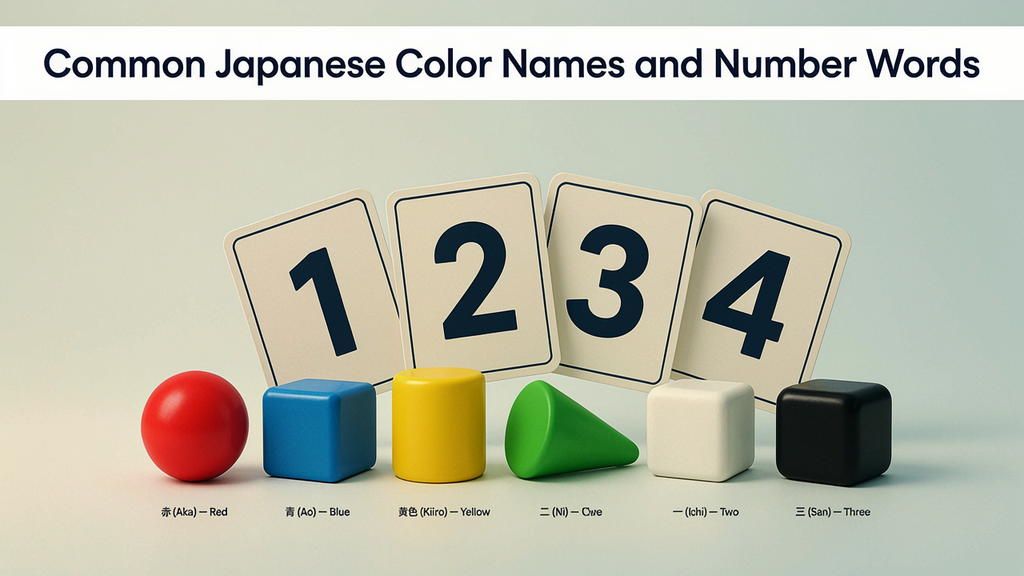
Colors and numbers are useful in many everyday situations, including shopping, describing objects, understanding prices, and telling quantities. These basic Japanese words are important for every beginner.
| Japanese Word | English Meaning | Example Sentence |
| 赤 (Aka) | Red | 赤い車が好きです。 (I like red cars.) |
| 青 (Ao) | Blue | 空は青いです。 (The sky is blue.) |
| 白 (Shiro) | White | 白い猫がいます。 (There is a white cat.) |
| 黒 (Kuro) | Black | 黒い服を着ます。 (I wear black clothes.) |
| 黄色 (Kiiro) | Yellow | 黄色い花です。 (It is a yellow flower.) |
| 緑 (Midori) | Green | 葉は緑です。 (The leaves are green.) |
| 紫 (Murasaki) | Purple | 紫の花が好きです。 (I like purple flowers.) |
| 茶色 (Chairo) | Brown | 茶色の犬です。 (It is a brown dog.) |
| 一 (Ichi) | One | りんごを一つください。 (Please give me one apple.) |
| 二 (Ni) | Two | 二人います。 (There are two people.) |
| 三 (San) | Three | 三時です。 (It is three o’clock.) |
| 四 (Yon) | Four | 四つ買いました。 (I bought four.) |
| 五 (Go) | Five | 五分待ってください。 (Please wait five minutes.) |
| 六 (Roku) | Six | 六人の学生です。 (There are six students.) |
| 七 (Nana) | Seven | 七時に起きます。 (I wake up at seven.) |
| 八 (Hachi) | Eight | 八月が好きです。 (I like August.) |
| 九 (Kyuu) | Nine | 九時に会いましょう。 (Let’s meet at nine.) |
| 十 (Juu) | Ten | 十個あります。 (There are ten.) |
| 百 (Hyaku) | One hundred | 百円です。 (It is 100 yen.) |
| 数 (Kazu) | Number / Count | 数を数えます。 (I count the numbers.) |
Everyday Japanese Words for Daily Conversations
Everyday vocabulary helps learners understand common activities at home, school, work, and public places. These practical words are useful for building simple Japanese sentences and daily conversations.
| Japanese Word | English Meaning | Example Sentence |
| 家 (Ie) | House / Home | 家にいます。 (I am at home.) |
| 学校 (Gakkou) | School | 学校へ行きます。 (I go to school.) |
| 仕事 (Shigoto) | Work / Job | 仕事が忙しいです。 (Work is busy.) |
| 勉強 (Benkyou) | Study | 日本語を勉強します。 (I study Japanese.) |
| 話す (Hanasu) | To speak | 日本語を話します。 (I speak Japanese.) |
| 聞く (Kiku) | To listen / Ask | 音楽を聞きます。 (I listen to music.) |
| 見る (Miru) | To see / Watch | 映画を見ます。 (I watch a movie.) |
| 書く (Kaku) | To write | 手紙を書きます。 (I write a letter.) |
| 読む (Yomu) | To read | 本を読みます。 (I read a book.) |
| 寝る (Neru) | To sleep | 十時に寝ます。 (I sleep at ten.) |
| 行く (Iku) | To go | 店へ行きます。 (I go to the shop.) |
| 来る (Kuru) | To come | 友達が来ます。 (My friend is coming.) |
| 買う (Kau) | To buy | 新しい本を買います。 (I buy a new book.) |
| お金 (Okane) | Money | お金がありません。 (I don’t have money.) |
| 今 (Ima) | Now | 今、忙しいです。 (I am busy now.) |
| 今日 (Kyou) | Today | 今日は暑いです。 (Today is hot.) |
| 明日 (Ashita) | Tomorrow | 明日行きます。 (I will go tomorrow.) |
| 昨日 (Kinou) | Yesterday | 昨日映画を見ました。 (I watched a movie yesterday.) |
| いい (Ii) | Good | 今日はいい日です。 (Today is a good day.) |
| 悪い (Warui) | Bad | 天気が悪いです。 (The weather is bad.) |
Simple Japanese Words and Phrases for Tourists
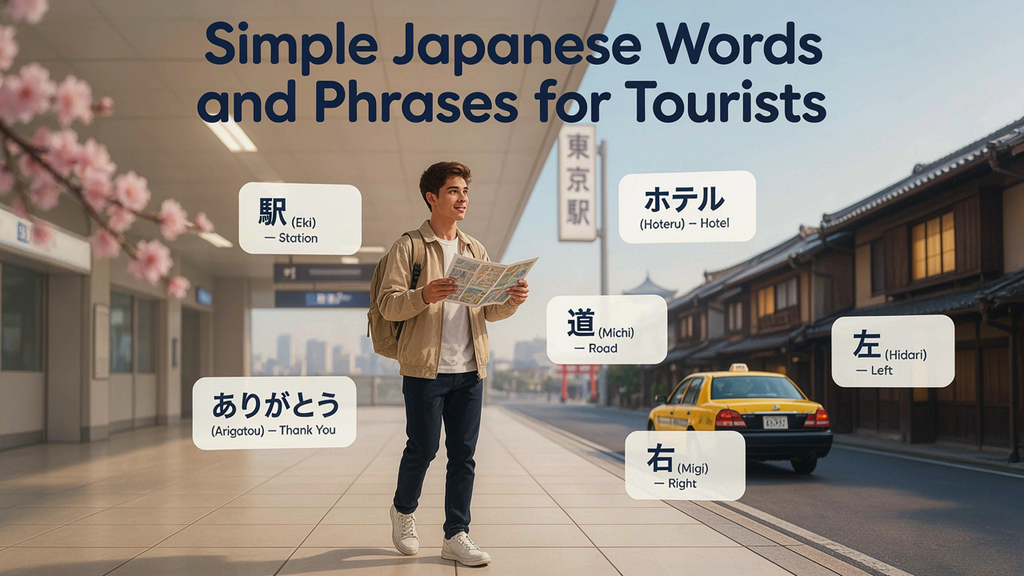
Tourists can communicate more easily by learning a few practical Japanese phrases. These expressions are useful for restaurants, shopping, transportation, hotels, and asking local people for help.
| Japanese Word | English Meaning | Example Sentence |
| お願いします (Onegaishimasu) | Please | これをお願いします。 (This one, please.) |
| これはいくらですか (Kore wa ikura desu ka) | How much is this? | これはいくらですか? (How much is this?) |
| トイレはどこですか (Toire wa doko desu ka) | Where is the toilet? | すみません、トイレはどこですか? (Excuse me, where is the toilet?) |
| メニューをください (Menyuu o kudasai) | Please give me the menu | メニューをください。 (Please give me the menu.) |
| わかりません (Wakarimasen) | I don’t understand | すみません、わかりません。 (Sorry, I don’t understand.) |
| 英語を話せますか (Eigo o hanasemasu ka) | Can you speak English? | 英語を話せますか? (Can you speak English?) |
| 助けて (Tasukete) | Help me | 助けてください! (Please help me!) |
| ここに行きたいです (Koko ni ikitai desu) | I want to go here | ここに行きたいです。 (I want to go here.) |
| 駅はどこですか (Eki wa doko desu ka) | Where is the station? | 駅はどこですか? (Where is the station?) |
| ホテルはどこですか (Hoteru wa doko desu ka) | Where is the hotel? | ホテルはどこですか? (Where is the hotel?) |
| おすすめは何ですか (Osusume wa nan desu ka) | What do you recommend? | おすすめは何ですか? (What do you recommend?) |
| これをください (Kore o kudasai) | This one, please | これをください。 (This one, please.) |
| 大丈夫です (Daijoubu desu) | It’s okay / I’m fine | はい、大丈夫です。 (Yes, I’m fine.) |
| ちょっと待ってください (Chotto matte kudasai) | Please wait a moment | ちょっと待ってください。 (Please wait a moment.) |
| だめ (Dame) | No / Not allowed | ここではだめです。 (It is not allowed here.) |
| 写真を撮ってもいいですか (Shashin o totte mo ii desu ka) | May I take a photo? | 写真を撮ってもいいですか? (May I take a photo?) |
| 日本語が少しわかります (Nihongo ga sukoshi wakarimasu) | I understand a little Japanese | 日本語が少しわかります。 (I understand a little Japanese.) |
| 道を教えてください (Michi o oshiete kudasai) | Please tell me the way | 駅への道を教えてください。 (Please tell me the way to the station.) |
| ください (Kudasai) | Please give me | 水をください。 (Please give me water.) |
| ありがとうございました (Arigatou gozaimashita) | Thank you very much | どうもありがとうございました。 (Thank you very much.) |
Important Japanese Vocabulary for Language Learners
Learning about Japanese writing and study terms can make the language easier to understand. These important words introduce beginners to Hiragana, Katakana, Kanji, grammar, pronunciation, and effective vocabulary practice.
| Japanese Word | English Meaning | Example Sentence |
| ひらがな (Hiragana) | Hiragana | ひらがなを勉強しています。 (I am studying Hiragana.) |
| カタカナ (Katakana) | Katakana | カタカナを読めます。 (I can read Katakana.) |
| 漢字 (Kanji) | Kanji | 漢字は難しいです。 (Kanji is difficult.) |
| 発音 (Hatsuon) | Pronunciation | 発音を練習します。 (I practice pronunciation.) |
| 単語 (Tango) | Word / Vocabulary | 新しい単語を覚えます。 (I learn a new word.) |
| 文法 (Bunpou) | Grammar | 文法を勉強します。 (I study grammar.) |
| 文 (Bun) | Sentence | この文を読んでください。 (Please read this sentence.) |
| 声 (Koe) | Voice | 大きな声で話してください。 (Please speak in a loud voice.) |
| 聴解 (Choukai) | Listening comprehension | 聴解の練習をします。 (I practice listening comprehension.) |
| 読解 (Dokkai) | Reading comprehension | 読解が上手になりました。 (My reading comprehension improved.) |
| 書き取り (Kakitori) | Dictation / Writing practice | 書き取りを練習します。 (I practice dictation.) |
| 覚える (Oboeru) | To remember | 新しい言葉を覚えます。 (I remember new words.) |
| 練習 (Renshuu) | Practice | 毎日練習します。 (I practice every day.) |
| 日本語能力試験 (Nihongo Nouryoku Shiken) | JLPT | 日本語能力試験を受けます。 (I will take the JLPT.) |
| 辞書 (Jisho) | Dictionary | 辞書で調べます。 (I check it in the dictionary.) |
| 単語カード (Tango kaado) | Vocabulary flashcard | 単語カードを使います。 (I use vocabulary flashcards.) |
| 復習 (Fukushuu) | Review | 今日の復習をします。 (I review today’s lesson.) |
| 会話 (Kaiwa) | Conversation | 日本語で会話します。 (I have a conversation in Japanese.) |
| 上手 (Jouzu) | Skillful / Good at | 日本語が上手ですね。 (You are good at Japanese.) |
| 初心者 (Shoshinsha) | Beginner | 私は日本語の初心者です。 (I am a Japanese beginner.) |
Practical Japanese Words Every Beginner Should Know
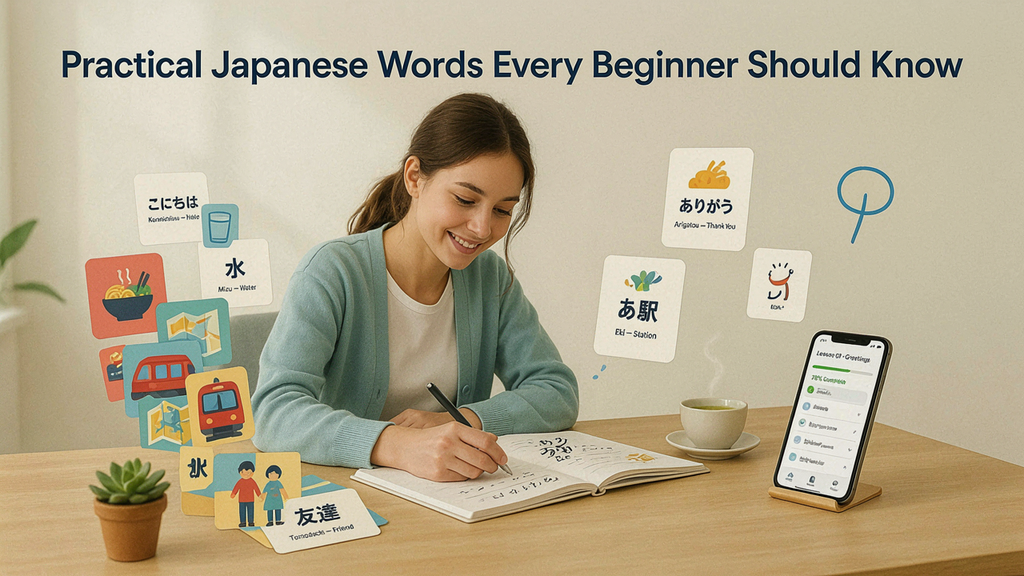
Practical vocabulary helps learners express feelings, ideas, goals, and everyday experiences. These useful Japanese words can make your conversations more meaningful as you move beyond basic greetings.
| Japanese Word | English Meaning | Example Sentence |
| 始め (Hajime) | Beginning / Start | これが始めです。 (This is the beginning.) |
| 目標 (Mokuhyou) | Goal | 私の目標は日本語を話すことです。 (My goal is to speak Japanese.) |
| 知識 (Chishiki) | Knowledge | 知識を増やしたいです。 (I want to increase my knowledge.) |
| 学習 (Gakushuu) | Learning | 日本語の学習は楽しいです。 (Learning Japanese is enjoyable.) |
| 毎日 (Mainichi) | Every day | 毎日日本語を勉強します。 (I study Japanese every day.) |
| もう一度 (Mou ichido) | One more time | もう一度言ってください。 (Please say it one more time.) |
| ゆっくり (Yukkuri) | Slowly | ゆっくり話してください。 (Please speak slowly.) |
| 頑張って (Ganbatte) | Do your best | 試験、頑張って! (Do your best on the exam!) |
| やった (Yatta) | I did it! | やった!できました。 (I did it!) |
| 大丈夫 (Daijoubu) | Okay / All right | 大丈夫です、心配しないで。 (It’s okay, don’t worry.) |
| 素晴らしい (Subarashii) | Wonderful | 素晴らしい仕事です。 (It is wonderful work.) |
| 嬉しい (Ureshii) | Happy / Glad | 会えて嬉しいです。 (I am happy to meet you.) |
| 悲しい (Kanashii) | Sad | その話は悲しいです。 (That story is sad.) |
| 驚く (Odoroku) | To be surprised | そのニュースに驚きました。 (I was surprised by the news.) |
| 心 (Kokoro) | Heart / Mind | 心からありがとう。 (Thank you from my heart.) |
| 世界 (Sekai) | World | 世界を旅行したいです。 (I want to travel the world.) |
| 平和 (Heiwa) | Peace | 世界の平和を願います。 (I wish for world peace.) |
| 希望 (Kibou) | Hope | 希望を持ってください。 (Please have hope.) |
| 未来 (Mirai) | Future | 明るい未来を信じます。 (I believe in a bright future.) |
| 夢 (Yume) | Dream | 私の夢は日本へ行くことです。 (My dream is to go to Japan.) |
Frequently Asked Questions
What are the most essential Japanese words for beginners?
Beginners should start with greetings, polite expressions, numbers, food vocabulary, travel words, and common verbs. Words such as Konnichiwa, Arigatou, Sumimasen, Mizu, Doko, and Gohan are useful in many everyday situations.
How many Japanese words should I learn first?
Start with a manageable number, such as 10 to 20 words each week. Focus on practical vocabulary and review it regularly. Learning words slowly but consistently is often more effective than trying to memorize hundreds at once.
Should I learn Hiragana before vocabulary?
Learning Hiragana early is helpful because it allows you to read many Japanese words. However, you can study simple spoken vocabulary and Hiragana together for a balanced approach.
What is the easiest way to memorize Japanese words?
Use flashcards, example sentences, images, and daily repetition. Connecting a word with a real situation can make it easier to remember and use naturally.
Are Japanese words difficult for English speakers?
Some vocabulary may feel unfamiliar at first, but Japanese pronunciation is often straightforward. Regular practice can make common words easier to recognize and remember.
What Japanese phrases should tourists learn?
Tourists should learn phrases such as Arigatou gozaimasu, Sumimasen, Onegaishimasu, Wakarimasen, and Kore wa ikura desu ka. These expressions are useful in restaurants, shops, hotels, and public places.
What is the difference between Hiragana, Katakana, and Kanji?
Hiragana represents basic Japanese sounds and grammar. Katakana is commonly used for foreign words, while Kanji uses characters connected with meanings and concepts.
Can I learn Japanese vocabulary without formal lessons?
Yes. You can learn through books, flashcards, videos, applications, and conversation practice. A regular study routine is more important than the method you choose.
How can I improve Japanese pronunciation?
Listen to native speakers and repeat short words and sentences. Practice slowly, pay attention to vowel sounds, and gradually develop a natural rhythm.
Are Japanese words important for understanding Japanese culture?
Yes. Language and culture are closely connected. Learning Japanese vocabulary related to food, family, seasons, politeness, and daily life can help you understand Japanese culture more deeply.
Conclusion
Learning Essential Japanese Words is a practical and enjoyable way to begin your Japanese language journey. By starting with greetings, food, travel, family, numbers, and everyday expressions, you can build a useful vocabulary that supports real conversations. Regular practice will help these words become easier to remember and use.
The best way to master Essential Japanese Words is to study consistently and use them in simple sentences. Review the vocabulary, practice pronunciation, and return to these tables whenever you need a quick reference. Keep learning step by step, and share this guide with other beginners who want to explore the Japanese language.
Read More: SYBAU Meaning: The TikTok Acronym Explained (2026 Guide)